WireGuard & Tailscale DMZ: Secure External Access to Home Assistant and Self-Hosted Servers
Part 4 of 5 in the series Home Assistant without the cloud
Traditional remote access architectures for home automation platforms like Home Assistant and self-hosted servers have long relied on exposing ports 80 and 443 to the public internet via NAT port forwarding. However, public-facing endpoints attract continuous automated vulnerability scanners, brute-force attacks, and zero-day exploitation attempts against reverse proxies and web applications. Modern network design eliminates public port exposure entirely by transitioning to encrypted point-to-point VPN tunnels using WireGuard or Tailscale.
1. The Security Risks of NAT Port Forwarding and Reverse Proxies
Opening external firewall ports directs untrusted internet ingress traffic directly into the local network perimeter. Even with automated SSL certificate renewal and reverse proxy authentication, several structural vulnerabilities remain:
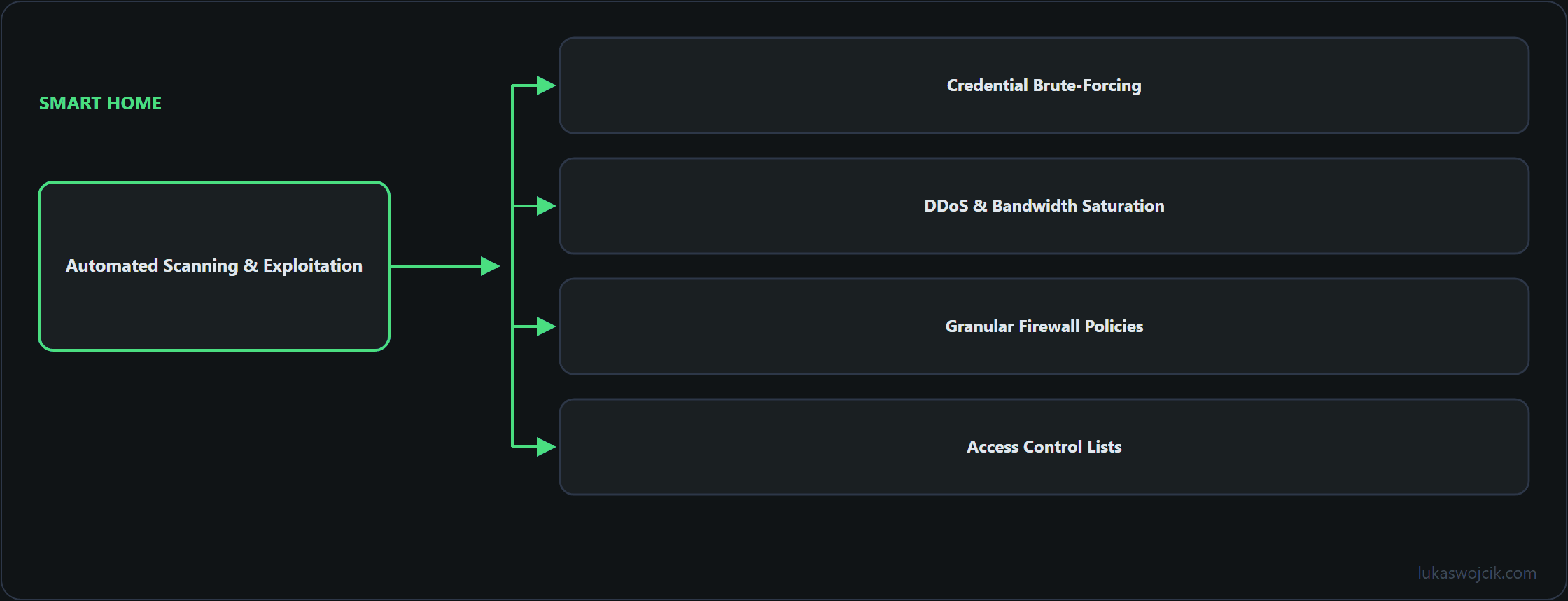
- Automated Scanning & Exploitation: Public IPv4 addresses are scanned continuously. Unpatched CVEs in web servers, authentication daemons, or IoT dashboards can lead to immediate compromise without prior authentication.
- Credential Brute-Forcing: Login interfaces exposed via port 443 remain accessible to automated dictionary attacks from global botnets.
- DDoS & Bandwidth Saturation: Public endpoints lack native protection against application-layer denial-of-service floods, which can degrade residential internet connectivity.
2. Point-to-Point VPNs: WireGuard vs. Tailscale
Replacing traditional inbound NAT rules with encrypted overlay networks enforces a Zero-Trust approach. Remote access requires cryptographic key exchange before any application-layer data is transmitted.
WireGuard (Kernel-Space Raw Performance)
WireGuard operates as a lightweight, kernel-space VPN protocol utilizing state-of-the-art cryptography (ChaCha20, Curve25519, BLAKE2s). Its primary architectural advantage is stealth: a WireGuard interface drops all unauthenticated packets silently without responding, making the host invisible to network scanners. It requires a single UDP port to be reachable or benefits from direct integration into perimeter routers.
Tailscale (Zero-Config Mesh Overlay with DERP Relays)
Tailscale builds a mesh overlay network (Tailnet) on top of the WireGuard protocol without requiring any open firewall ports or static public IPs. Utilizing advanced NAT traversal techniques (STUN/ICE) and encrypted DERP relay servers as fallbacks, Tailscale connects devices point-to-point regardless of Carrier-Grade NAT (CGNAT) restrictions or dynamic residential IP changes.
3. DMZ Architecture and Restricted Access Rules
Establishing an encrypted VPN tunnel should not grant remote devices unrestricted access to every internal LAN subnet. Proper network hygiene requires deploying the VPN termination endpoint inside a restricted DMZ or VLAN:
- Granular Firewall Policies: Ingress traffic from the VPN subnet must be restricted strictly to the IP addresses and port numbers of the target services (e.g., TCP port 8123 for Home Assistant).
- Access Control Lists (ACLs): In Tailscale deployments, server-side ACL rules ensure that specific identities or devices can only communicate with designated servers, preventing lateral movement across the network.
- WAN Ingress Prohibition: All standard inbound NAT forwarding rules on the edge router can be permanently deleted, reducing the external attack surface to zero.
Sources
Home Assistant without the cloud
- Zigbee2MQTT vs. ZHA: Building a Highly Reliable Mesh Network in Home Assistant
- ESPHome and ESP32 in Practice: Building Cloud-Free Environmental Sensors
- Presence Detection 2.0: mmWave Radars (LD2410/LD2450) in Lighting Automation
- WireGuard & Tailscale DMZ: Secure External Access to Home Assistant and Self-Hosted Servers
- Local Energy Management: Integrating PV Inverters and Battery Storage via Modbus TCP
Related articles