Server-Side PII Redaction: Building a Privacy Firewall in ssGTM

Contents
Accidental leakage of Personally Identifiable Information (PII) within HTTP query parameters represents one of the most critical regulatory and technical risks in digital analytics. When forms submit data via GET requests or marketing automation tools append unencrypted email addresses, phone numbers, or national identification numbers (such as Polish PESEL numbers) to URL parameters, client-side tags transmit this PII directly to third-party endpoints. Modern analytics architectures mitigate this risk by utilizing Server-Side Google Tag Manager (ssGTM) as an intermediary privacy firewall, scrubbing sensitive strings before outgoing network payloads are dispatched to Google Analytics 4 or the Meta Conversions API.
1. Why PII Leakage in URLs is a Critical Compliance Risk
Transmitting PII to external vendors without explicit cryptographic hashing violates both strict data privacy regulations (such as GDPR) and the mandatory terms of service of major advertising platforms. Google Analytics 4 immediately terminates or deletes historical property data if unhashed PII is detected within standard dimensions like page_location or custom event parameters. Traditional client-side redaction is often fragile, as scripts can be bypassed or fail to catch dynamically decorated query strings.
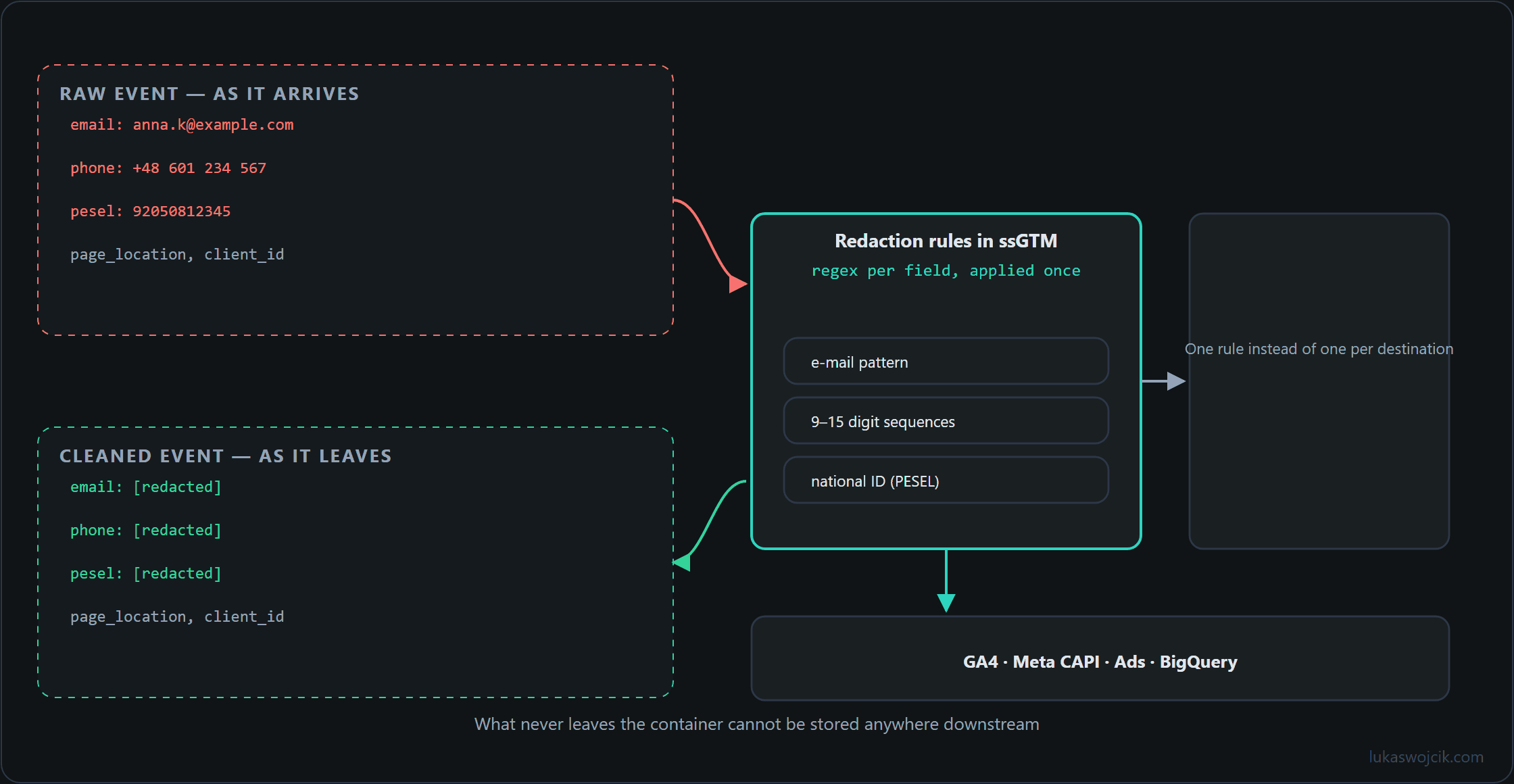
2. Server-Side GTM as an Intermediary Privacy Firewall
In a server-side tagging topology, incoming analytics requests from the browser terminate first at a first-party tagging server. Because the incoming HTTP request is held inside the server environment before any third-party dispatch occurs, developers can inspect, transform, and redact the event data model completely within a trusted boundary:
- Decoupled Ingestion and Dispatch: Client-side browsers send raw event streams solely to the ssGTM container. Third-party vendors never communicate directly with the end-user browser.
- Centralized Transformation: A single redaction rule applied in the server container protects all outbound downstream tags simultaneously, preventing accidental data leaks across multiple marketing platforms.
3. Developing Sandboxed JavaScript Variables for PII Detection
Implementing an automated scrubbing engine in ssGTM requires creating a custom Sandboxed JavaScript Variable that evaluates URL strings and replaces matching regular expression patterns with safe placeholders. Within the server container, regular expression logic must adhere to Sandboxed JavaScript APIs (utilizing native regex evaluation patterns available in the environment):
- Email Address Redaction: A regex pattern matches standard email formats (
[a-zA-Z0-9_.+-]+@[a-zA-Z0-9-]+.[a-zA-Z0-9-.]+) and replaces the detected sequence with a static string such as[REDACTED_EMAIL]. - Phone Number Masking: Numerical sequences containing 9 to 15 digits, frequently preceded by country codes or formatting characters (e.g.,
+48or hyphens), are identified and stripped from query parameters to prevent accidental transmission of contact numbers. - National Identification (PESEL) Filtering: For Central European deployments, specialized regex expressions identify 11-digit numeric sequences matching PESEL checksum algorithms or date-of-birth structures, substituting them with
[REDACTED_PESEL].
4. Applying Redaction Across GA4 and Meta Conversions API Tags
Once the custom scrubbing variable is defined, it must be mapped to the primary URL parameters inside the server container. For Google Analytics 4 tags, overriding the page_location, page_referrer, and any custom URL event parameters with the sanitized variable output ensures that no plaintext PII ever leaves the server infrastructure. Similarly, Meta Conversions API tags can safely process sanitized event URLs while reserving user identification strictly for properly SHA-256-hashed user data parameters.
Related articles