Querying Microsoft Clarity via MCP: Ten Requests a Day, Three Days of History
Microsoft published five example query patterns for the Clarity MCP server on 18 August 2026. The patterns themselves are unremarkable, which is fine, because the useful part of the announcement is the constraint they operate under. Three limits apply simultaneously, and together they change what kind of question is worth asking at all.
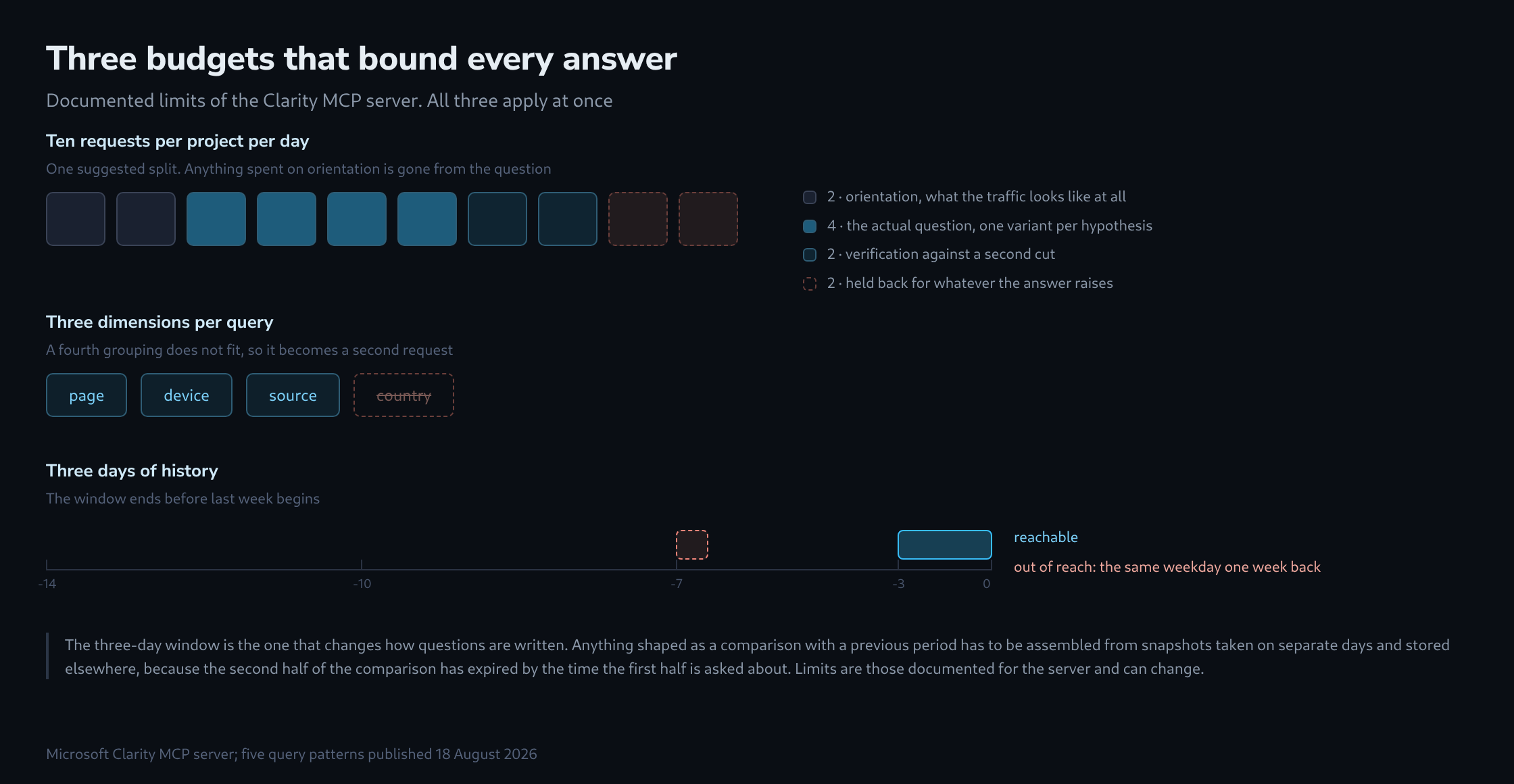
Ten requests per project per day. Three dimensions per query. Three days of history. Any one of those is a nuisance; the combination is a design problem.
What the three-day window rules out
Almost every routine analytics question is a comparison, and almost every comparison reaches back further than three days. Week over week is the standard unit precisely because it cancels the weekday effect, and the point it needs – the same weekday, seven days ago – has expired before the window opens.
This is not something a cleverer prompt works around. The data is not there to be asked for. What works instead is treating the server as a source of snapshots rather than a source of series: take the cut today, store it, take the same cut next week, and do the comparison outside the tool entirely.
Spending ten requests
A budget this small rewards deciding the split in advance, because the failure mode is spending six requests discovering what the traffic looks like and then having four left for the thing that mattered.
2   orientation      volume and shape, one for sessions,
                     one for the pages carrying them

4   the question     one request per hypothesis, phrased so
                     that the answer eliminates a hypothesis
                     rather than describing the data again

2   verification     the same finding cut a second way
                     a finding that survives one recut is
                     usually real

2   reserve          for whatever the first eight raised
                     unspent by the end of the day is fine;
                     the quota does not roll over
The one habit worth forming is phrasing requests so that each answer removes a possibility. A question whose answer is a description costs the same as a question whose answer is a decision, and only one of them is affordable ten times a day.
The three-dimension cap
Three groupings sound generous until a real question needs page, device, source and country at once. What the cap forces is a choice about which dimension is the subject and which are context, and that choice is usually clarifying rather than limiting.
The workaround is to fix one dimension as a filter instead of a grouping. Asking for page by device by source within one country spends the country as a constraint rather than a column, which stays inside the cap and answers the same question. It also produces a smaller answer, which matters when the answer is being read by a model with its own context to manage.
Where this sits next to the rest of Clarity
The MCP server is not the whole product and was never meant to replace the interface. Clarity’s own reports carry the long history, the session recordings and the heatmaps; the server exists so that a question can be asked in a sentence instead of assembled by hand.
Which makes the sensible division of labour fairly clear. Exploratory questions with a short reach go through the server, where a sentence is cheaper than a click path. Anything historical, anything periodic and anything that has to be reproduced on a schedule belongs in the interface or in an export, because the constraints that make the server pleasant to talk to are the same ones that make it unsuitable for a report.
One caveat worth carrying: these limits are the documented ones, and documented limits move. A pipeline built to sit exactly at ten requests will break quietly on the day the number changes in either direction.
Related articles