Presence Detection 2.0: mmWave Radars (LD2410/LD2450) in Lighting Automation
Part 3 of 4 in the series Home Assistant without the cloud
Contents
Presence Detection 2.0: mmWave Radars (LD2410/LD2450) in Lighting Automation
Traditional lighting automations in residential and commercial environments often suffer from reliability issues caused by Passive Infrared (PIR) sensor limitations. Because PIR modules detect rapid changes in infrared radiation across spatial zones, static occupants experiencing minimal physical displacement—such as individuals reading or working at a desk—frequently trigger false-negative occupancy states, causing lights to switch off unexpectedly. Implementing 24 GHz millimeter-wave (mmWave) radars like the Hi-Link LD2410 and LD2450 eliminates these “dead zones” by measuring micro-motions and respiration patterns via Doppler frequency shifts and Frequency Modulated Continuous Wave (FMCW) radar principles.
1. The Architectural Limitations of PIR Sensors
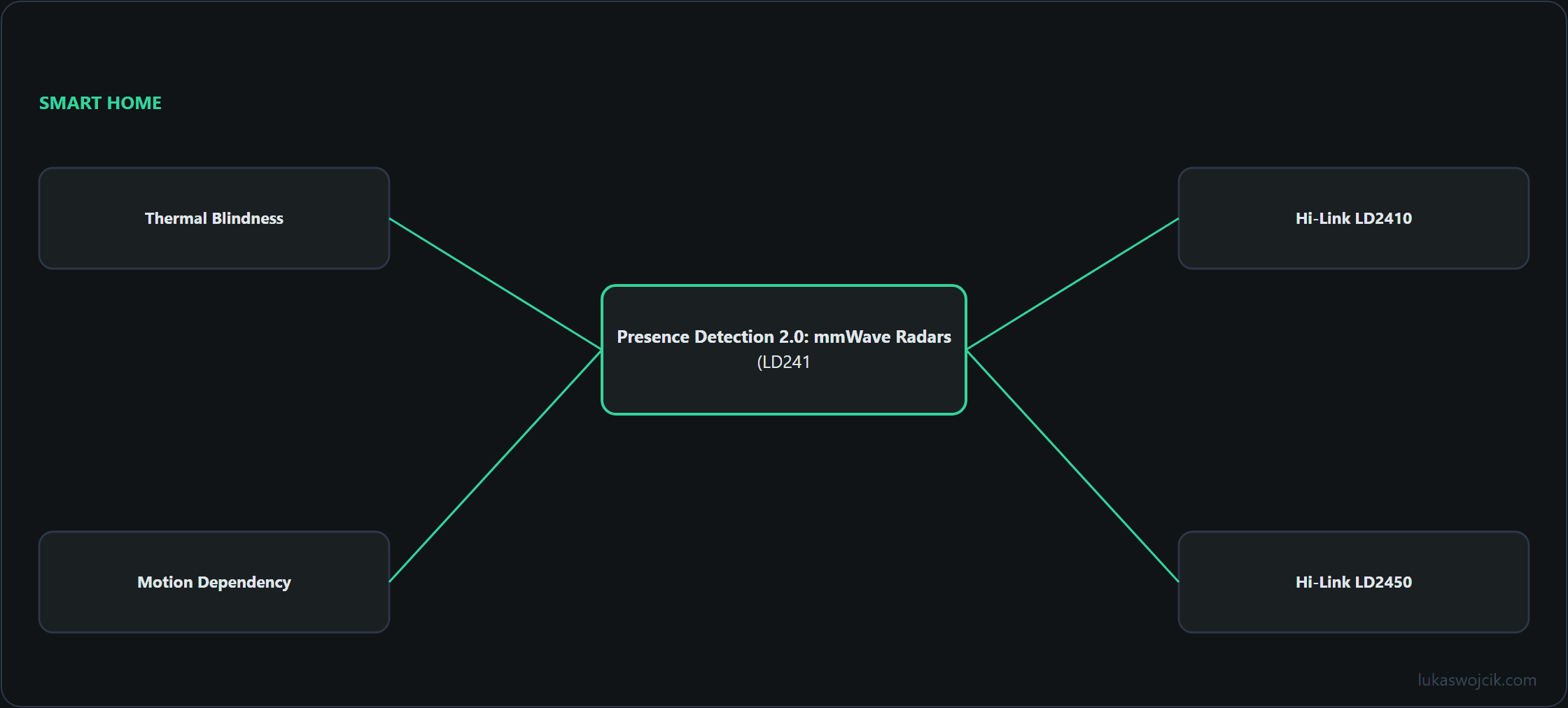
PIR sensors operate by focusing ambient infrared energy onto a pyroelectric sensor using a faceted Fresnel lens. This passive detection mechanism presents inherent mechanical and thermal disadvantages:
- Thermal Blindness: During warmer seasons when ambient room temperatures approach human body heat (~36–37°C), the differential infrared signature drops, drastically reducing PIR detection range and accuracy.
- Motion Dependency: A PIR sensor requires crossing multiple Fresnel optical zones to generate a voltage differential; stationary presence without macroscopic limb movement goes entirely undetected after the initial cooldown timer expires.
2. The mmWave Advantage: Micro-Motion and Coordinate Tracking
Millimeter-wave radar modules actively transmit high-frequency electromagnetic waves and evaluate the phase and frequency shifts of the reflected signals. This active FMCW approach allows detecting sub-millimeter displacements:
- Hi-Link LD2410 (Range-Gated Micro-Motion): Splits the detection cone into distinct distance gates (up to 6 meters), allowing independent sensitivity tuning for macroscopic movement and microscopic chest expansion caused by breathing.
- Hi-Link LD2450 (Multi-Target Coordinate Tracking): Employs multi-antenna arrays to calculate exact X and Y spatial coordinates for up to three simultaneous targets, enabling precise zone-based lighting control within open-plan rooms.
# Example: ESPHome configuration combining PIR (instant trigger) and LD2410 (presence hold)
binary_sensor:
  - platform: gpio
    pin: GPIO14
    name: "Room PIR Instant Motion"
    id: pir_motion

  - platform: template
    name: "Room Unified Occupancy"
    lambda: |-
      return id(pir_motion).state || id(ld2410_has_target).state;
    device_class: occupancy
3. Designing Zero-Dead-Zone Lighting Automations
While mmWave radars provide exceptional stationary presence detection, their signal processing algorithms can introduce a slight trigger latency (approx. 200–500 ms) upon initial room entry. Designing an enterprise-grade presence detection node requires a hybrid sensor architecture: pairing a fast PIR sensor for zero-latency initial light triggering with an LD2410/LD2450 mmWave module to hold the occupancy state indefinitely while micro-motions or respiration persist.
Summary
Upgrading from legacy PIR sensors to 24 GHz mmWave radar modules like the LD2410 and LD2450 fundamentally resolves stationary lighting failures. By leveraging FMCW micro-motion detection and multi-target coordinate tracking, modern smart home infrastructures achieve absolute presence awareness without frustrating dead zones.
Sources
Home Assistant without the cloud
- Zigbee2MQTT vs. ZHA: Building a Highly Reliable Mesh Network in Home Assistant
- ESPHome and ESP32 in Practice: Building Cloud-Free Environmental Sensors
- Presence Detection 2.0: mmWave Radars (LD2410/LD2450) in Lighting Automation
- Local Energy Management: Integrating PV Inverters and Battery Storage via Modbus TCP
Related articles