English
Structure Instead of a Readability Score: What Is Measurable Without Rendering

Management Summary
Readability tools turn features such as sentence length or heading structure into numbers. For website articles, these can point to passages worth reviewing, but they do not measure understanding, accuracy or the full reading experience. A tool inspecting source text may miss lists, hidden content or material added later. The value lies in supporting editorial judgement, not replacing it. Clear explanations, suitable examples and the page as actually presented remain central to whether readers can follow the subject.
Contents
A single readability score cannot establish whether a text is understandable, accurate or useful. Sentence lengths can identify passages worth examining; terminology, examples, prior knowledge and reasoning require editorial judgment. Formally tidy HTML does not replace that judgment.
Inspection without rendering—without the browser building the displayed page—still provides useful clues: heading tags, selected paragraph text and the size of the received HTML. The important question is which portion a tool actually examines.
Server HTML is not a screen-reader view
A basic HTTP fetch contains no subsequent JavaScript changes. A screen reader normally uses accessibility information supplied by the browser and derived from the DOM, the browser’s current structure of page elements. Dynamically created headings can appear there. Whether content arrives promptly, with useful names and usable controls, requires browser and assistive-technology testing.
Crawlers also differ. Google can render JavaScript, subject to limitations and a separate processing stage. One fetch without JavaScript therefore does not represent every search engine or preview generator. Server-delivered core content improves availability to clients without script execution, but does not replace testing.
What the linked inspector counts
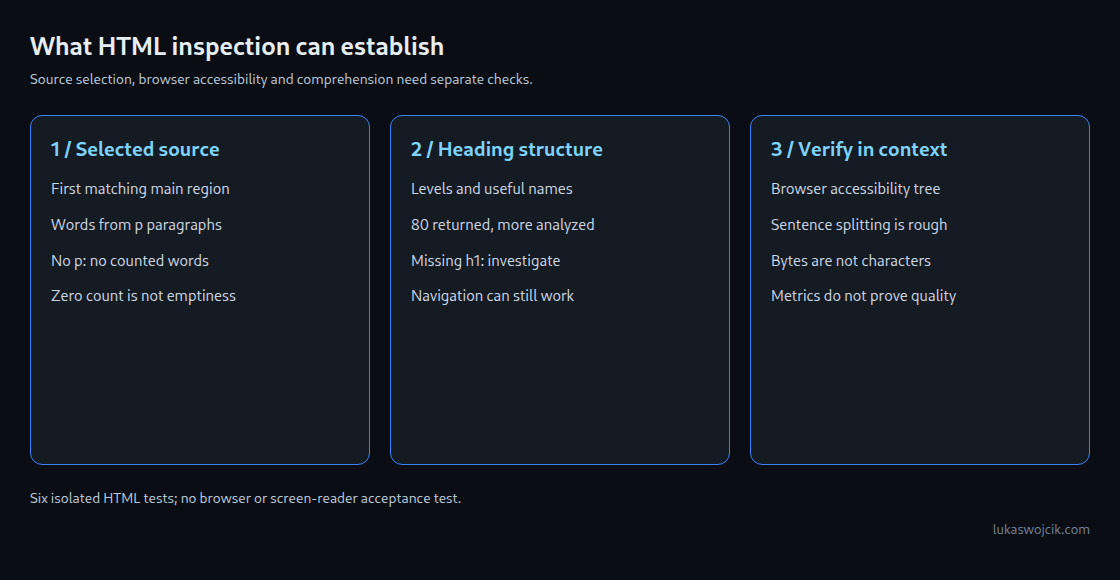
The Page Structure and Readability Inspector, in the implementation checked on 25 October 2026, initially selects a main region: for example, the first main, or the first article when no main exists. A cleaned body is used only when no matching region is selected. Headings outside that region can be absent from the result despite existing in the full document.
Words and sentences come only from eligible p paragraphs after code removal. Text in lists, table cells or headings outside those paragraphs contributes no words to that count. A simple test with a heading and a visible list therefore produces zero counted words. This establishes neither an empty page nor an application relying entirely on client-side content.
The inspector performs no CSS visibility analysis. Hidden paragraphs can contribute text, while noscript content is removed. Truncated HTML additionally leaves an incomplete source. Interpretation must account for these selection rules.
Interpreting headings
A descriptive main heading and coherent subordinate levels aid orientation. Moving directly from h1 to h3 warrants a hierarchy check. Returning from h3 to h2 can correctly start another section at the earlier level.
A missing h1 does not automatically destroy heading navigation. Headings such as h2 remain navigable. Page titles, named regions and accessible names provide additional orientation. Heading count alone establishes neither misuse for layout nor poor comprehension.
The inspector returns at most 80 headings but internally evaluates additional recognized headings. An isolated test recognized 91 and returned 80. A list of 80 entries is therefore not a complete inventory count. An element with empty text content also needs an accessible-name check before concluding that the section is unnamed.
A text metric is not a transfer ratio
The metric compares characters from selected paragraphs with bytes in the available HTML. Those are different units covering different portions. The result is neither the actual proportion of visible text nor total network transfer. Compression, character encoding and separately fetched resources affect other measurements.
With zero counted text characters, “bytes per text character” is undefined. A high value can result from scripts, embedded data or excluded text regions. Comparisons require the same selection rules and comparable page types.
Sentence length as a clue
Full stops can mark abbreviations, numbers or sentence endings. The existing rules recognize some common abbreviations and number patterns, but do not reliably identify every sentence boundary. In a test, “Der Wert lag bei 12. Danach folgte Text.” remained one counted sentence. Claiming that such errors are generally rare would require an evaluated text collection.
Long passages need examination in context: unnecessarily nested reasoning, a missing example or an unclear term may matter more than the count. A coherent longer explanation can be more useful than several disconnected short sentences.
Questions and answers
Is an empty alt attribute always wrong?
No. Purely decorative images can correctly use alt="". The inspector distinguishes absent attributes from existing empty values, but does not assess whether the alternative is appropriate. Informative images require a suitable text alternative.
Can grep and sort check a heading hierarchy?
Counting sorted opening tags loses document order and heading text. It does not produce a heading tree. Structural inspection requires ordered elements with levels and names, followed by checks in the rendered document.
What actually improves article quality?
Clear terminology, suitable examples, a coherent sequence and accurate content. Technical metrics help locate passages for review; comprehension depends on the actual text and intended audience.
Related articles