English
 Deutsch
 Polski
When AI Reads Content: Pay per Crawl, Data Licensing or a Paid API?

Management Summary
Content can be offered to AI services through payment per fetch, agreed usage rights or a regular supply of prepared data. Each model sells a different service. Technical access alone neither permits unrestricted reuse nor creates revenue. A small trial with specific potential buyers can establish demand, available rights, operating costs and effects on search visits. Confirmed deliveries and money received need separate records; the business case rests on what remains after costs.
Contents
An AI crawler is a program that retrieves web pages automatically, for example to collect material for an AI application. These requests do not necessarily produce human visits or advertising revenue. Content can be offered through payment per fetch, a licence for agreed uses or a paid data interface. The models can be combined; each charges for a different part of the service.
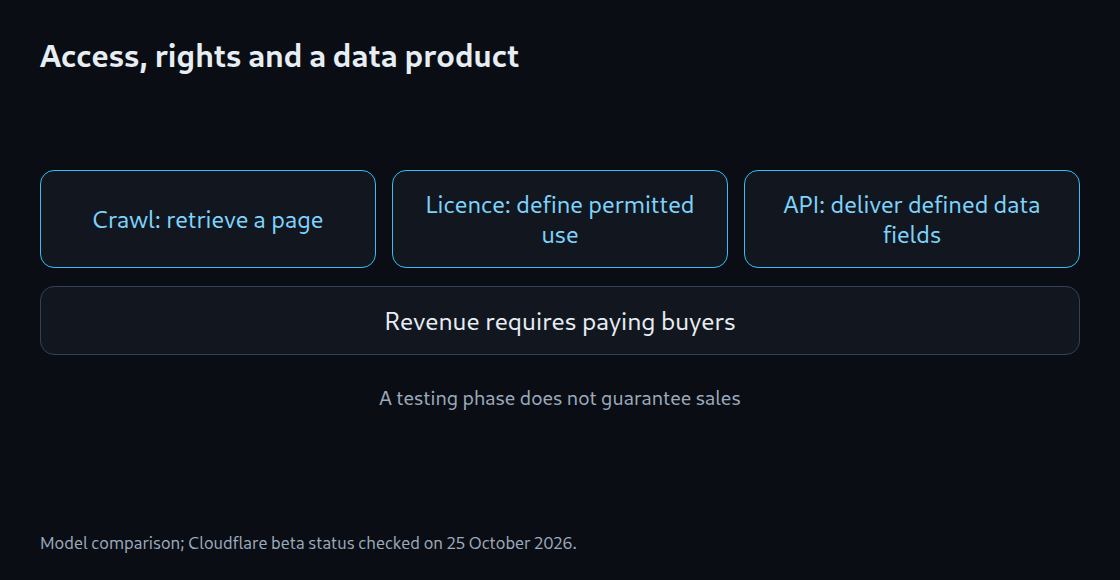
Three distinct layers
| Model | Service sold | Requirement |
|---|---|---|
| Pay per crawl | Paid technical access | Participating crawler willing to pay |
| Data licence | Agreed usage scope | Sufficient rights and a specific buyer |
| Paid API | Structured, dependable delivery | Quality, operation and integration |
Cloudflare’s described mechanism
Cloudflare’s described pay-per-crawl process requires participating, registered crawlers. A paid request can initially receive HTTP 402 Payment Required with a price: the content is available at that price. The crawler can accept or stop. Confirmed paid delivery is recorded for billing; Cloudflare aggregates the events and settles later. A 402 response alone does not trigger payment. [1]
On 25 October 2026, the public signup page still calls pay per crawl a private beta: a testing phase with restricted access. AI Crawl Control displays and manages crawler requests; pay per crawl adds paid access. Applying does not establish activation. Even after activation, revenue requires participating operators that actually pay. [2]
Access is not a complete usage licence
A successful fetch initially means that data was transferred. Further permitted uses must follow from the applicable terms. A licence could allow internal search while excluding redistribution to third parties. Duration, storage and processing can also be specified. A price in a server response does not replace a complete description of those rights.
An article can contain original text and a third-party photograph. Permission to display the photograph on a blog may not cover redistribution in a data pack. An offer therefore needs a list of included material and the associated rights. Promised uses must stay within the rights actually available.
When an API adds value
An API is an interface that lets programs request specific data. One example is a product catalogue with fixed fields for item number, price, currency and modification date. Another program can import those values directly instead of extracting them from a web page. Verified sources, current entries and announced format changes can add value.
Running the interface requires ongoing work. Access keys need checking, request volumes need limits and outages need repairs. Data errors and customer questions also take time. End-of-contract terms need to explain export, deletion and which copies may remain in use. A working API does not establish that a paying customer exists.
A bounded business experiment
An initial trial starts with a small sample dataset and a defined audience. Discussions establish the required fields, update frequency and service worth paying for. A paid-fetch trial records confirmed billing events, money actually received and operating costs separately. Changes in search traffic or other visits also belong in the evaluation. This comparison contains no revenue results from a paid crawling trial on this site.
The robots.txt file contains rules for crawlers that choose to follow them. A block does not stop programs that ignore the file and does not replace password protection. Google can still list a blocked URL when other pages link to it. Search and AI crawler rules therefore need to match the intended purpose; a blanket block can affect wanted traffic too. [3]
A useful decision starts with a specific question: which data does a buyer need, and which service saves work? A fetch price charges for access. A licence defines permitted uses. An API can additionally deliver regularly prepared data. Demand and the amount left after costs need checking for each offer; available technology alone establishes neither.
Related tools
Questions and answers
Does every AI crawler automatically pay?
No. The described Cloudflare process requires registration and willingness to pay. A crawler can decline a paid offer. A price response therefore does not automatically generate income.
Does the comparison include measured revenue from this site?
No. The article compares documented offers and processes. It does not claim a paid crawling trial or measured revenue from such a trial on this site.
Sources
- Cloudflare: Introducing pay per crawl
- Cloudflare: Pay per crawl private beta
- Google: Robots.txt limitations
- data.europa.eu: rights in third-party data and illustrations
Sources checked again: 25 October 2026.
Related articles