English
 Deutsch
 Polski
Niche Newsletter, Affiliate Site or SaaS: Three Models for the Same Audience

Management Summary
A newsletter sells information, an affiliate site earns commission for accepted referrals, and online software performs a task. The article compares these business models for small agencies supporting online shops. All three can serve the same audience, but require different work and meet different needs. The comparison helps put revenue and effort in context. Equal sales do not mean equal profit, and a large readership does not establish demand for software. Each offer needs a useful benefit of its own.
Contents
Small agencies might subscribe to a newsletter, buy a tool through a comparison or pay for a software feature. The money comes from different sources: readers pay for the newsletter, a vendor pays an affiliate commission, and customers pay for SaaS. A large readership alone does not prove demand for all three offers.
One customer segment
The example targets small agencies maintaining online shops. A newsletter explains shop-platform changes. An affiliate site compares tools for the same task and earns a commission for eligible referrals. SaaS, software provided over the internet, might report missing product data or failed purchase tracking. These are examples, not demonstrated income sources for this blog.
| Model | Revenue basis | Recurring work |
|---|---|---|
| Paid newsletter | Paid access to researched information | Research, selection, dependable schedule |
| Affiliate site | Commission for referrals accepted under programme rules | Testing, updates, checking commission terms |
| SaaS | Paid function or usage | Operation, development, support |
A defined newsletter promise
A specialised newsletter can explain relevant platform changes each week: which shops are affected, which setting needs changing and by when. That is a specific offer whose usefulness can be tested. Ghost supports memberships, paid subscriptions and email newsletters. Those features enable billing but do not demonstrate willingness to pay for this particular content. [1]
Visible affiliate interests
Shopify runs an affiliate programme but does not accept every application. Commission requires an eligible referral under the programme rules, including attributing an eligible purchase to the referral link. A free trial signup alone is insufficient. Shopify can reverse commissions for fraudulent or refunded stores. The applicable terms determine payment. [2]
A useful comparison tests every tool against the same task, such as exporting product data. It explains errors, limits and the test date. A possible commission belongs visibly alongside the recommendation. The highest-paying tool is not necessarily the best solution, so assessment criteria should be set independently of commission.
SaaS sells a function
Checking software can take over regular inspections. In return, outages need fixing, interface changes need adapting to, and support requests need answering. A small agency pilot tests whether the necessary data is accessible, reports identify useful problems, and agencies pay repeatedly. Interest in a newsletter does not answer those questions.
Arithmetic without a revenue promise
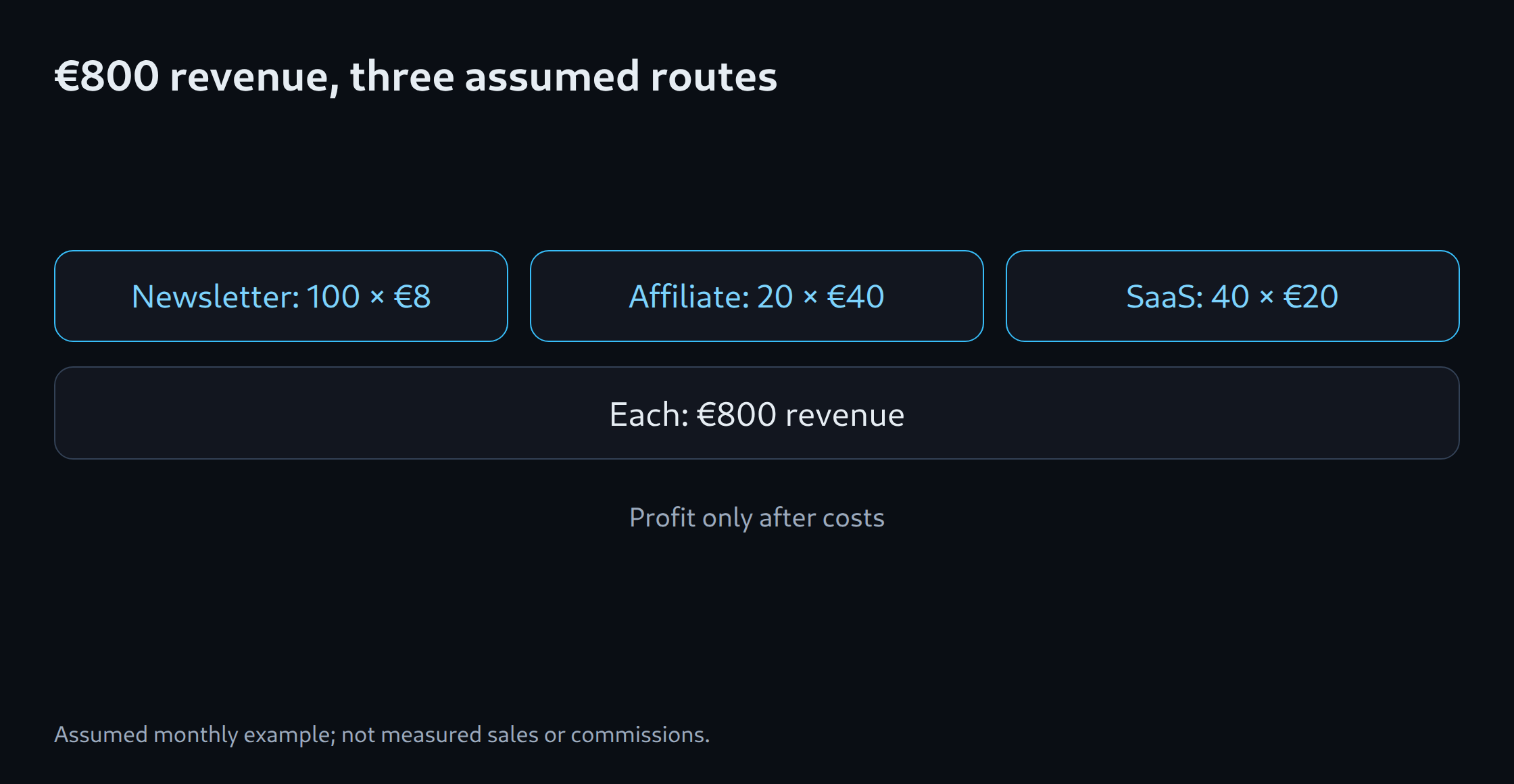
All figures are invented monthly amounts excluding VAT, not current programme rates: 100 subscriptions at €8 produce €800; twenty confirmed referrals at €40 also produce €800; forty SaaS customers at €20 produce €800. Equal revenue does not establish equal profit. Research, advertising to attract customers and software support have different costs. In particular, the €40 commission is not a quoted Shopify rate.
Comparison requires working hours, running costs, refunds and repeat purchases. Dependence on a platform also matters: a change to an affiliate programme can stop income. Existing subscribers may continue paying next month; one-off commissions require new eligible referrals. Lower revenue can leave a larger surplus after costs. Personal working time and taxes also need accounting for.
Combining the models
A newsletter might draw attention to faulty product data. A comparison then explains existing checking tools. If an important check is missing, original software might fill the gap. Each part should also be useful on its own; an information offer should not merely serve as a pretext for further sales.
Related tools
Questions and answers
Are newsletter readers automatically SaaS customers?
No. Interest in information does not prove data access or willingness to buy software.
Does equal revenue mean equal economics?
No. Costs, labour and dependencies also need comparison.
Sources
Sources checked: 25 October 2026.
Shopify: Affiliate earnings (25.10.2026).
Related articles