Storage and Bandwidth Engineering for Enterprise CCTV Networks
Part 2 of 3 in the series Video surveillance on your own hardware

Contents
Deploying high-density 4K IP camera networks requires rigorous mathematical sizing of bandwidth throughput and disk storage arrays. A single unoptimized 8-megapixel (4K) stream can easily consume 15 to 20 Mbps of continuous network bandwidth, rapidly congesting standard gigabit switches and exhausting enterprise storage arrays within days. Establishing a resilient CCTV infrastructure capable of maintaining redundant 30-day video retention without packet loss mandates advanced video codec tuning, dedicated VLAN isolation, and fault-tolerant RAID topologies engineered specifically for continuous 24/7 sequential write workloads.
1. Codec Optimization: H.265/HEVC & Smart Bitrate Control
Selecting the correct compression codec and bitrate control strategy is critical to reducing network load and storage ingestion rates:
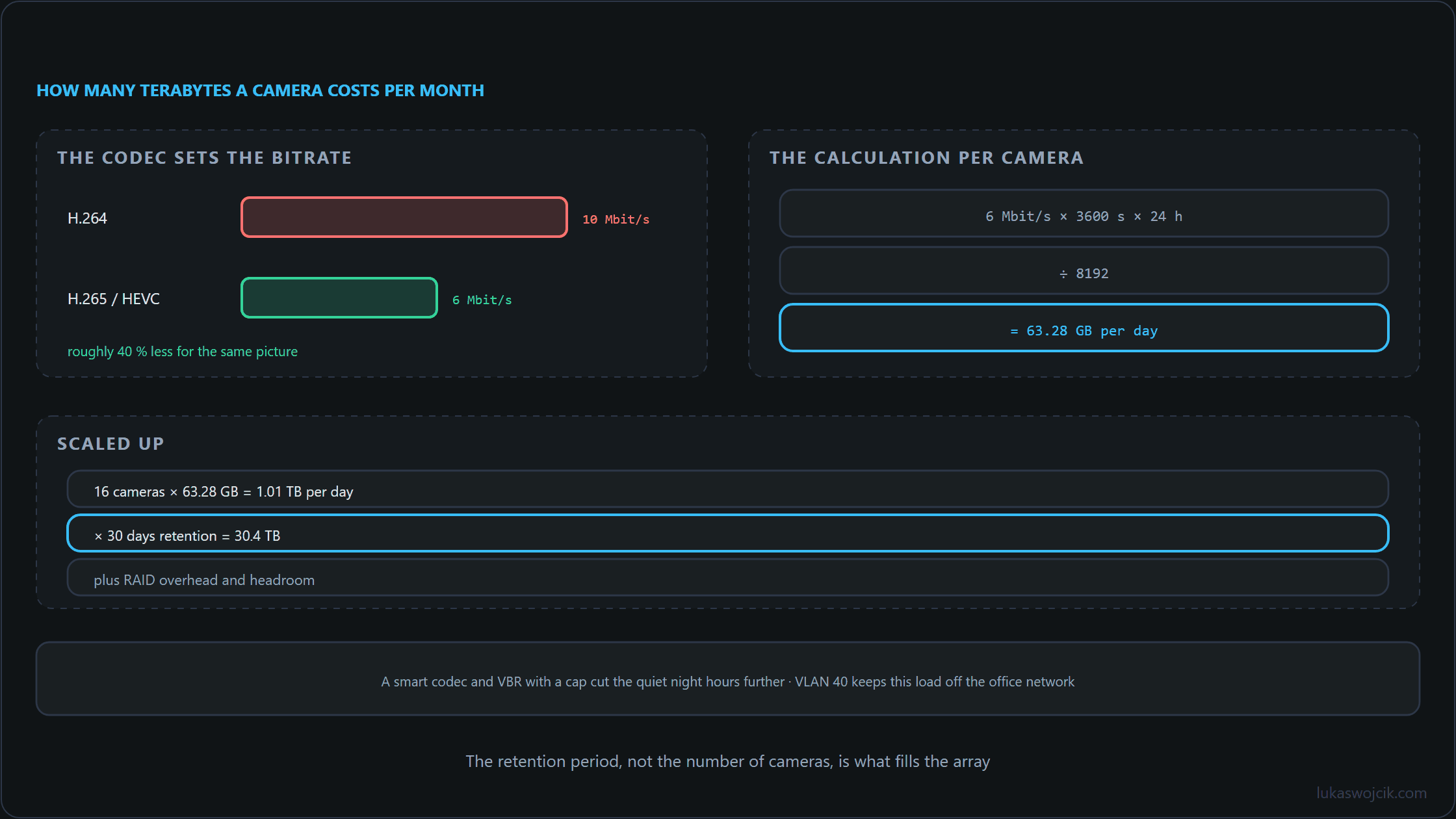
- H.265 (HEVC) vs. H.264: Migrating from H.264 to H.265 reduces bitrate requirements by roughly 40% to 50% at identical perceptual image quality. For 4K streams at 15 frames per second (FPS), H.265 allows target bitrates to be lowered from 12 Mbps down to 6 Mbps.
- Smart Codecs (H.265+ / Zipstream): Vendor-specific dynamic Group of Pictures (GOP) algorithms increase intra-frame intervals during periods of static background scenes, dropping bitrate consumption by up to 70% without sacrificing detail when motion occurs.
- Variable Bitrate (VBR) with Caps: Constant Bitrate (CBR) wastes bandwidth during inactive night hours. Configuring VBR with an upper bitrate cap (e.g., maximum 8 Mbps per 4K stream) prevents sudden network spikes during complex, high-motion events.
2. Mathematical Storage Capacity Sizing
Calculating raw storage requirements requires applying a precise mathematical formula across all active camera feeds:
Storage (Gigabytes) = [Bitrate (Mbps) × 3600 seconds × 24 hours × Days] / (8 bits × 1024)For an enterprise installation of 16 cameras recording in 4K at an average VBR of 6 Mbps over a retention period of 30 days:
- Single Camera Daily Ingestion: (6 Mbps × 3600 × 24) / 8192 = 63.28 GB / day
- 16-Camera 30-Day Raw Demand: 63.28 GB × 16 × 30 = 30,374.4 GB (~30.37 TB)
- RAID & Formatting Overhead Buffer: Adding a mandatory 20% overhead buffer for filesystem structures and RAID parity requires a usable net capacity of at least 36.5 TB.
3. Step-by-Step Storage Array & Network Infrastructure Setup
To eliminate frame drops, stuttering recordings, and hardware wear, storage arrays and network switching backplanes must be provisioned according to strict engineering standards:
- Surveillance-Grade Hard Drive Selection: Conventional desktop hard drives fail rapidly under continuous 24/7 write cycles. Deploy only dedicated surveillance drives (e.g., WD Purple Pro or Seagate SkyHawk AI) equipped with AllFrame/ImagePerfect firmware and rotational vibration (RV) sensors.
- Fault-Tolerant RAID Topology: For arrays exceeding 24 TB, avoid RAID 5 due to long rebuild times and URE (Unrecoverable Read Error) risks. Implement RAID 6 (dual-drive parity) or RAID 10 (striped mirrors) across six 10 TB surveillance HDDs to ensure zero data loss during disk rebuilding.
- Network VLAN & MTU Optimization: Isolate all IP cameras within a dedicated, non-routed VLAN (e.g.,
VLAN 40 - Surveillance) to block broadcast storms from enterprise office networks. Ensure Power over Ethernet (PoE+) switches feature a non-blocking backplane switching capacity of at least 50 Gbps. - Jumbo Frames Configuration: Enable 9000-byte Jumbo Frames on switch ports connecting the NVR server and primary aggregation switches to reduce CPU packet-processing overhead by up to 80%.
4. Summary & Architectural Value
What this tutorial achieves: The design and deployment of a mathematically verified, high-capacity CCTV storage and bandwidth infrastructure capable of sustaining 30 days of redundant 4K video recording across enterprise camera networks.
Resulting value: Network congestion, dropped frames, and packet loss are eliminated through H.265+ codec tuning and dedicated VLAN isolation. Implementing fault-tolerant RAID 6/10 arrays with surveillance-grade drives guarantees zero data loss during hardware failures, ensures compliance with statutory 30-day evidence retention mandates, and prevents expensive storage over-provisioning.
Sources
Video surveillance on your own hardware
- AI-Powered Edge Video Surveillance: Frigate NVR with Google Coral TPU
- Storage and Bandwidth Engineering for Enterprise CCTV Networks
- CCTV Cabling: PoE Compared With Coax for Security Installations
Related articles