English
 Deutsch
 Polski
HTTP/3 on a First Visit: How a Client Discovers the Protocol and What Twenty Sites Answered

Management Summary
HTTP/3 is a newer way for browsers and servers to transfer website content. To use it on a first visit, the connecting program needs to discover suitable connection information. The article explores how that discovery works and what observations from twenty sites can establish. Announcing support, being reachable and actually using the connection are different stages. Successful direct first requests on three tested sites show that early use is possible, but do not prove that every browser chooses it or that pages load faster.
Contents
HTTP/3 can carry the first request to a site. Whether that happens depends on the client, available endpoint information and the network path. A server advertising HTTP/3, a reachable QUIC endpoint and a request actually using HTTP/3 are three different observations.
A different transport, still a TLS handshake
HTTP/3 uses QUIC over UDP. HTTPS with HTTP/1.1 or HTTP/2 normally uses TLS over TCP. QUIC integrates a TLS handshake too: HTTP/3 is normally selected with the ALPN identifier h3. It cannot be negotiated into an existing TCP connection.
QUIC transfers separate HTTP exchanges in independent streams. A missing packet in one stream therefore does not automatically hold up unrelated streams as it can with TCP. That does not make packet loss harmless: a packet can contain data from several streams, congestion control affects the connection, and application dependencies can still delay work. HTTP/3 is not a universal speed guarantee.
Three ways to reach HTTP/3
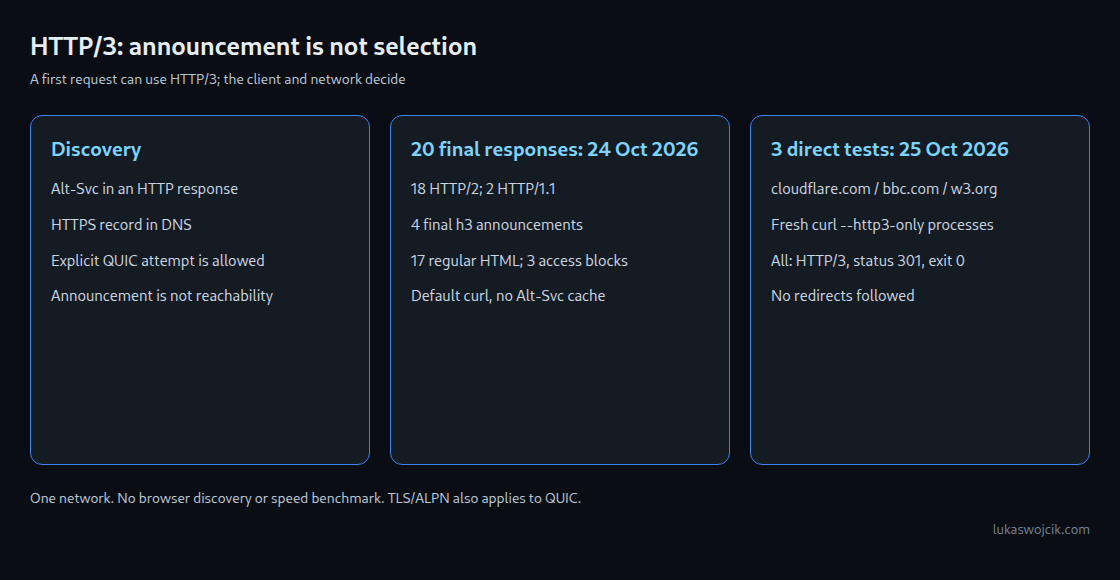
- An alternative-service announcement: an HTTP response can include
Alt-Svc: h3=":443"; ma=3600. It advertises an equivalent endpoint on UDP port 443 of the same host for a freshness lifetime of one hour. A supporting client may use it for later requests, including resources within the same page load. No automatic switch of every subsequent request is guaranteed. - DNS information: an HTTPS record can provide protocol and endpoint information before the first HTTP request. Client and resolver behavior determine whether that information is obtained and used.
- An explicit attempt or other endpoint knowledge: RFC 9114 permits a client to attempt a QUIC connection directly. A tool configured for HTTP/3 does not require an earlier HTTP/2 response.
Fallback is possible. For example, curl with --http3 can race a TCP-based alternative after a short delay; --http3-only deliberately excludes that fallback. Browser strategies vary. A failed UDP attempt can add delay, but does not necessarily force the page to wait for a full UDP timeout.
What twenty recorded requests showed
The following sample was collected on 24 October 2026, between 04:45:33 and 04:45:37 UTC, from one network using curl 8.14.1 with HTTP/3 support. Each domain started a separate curl process. HTTPS redirects were followed, up to five; there was no --http3 option or persisted Alt-Svc cache. The configured timeout was 25 seconds and the transfer-size limit 10 MB. These were command-line requests, not browser page loads.
The table reports the final response in each redirect chain, not every intermediate connection. Eighteen final responses used HTTP/2 and two used HTTP/1.1. Four final responses advertised the standard h3 token. That is an announcement count, not a complete HTTP/3 capability test.
| Domain | Status | HTTP version | h3 announced | Content |
|---|---|---|---|---|
| wikipedia.org | 200 | 2 | no | regular HTML |
| github.com | 200 | 2 | no | regular HTML |
| bbc.com | 200 | 2 | yes | regular HTML |
| nytimes.com | 403 | 2 | no | access block |
| cloudflare.com | 200 | 2 | yes | regular HTML |
| mozilla.org | 200 | 2 | no | regular HTML |
| apple.com | 200 | 2 | no | regular HTML |
| microsoft.com | 200 | 2 | no | access block |
| spiegel.de | 200 | 2 | yes | regular HTML |
| heise.de | 200 | 2 | no | regular HTML |
| python.org | 200 | 2 | no | regular HTML |
| debian.org | 200 | 2 | no | regular HTML |
| kernel.org | 200 | 2 | no | regular HTML |
| gnu.org | 200 | 1.1 | no | regular HTML |
| w3.org | 200 | 2 | yes | regular HTML |
| nginx.org | 200 | 1.1 | no | regular HTML |
| postgresql.org | 200 | 2 | no | regular HTML |
| zeit.de | 403 | 2 | no | access block |
| tagesschau.de | 200 | 2 | no | regular HTML |
| php.net | 200 | 2 | no | regular HTML |
Seventeen responses contained regular page HTML. The New York Times and ZEIT returned 403 access blocks; Microsoft returned a blocking page with status 200. Those three rows still identify the transport used for the response, but do not describe the requested homepage. A missing Alt-Svc header in one response does not prove that HTTP/3 is unavailable.
A direct first request can use HTTP/3
A separate check on 25 October 2026 at 14:47:15 UTC used a fresh process with --http3-only for each of cloudflare.com, bbc.com and w3.org. No Alt-Svc cache was supplied and redirects were not followed. All three requests completed with curl exit code 0, HTTP version 3 and status 301, pointing to the corresponding www host.
This demonstrates a successful HTTP/3 response without a previous HTTP/2 request in those test processes. It does not demonstrate browser discovery, homepage delivery or a speed advantage. The choice of protocol was explicitly configured.

Reading an HTTPS DNS record
example.com. 3600 IN HTTPS 1 . alpn=h3,h2This illustrative record uses ServiceMode because the priority is nonzero. The dot means that the target is the name at the start of this record, here example.com; alpn advertises HTTP/3 and HTTP/2. The TTL allows this DNS record to remain cached for 3600 seconds. The record requires an actually configured endpoint and suitable address records; publishing the text does not activate a server. It also does not force every client to choose HTTP/3.
Further details are described in The HTTPS Record in DNS: Finding HTTP/3 Without the Detour.
Questions and answers
Which port must be reachable?
The advertised UDP endpoint must be reachable, commonly port 443 but not necessarily. TCP port 443 alone does not provide QUIC. A failed external test concerns that client and network path; it is not sufficient to declare a service globally unavailable.
How long can an incorrect Alt-Svc announcement persist?
Without ma, RFC 7838 defines a freshness lifetime of 24 hours from message generation; the response age counts. A shorter lifetime can limit rollout risk. Removing the header does not immediately clear an existing client cache. A received Alt-Svc: clear requests invalidation; it cannot reach an offline client.
What changes with a CDN?
The measured protocol describes the client-to-CDN connection. The CDN-to-origin connection can use another version. A successful edge connection therefore says nothing by itself about the origin protocol.
What should a useful test record?
Client version and options, cache state, exact URL, redirect chain, time, network path, negotiated protocol, exit status and response content. Announcement, reachability and observed selection need separate results. Repeated trials are necessary for performance comparisons.
Related articles