The Window Moved, the Conversions Did Not

Contents
On 11 August 2026 the conversion window settings stopped being a short list. Engaged-view conversions – sales that follow a video someone watched but never clicked – had been fixed at three days and can now be any whole number from one to thirty. Click-through conversions, meaning sales that follow an actual click, had six preset values: 1, 7, 14, 30, 60 and 90 days. They too can now be any whole number, up to ninety. The setting sits under Advertising, Conversion management, Settings, where it always did.
Read as a feature this is unremarkable: a dropdown became a field. Read as a change to a measurement it is worth some care, because the window does not decide how many conversions happened. It decides how many of them get counted, and moving it moves the count while the world stays put.
What Changed on 11 August
| Setting | Until 11 August 2026 | Since |
|---|---|---|
| Engaged-view conversions | Fixed at 3 days, not editable | Any whole number, 1 to 30 days |
| Click-through conversions | Six presets: 1, 7, 14, 30, 60, 90 days | Any whole number, 1 to 90 days |
The engaged-view row is the larger change of the two, because a value that could not be edited was never a decision anyone made. Wherever those conversions matter, three days was a number inherited rather than chosen, and it is now worth a look.
Why a Longer Window Reports More Without More Happening
Time passes between the click on an ad and the purchase. Some people decide the same evening, others think about it for three weeks. The window is the cut-off date up to which a purchase still counts towards the ad: buy before it and the ad gets the credit, buy after it and the sale shows up with no origin at all.
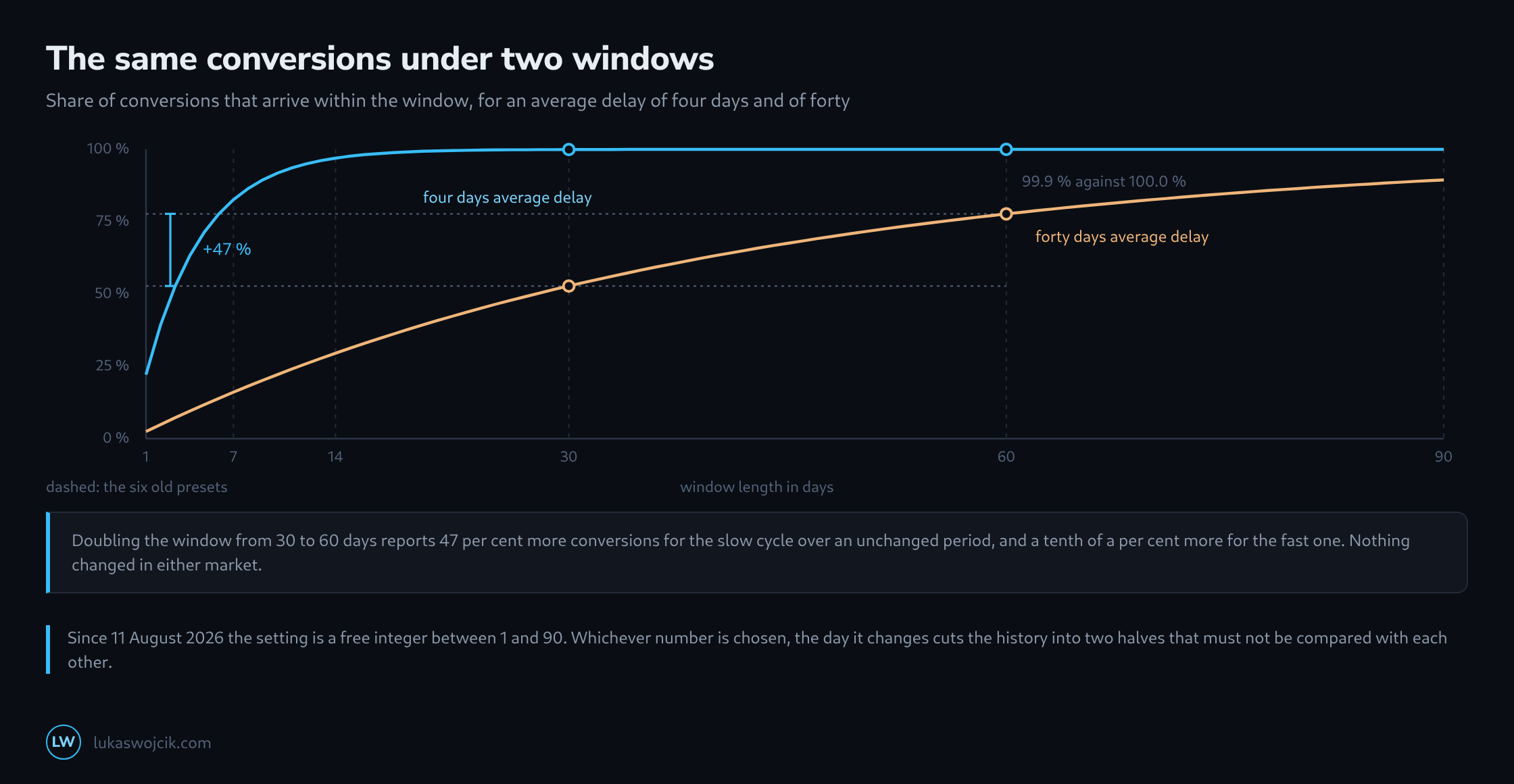
What matters, then, is not the window on its own but how long a given shop’s customers usually take. The table below sets two markets side by side: one where the average purchase follows after four days, and one where it takes forty. The columns give the share of all purchases that falls inside the window and therefore gets counted.
| Window length | Fast market, four days on average | Slow market, forty days on average |
|---|---|---|
| 7 days | 83 % | 16 % |
| 14 days | 97 % | 30 % |
| 30 days | 99.9 % | 53 % |
| 60 days | 100 % | 78 % |
| 90 days | 100 % | 90 % |
Going from thirty days to sixty changes next to nothing in the left column, a tenth of a per cent. In the right one it lifts the captured share from 53 to 78 per cent – almost half as many reported conversions again, over a period in which nothing changed. The same setting, moved by the same amount, is a rounding error in one business and a step change in the other. That is precisely why a house default for the window is a bad idea.
The percentages rest on a simplified assumption about how the waiting times are spread out; in a real shop they come out somewhat differently. The shape holds in every market, though: at first each extra day buys a lot, and eventually almost nothing.
Where the Gain Actually Sits
That poses the only question worth settling before touching the field: at the current window, do meaningful numbers of purchases still arrive if it gets longer? If not, a longer window adds noise and latency and nothing else, because the conversions it lets in are so few and so late that they arrive after every decision they could have informed.
If more do still arrive, the current window is discarding real sales, and their absence is not neutral. Discarded conversions are not spread evenly across campaigns: the ones with the longest consideration phase lose the most, which usually means the ones that work early and create the attention in the first place. Those then look unprofitable and get cut. That is the expensive version of this mistake, and it predates the change by years.
The Break in the Period Comparison
Nothing warns when the window changes. There is no error, no annotation in the report, no marker on the time series. The number simply steps, and a step in a time series is indistinguishable from a good week if nobody remembers what happened that day.
From that day there are two states, and any comparison that crosses the boundary compares them rather than the business. A month-over-month view spanning the change, a year-over-year view once twelve months have passed, a moving average, an anomaly rule with a baseline learned from before the change – all four are wrong in the same direction and none of them says so.
How to Keep the Comparison Honest
The cheap safeguard is an annotation with the date and both values, written when the change is made rather than reconstructed afterwards. It costs a minute and it is the only artefact that will still exist in a year, when someone asks why the spring looks so strange.
The second is to leave the window alone for the length of the longest window in play. Changing it back and forth to see what happens produces a time series with several states and no way to reconstruct which was which. If a comparison is needed across the boundary, it has to be done on the waiting time rather than on the count – how long customers take before buying is a property of the market and does not move when the setting does.
Where the Free Integer Earns Its Keep
For a shop where purchases follow within days, none of this matters much: anything from fourteen upwards captures the same traffic, and the freedom to pick nineteen is not worth the meeting. The gain sits with the businesses that were badly served by the old list, and there were two kinds.
One is the long consideration cycle that fell between thirty and sixty, or between sixty and ninety, and had to round in a direction that was known to be wrong. The other is engaged-view conversions, where three days was the only option and nobody could ask whether it fitted. Both are now a decision, which is an improvement – provided the decision is made once, written down, and left alone.
Related articles