Zero-Trust DNS Infrastructure: Unbound & Pi-hole with DoH and DNSSEC

Contents
Relying on external public DNS resolvers (such as 8.8.8.8 or 1.1.1.1) inherently requires trusting third-party infrastructure with complete browsing metadata. Even with encryption, central DNS providers can log domain queries and profile network activity. Establishing a Zero-Trust DNS architecture by combining Pi-hole with a local, validating Unbound recursive resolver eliminates third-party reliance entirely. By performing direct root-server recursion with DNSSEC validation, cryptographic integrity is guaranteed, preventing cache poisoning and ISP eavesdropping or manipulation.
1. Architectural Principles: Zero-Trust DNS & Recursion
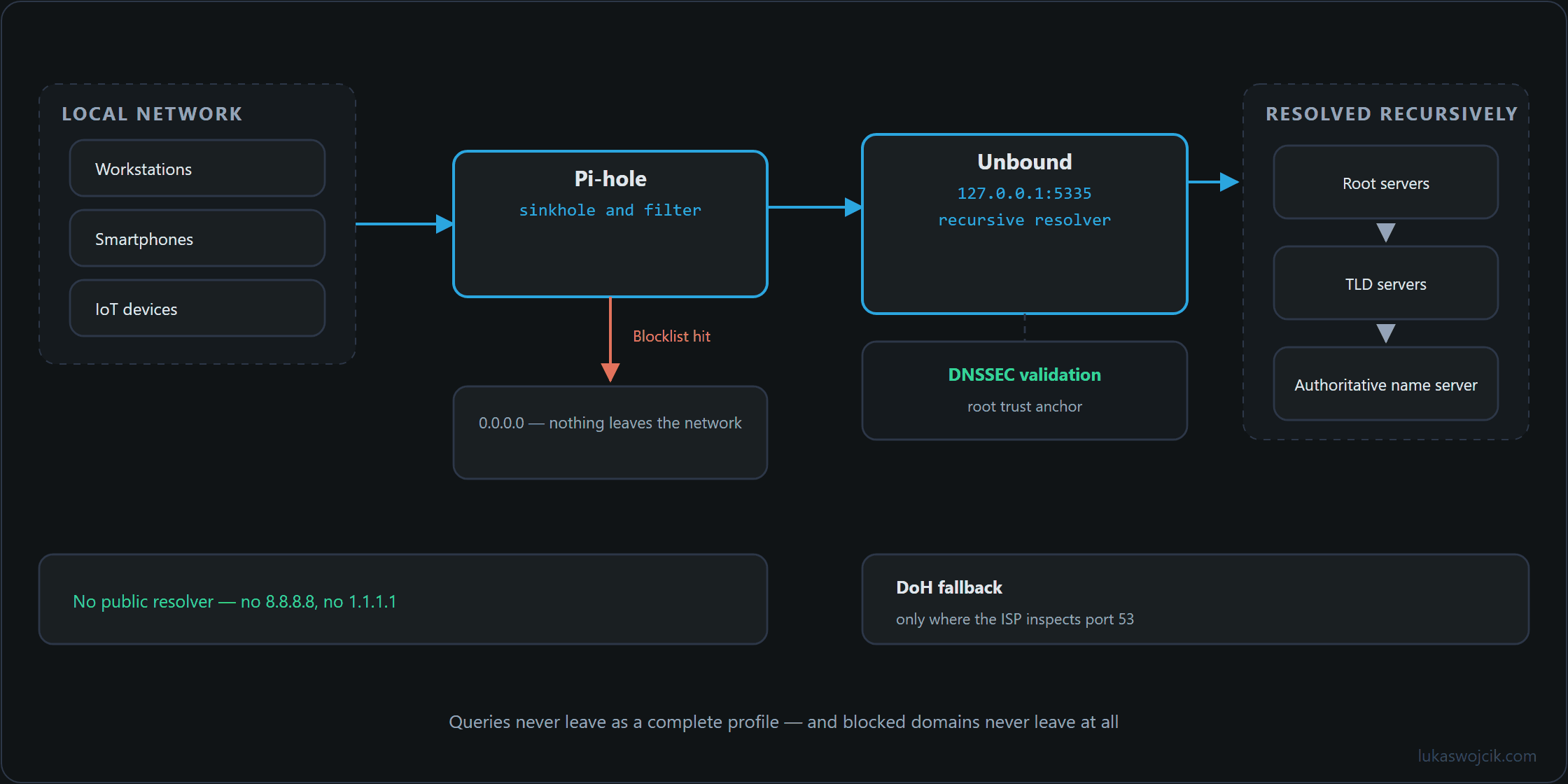
In a standard network setup, DNS queries are forwarded upstream to an ISP or public resolver. In contrast, a Zero-Trust local resolver architecture separates responsibilities into two distinct stages:
- Pi-hole (DNS Sinkhole & Filtering Engine): Intercepts incoming queries from local network devices, filtering out telemetry, advertising, and known malicious domains based on blocklists.
- Unbound (Recursive Resolver & Validator): Receives legitimate requests from Pi-hole and recursively queries the DNS hierarchy (Root Servers → TLD Servers → Authoritative Nameservers) directly. Each answer is validated against DNSSEC cryptographic signatures before being cached locally.
2. Step-by-Step Installation and Hardening of Unbound
To configure Unbound as a high-security recursive resolver on a Linux server (e.g., Debian or Raspberry Pi OS), the following deployment procedure must be executed:
- Package Installation: Install the resolver and standard DNS documentation packages:
sudo apt update && sudo apt install unbound unbound-anchor -y - DNSSEC Root Trust Anchor Setup: Retrieve the official DNSSEC root key to verify signatures:
sudo unbound-anchor -a /var/lib/unbound/root.key - Configuring the Hardened Resolver File: Create or edit the main configuration file at
/etc/unbound/unbound.conf.d/pi-hole.confwith optimized privacy and security parameters:server: verbosity: 1 interface: 127.0.0.1 port: 5335 do-ip4: yes do-udp: yes do-tcp: yes # Security & DNSSEC Validation auto-trust-anchor-file: "/var/lib/unbound/root.key" harden-glue: yes harden-dnssec-stripped: yes use-caps-for-id: no edns-buffer-size: 1232 prefetch: yes num-threads: 1 # Privacy Hardening (Minimal Information Disclosure) qname-minimisation: yes hide-identity: yes hide-version: yes private-address: 10.0.0.0/8 private-address: 172.16.0.0/12 private-address: 192.168.0.0/16 - Service Restart & Verification: Enable and restart the Unbound daemon, then test local resolution and DNSSEC validation on the assigned port:
sudo systemctl restart unbounddig @127.0.0.1 -p 5335 dnssec-failed.org +dnssec(Must returnSERVFAILdue to invalid DNSSEC signature).
3. Step-by-Step Integration with Pi-hole & DoH Fallback
Once local recursion is functional, Pi-hole must be routed to communicate exclusively with Unbound:
- Upstream Configuration in Pi-hole: Access the Pi-hole Web Admin Interface and navigate to
Settings > DNS. - Disable Default Upstream Providers: Uncheck all pre-configured external upstream DNS servers (e.g., Google, Cloudflare, Quad9).
- Assign Local Custom Upstream: Under
Custom 1 (IPv4), enter the localhost Unbound socket:127.0.0.1#5335. - Enable DNSSEC Checkbox: Check the
Use DNSSECsetting to allow Pi-hole to properly pass and report DNSSEC status flags to local clients. - Optional DNS-over-HTTPS (DoH) Tunneling: In environments where ISP packet inspection on port 53 is a concern, Unbound can be configured to forward queries through a local cryptographic DoH proxy (e.g.,
cloudflaredordnscrypt-proxy) instead of direct root recursion, ensuring TLS encryption across untrusted transit networks.
4. Summary & Architectural Value
What this tutorial achieves: The successful deployment of a sovereign, Zero-Trust DNS resolver architecture combining Pi-hole ad-blocking with an Unbound recursive resolver enforcing strict DNSSEC cryptographic validation and query minimization.
Resulting value: Complete independence from commercial DNS providers is established, ensuring that no external third party can profile or monetize internal network lookup logs. Cryptographic validation protects all local devices against cache poisoning, spoofing, and man-in-the-middle manipulation, while query name (QNAME) minimization leaks only the bare minimum of domain information required to resolve each target address.
Sources
Related articles