AI Music vs. Self-Produced Music in 2026: Control, Copyright and Effort Compared

Contents
- How a generated song and a produced song come about
- The range in between: five levels of AI involvement
- Creative control: what can still be changed
- Copyright: who owns a generated song
- Training data: the lawsuits and the licence deals
- How streaming services treat AI music
- Effort, cost and result compared
- Hybrid workflows: AI inside a self-produced track
- Conclusion
- Sources
Two recordings can sound equally polished and still have nothing in common beyond the file format. One was built in a DAW from recorded takes, programmed notes and hundreds of mixing decisions. The other came out of a text box a minute after a prompt was typed. In 2026 both reach the same streaming services, and the difference between them has turned from a matter of taste into a question of control, copyright, platform rules and money.
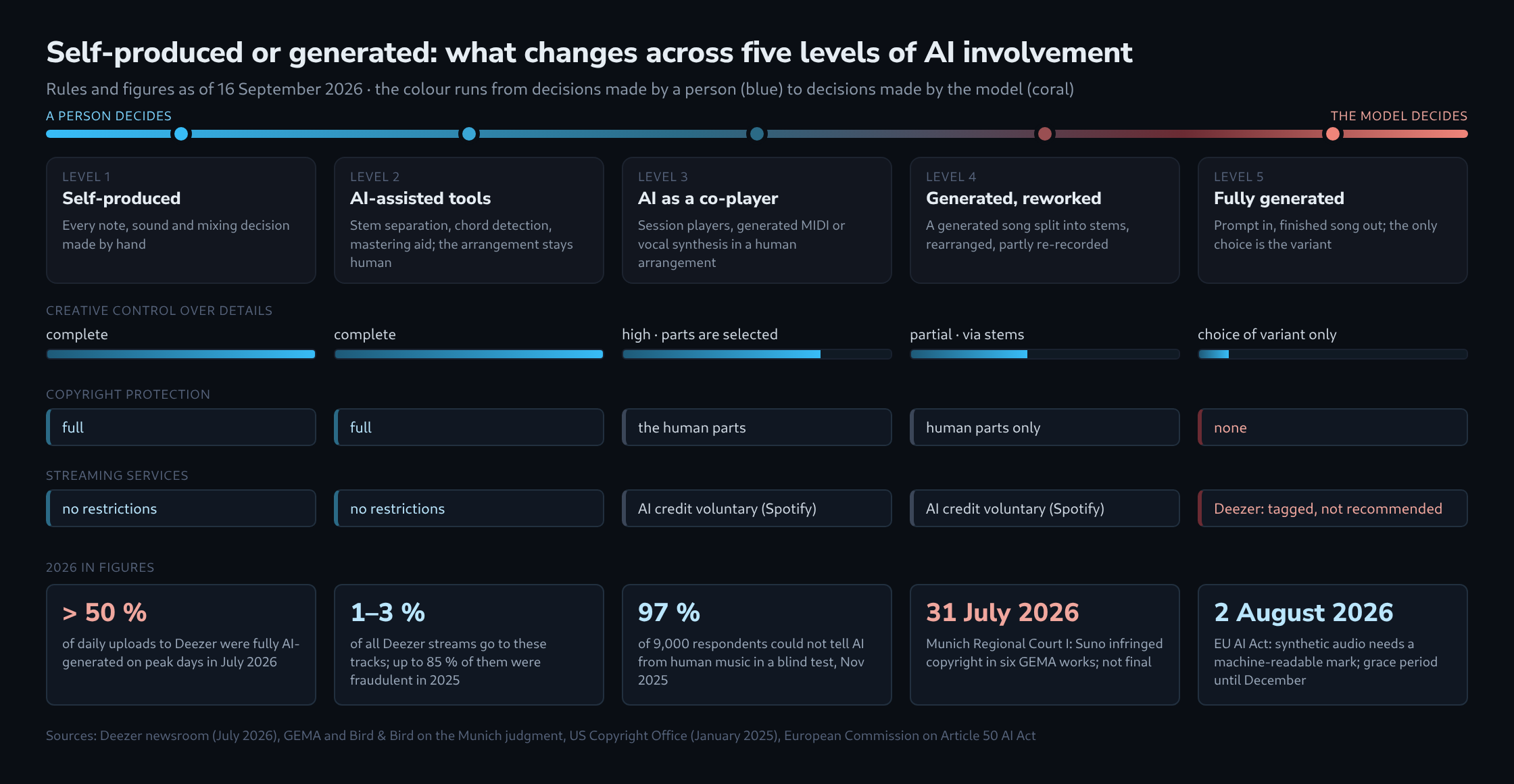
The scale is new. According to Deezer, fully AI-generated tracks exceeded half of all daily uploads on peak days in July 2026, after a monthly average of around 90,000 tracks per day in June — compared with 10,000 per day in January 2025. Listening has not followed: those tracks account for 1 to 3 per cent of all streams, and in 2025 up to 85 per cent of the streams they received were classified as fraudulent. This article compares both routes on the points that matter for a release, based on court decisions, platform rules and figures published up to 16 September 2026.
How a generated song and a produced song come about
A generated song starts with a description: genre, mood, instrumentation, sometimes lyrics or a structure. Services such as Suno or Udio turn it into a complete track with vocals within minutes, typically in two variants per request. The creative work consists of describing, generating again and choosing. Newer tools add editing steps — extending a song, replacing a section, exporting individual stems — but the model decides how every note, every sound and every syllable is realised.
A self-produced song is the sum of decisions a person makes in a DAW: which chord follows which, which sound carries the bass line, how the drums swing, where a vocal is recorded, how loud each element sits in the mix and how the master is limited. Even with sample packs and presets, every placement is a human choice. The process takes days or weeks instead of minutes, and it requires skills in arrangement, sound design, recording and mixing that take years to build.
The range in between: five levels of AI involvement
The contrast between “AI” and “self-made” is too coarse for 2026, because AI features now sit inside every major DAW, as the overview of the top 5 DAWs in 2026 shows. Five levels describe the practice more precisely:
- Self-produced without AI. Every note, sound and mixing decision is made by hand.
- AI-assisted tools. Stem separation, chord detection, pitch correction or a mastering assistant speed up single steps; composition and arrangement stay human.
- AI as a co-player. Session players, generated MIDI patterns or vocal synthesis contribute parts inside a project that a person arranges and selects from.
- Generated, then reworked. A generated song is split into stems, rearranged, partly re-recorded or re-sung and mixed anew.
- Fully generated. A prompt goes in, a finished song comes out, and the only decision is which variant is kept.
Most of the questions that follow — control, rights, labelling — do not flip at a single point on this scale. They shift gradually, and levels 3 and 4 are where the grey zone lies.
Creative control: what can still be changed
In a DAW project, every element remains editable until the export: a single note can be moved, a snare replaced, a vocal phrase recorded again, a frequency range in one instrument lowered by two decibels. The result is exactly as specific as the decisions behind it.
With a generated track, control is indirect. A prompt describes an outcome but not its details, so a change means a new generation — which usually alters more than the one aspect that was meant. Editors inside the generation services and stem exports narrow the gap: sections can be replaced or extended, and separated stems can be mixed in a DAW. What stays out of reach is the fine structure within a stem. A melody that is almost right cannot be corrected note by note unless it is transcribed and played again — at which point the track moves from level 5 towards level 4.
Uniqueness is the second side of control. Generative models produce what is statistically plausible for a description, so similar prompts lead to similar arrangements, sounds and vocal timbres. A self-produced track can be just as generic, but its distinctiveness is decided by the person producing it, not by the average of a training set.
Copyright: who owns a generated song
United States. Copyright protects only works of human authorship. In the second part of its report on copyright and artificial intelligence, published in January 2025, the US Copyright Office stated that prompts alone do not give enough control over the output to make the person entering them its author; human contributions such as the selection, arrangement or modification of generated material can be protected. On 2 March 2026 the Supreme Court declined to hear Thaler v. Perlmutter, leaving in place the ruling that a work created autonomously by an AI system cannot be registered.
Germany and the EU. The German Copyright Act protects “personal intellectual creations” (section 2(2) UrhG), and the EU standard of originality likewise requires the author’s own intellectual creation. A song generated without meaningful human input is therefore not protected as a work. Lyrics written by a person and a melody composed by hand remain protected as works, and a recorded vocal performance is covered by performers’ rights, even when other parts of the track were generated.
The practical consequence is easy to overlook. A track without copyright protection can be released, but there are few means to act against copies of it. Commercial use of a generated song additionally depends on the terms of the service: songs created on Suno’s free plan are not licensed for commercial use, which requires a paid plan at the time of creation.
Training data: the lawsuits and the licence deals
The second legal question concerns not the output but the input: the music the models were trained on. In the United States, the major labels sued Suno and Udio in June 2024. Universal Music Group settled with Udio at the end of October 2025 and plans a jointly developed, licensed service. Warner Music Group reached a settlement and licence agreement with Suno at the end of November 2025, under which Suno committed to launching licensed models in 2026, retiring its previous models and limiting downloads to paid accounts. Sony Music is still in court against both services, and Universal against Suno; in the Suno case, the court schedule does not foresee a ruling on the fair-use question before 2027.
In Europe, the first judgment has already been handed down. On 31 July 2026, the Munich Regional Court I ruled in proceedings brought by GEMA that Suno infringed copyright in six works from the GEMA repertoire, including “Forever Young”, “Atemlos” and “Daddy Cool”: by training on them, by memorising them in the model and through outputs that largely matched the originals in melody, harmony and rhythm. The court ordered Suno to disclose the extent of the use and held it liable for damages. It is the first European ruling on a generative music AI, and it is not yet final.
These proceedings are directed against the providers, not against the people who use their services. They do show, however, that the legal basis of the services themselves is not settled — and that outputs closely resembling protected works are precisely the point on which a court found infringement.
How streaming services treat AI music
Deezer has been detecting fully AI-generated tracks with its own tool since January 2025 and tagged more than 13.4 million of them in 2025. Tagged tracks are removed from algorithmic recommendations and editorial playlists, streams classified as fraudulent are excluded from royalty payments, and Deezer has announced that it will take down generated tracks used for stream fraud as well as those that have not been played for at least six months. In a survey Deezer published in November 2025, with 9,000 respondents in eight countries, 97 per cent could not tell AI-generated from human-made music in a blind test, and 80 per cent wanted fully AI-generated music to be clearly labelled.
Spotify does not remove music for having been made with AI, but in September 2025 it tightened three rules: unauthorised voice clones and impersonations of artists are removed, a spam filter targets mass uploads, duplicates and artificially short tracks, and AI involvement can be disclosed in the credits using the DDEX industry standard. Since a beta launch in April 2026, that disclosure appears as AI credits in the song credits of the mobile app, initially for music distributed via DistroKid. It is voluntary, and Spotify itself points out that a missing credit does not mean that no AI was used. In the twelve months before the announcement, Spotify had removed more than 75 million spam tracks.
The EU AI Act adds transparency obligations from 2 August 2026. Providers of AI systems that generate synthetic audio have to mark the output in a machine-readable way so that it can be detected as artificially generated; for systems placed on the market before that date, a grace period runs until December 2026. Whoever publishes audio that imitates real persons, such as a cloned voice, has to disclose that it is a deepfake; for evidently artistic works, the disclosure may be made in a way that does not spoil the work.
Effort, cost and result compared
| Criterion | Fully generated | Self-produced |
|---|---|---|
| Time per track | minutes, plus selection | days to weeks |
| Costs | subscription; Suno’s paid plans cost USD 10 or 30 per month | one-off DAW licence, from USD 60 for Reaper to EUR 599 for Ableton Live Suite, plus audio interface and monitoring |
| Skills required | describing music precisely | arrangement, sound design, recording, mixing |
| Control over details | indirect, via new generations and stems | complete, down to single notes and parameters |
| Uniqueness | tends towards the typical sound of a genre | decided by the person producing |
| Copyright protection | none for purely generated parts | full for the human creation |
| Commercial use | depends on the plan and the terms of the service | unrestricted for own material, licences needed for third-party samples |
| Treatment by platforms | tagged at Deezer, no algorithmic recommendation | no restrictions |
| Learning effect | low | high, every track improves the next |
Sound quality is no longer a reliable distinguishing feature. The Deezer survey shows that listeners cannot tell the difference in a blind comparison, and current models deliver mixes with clean vocals and a finished master. The differences lie elsewhere: in consistency across an album, in the ability to change a specific detail on request, and in whether a track can be performed live, remixed or developed further.
Hybrid workflows: AI inside a self-produced track
In practice, the question in 2026 is rarely “AI or not”, but at which steps AI is used and who makes the creative decisions. Typical combinations that leave authorship with the producer:
- Stem separation of older own recordings or of licensed material for remixes and sampling, built into FL Studio, Ableton Live Suite, Logic Pro and Cubase Pro.
- Harmony and arrangement aids such as chord detection or session players whose parts are selected, edited and placed by hand.
- Assistants for routine work such as routing, naming and setting levels, as FL Studio’s Gopher now does inside the project.
- Generated drafts as a reference: a generated sketch points in a direction, and the actual track is then written, played and produced from scratch.
- Mastering assistants as a starting point that is checked and adjusted by ear.
Documentation pays off in all of these cases. A record of which parts were generated makes it possible to fill in AI disclosures in the credits correctly, supports copyright in the human contributions and answers the questions that distributors are adding to their upload forms.
Conclusion
Generated music is unbeatable in speed and cost. It suits sketches, reference tracks, placeholder music for videos and experiments with styles that would otherwise be out of reach. As the basis of an artistic body of work, however, it has three structural weaknesses in 2026: control over details is indirect, purely generated parts are not protected by copyright, and platforms such as Deezer keep fully generated tracks out of their recommendations.
Self-produced music costs time and skill, and it pays that back with complete control, clear rights, a distinctive sound and a learning curve that makes every further track better. The direction the market is taking — licence deals, labelling obligations, the Munich judgment — strengthens exactly these advantages.
The most realistic route in 2026 lies in between: a track that a person composes, arranges and mixes, with AI tools taking over individual work steps and every use documented. That combines the speed of the new tools with what only self-production provides — a result in which the decisive creative choices were made by a person, which is exactly what copyright protects.
Sources
- AI Music Tops 50% of Daily Uploads on Deezer
- Gericht entscheidet pro Musikschaffende: GEMA setzt sich gegen SUNO durch
- Munich District Court Rules on AI-generated music GEMA v Suno
- Copyright and Artificial Intelligence, Part 2: Copyrightability
- Supreme Court Denies Certiorari in Thaler v. Perlmutter: “Human-Only Rule” for AI Works Stands
- Warner Music Group strikes landmark deal with Suno; settles copyright lawsuit against AI music generator
- Spotify updates AI policy to label tracks, cut down on spam
- Spotify rolls out its own AI-transparency feature in beta
- Quick Facts: Transparency rules for AI systems
Related articles