English
 Deutsch
 Polski
AI Music vs. Self-Produced Music in 2026: Control, Copyright and Effort Compared

Management Summary
AI music tools generate songs or parts from instructions, while self-production builds music through composition, recording and editing. Both approaches can be combined. Generation can provide a quick draft; separate recordings and editable notes usually offer more precise control over later changes. For a release, the decisive questions are what remains editable, which human creative contributions exist and what rights permit use. A paid service plan alone does not settle every copyright question.
Contents
- Five workflows, not five legal categories
- What remains editable?
- Three separate questions about rights
- Training disputes do not decide every release
- Platforms: uploads, streams and recommendations differ
- EU transparency: technical marks and deepfakes
- Useful evidence for a hybrid production
- Frequently asked questions
- Sources
A generated song can provide a quick first version. A production built from recordings and editable notes usually offers more direct access to individual musical details. Neither route guarantees originality, a particular sound quality or permission to release the result. The useful comparison concerns the available project files, the human creative contribution and the applicable rights.
Checked: 26 October 2026. Product functions and service conditions below refer to that date. A DAW is recording and editing software; the comparison of five DAWs explains their edition limits.
Five workflows, not five legal categories
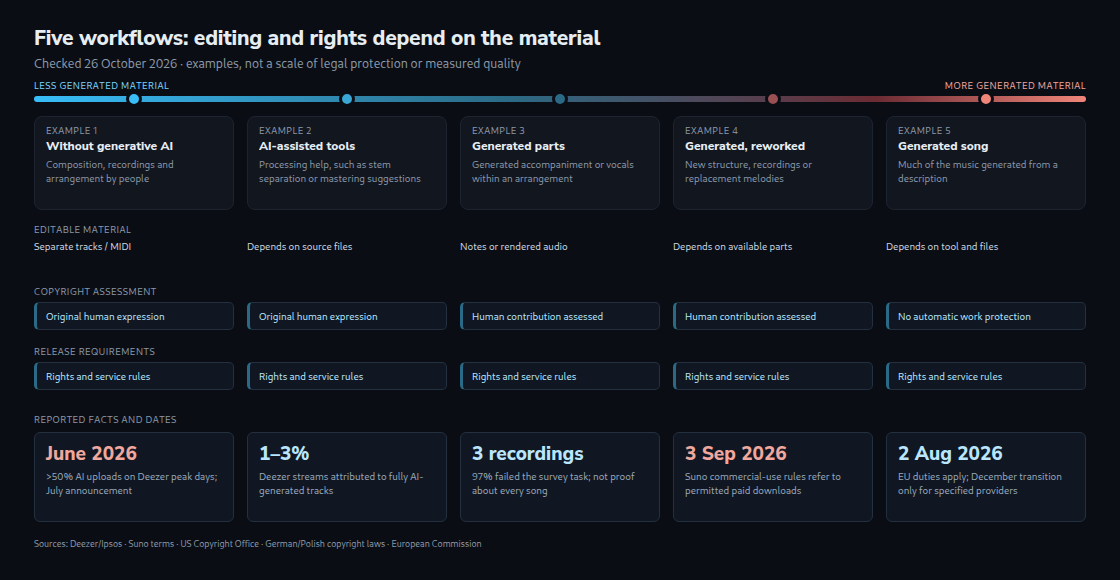
- Production without generative AI: composition, recordings and arrangement originate with people. Synthesizers and conventional automatic processing do not automatically count as generative AI.
- AI-assisted processing: a tool separates instruments from a recording or suggests mastering settings. Stem separation produces approximate instrument groups, not the original recording tracks.
- Generated parts: a generated accompaniment or vocal part joins a human arrangement.
- Generated material with substantial reworking: sections are rearranged, new parts recorded or melodies replaced.
- Generated song: a text description produces much of the musical material; the workflow may still include selection and later editing.
These examples describe working methods. The amount of AI use does not translate into a percentage of copyright protection. A small original contribution may matter legally; many hours of purely technical editing may not.
What remains editable?
MIDI stores playing instructions such as note pitch, start time and duration. An audio file stores the resulting sound. Changing one MIDI note is straightforward when the relevant instrument part remains available. In a mixed audio file, the same note may overlap with vocals and drums. That limitation also affects a self-produced project containing imported or permanently mixed recordings.
Generated music no longer means that every change requires a completely new song. Suno Studio 2.0 includes MIDI editing and audio-to-MIDI transcription; v6 supports section changes. Transcription estimates notes from sound and can require correction. These functions do not turn every generated recording into the original, independently editable instrument parts. Export options also differ: Udio’s current help page states that audio, video and stem downloads are disabled.
| Question | Recordings and editable notes | Generated material |
|---|---|---|
| Changing one musical detail | Often direct when the separate track or MIDI notes exist | Depends on section editing, available stems and transcription |
| Time to a usable result | Depends on arrangement, recording and editing work | A first version may arrive quickly; corrections and selection add time |
| Costs | Software, instruments and recording costs depend on the setup | Plan, download limits and later editing determine the total |
| Release requirements | Rights to compositions, samples, performances and recordings still matter | Provider conditions and the same relevant third-party rights require assessment |
There is no measured universal winner for speed or sound quality here. The comparison also does not establish that generated music is inherently generic or that human production is automatically distinctive.
Three separate questions about rights
1. Does the musical work qualify for copyright? In Germany, section 2 of the Copyright Act requires a personal intellectual creation. Polish law requires creative activity with an individual character. Writing lyrics or a melody by hand is therefore not, by itself, a guarantee of protection. A prompt is the text instruction sent to the generator. A prompt alone generally does not establish authorship under the US Copyright Office’s analysis. The US Copyright Office likewise distinguishes human creative expression from material generated without sufficient human control. Original selection, arrangement or changes can support protection, including protection of the resulting arrangement; unprotected generated elements do not thereby acquire independent copyright.
2. Which other rights affect the recording? Composition, artistic performance and sound recording are different objects of protection. German and Polish law provide separate related rights where their conditions are met. A recording is consequently not automatically free to copy merely because a generated composition lacks copyright. Samples are extracts from existing recordings. Samples, recognizable protected music and another person’s voice can introduce additional rights questions.
3. What does the provider permit? Permission for commercial use is a contractual matter and does not guarantee copyright or freedom from third-party claims. Under Suno’s terms effective 3 September 2026, the relevant route is a permitted download during a qualifying paid subscription, subject to the conditions and allocation. Earlier creation on a free plan is no longer a sufficient reason to reject every later commercial use. Upgrading alone is not the required download. The terms separately restrict the platform’s Remix feature to personal, non-commercial use. Other services can have different rules.
Training disputes do not decide every release
On 31 July 2026, Munich Regional Court I ruled in case 42 O 763/25 concerning six protected works and Suno models v3.5 and v4. According to the court’s announcement, the case involved memorization and reproduction of protected musical material; the judgment was not final when announced. This is not a ruling that every AI song or every later model infringes copyright.
Universal Music Group and Udio announced a settlement and licensing agreements in October 2025; Warner Music Group and Suno announced an agreement in November 2025. Suno subsequently announced v6 in September 2026. Such agreements concern specified parties and uses. They neither establish that all generated outputs are unlawful nor clear every possible right for a later release.
Platforms: uploads, streams and recommendations differ
Deezer’s July 2026 announcement reports that fully AI-generated music exceeded half of daily uploads on peak days in June, with about 90,000 such uploads per day on average that month. These tracks accounted for only 1–3% of streams on Deezer. Upload share is therefore not listening share. These are the company’s figures for its own service, not measurements of the entire music market.
Deezer tags detected fully generated tracks and excludes that content from algorithmic recommendations and editorial playlists. The reported figure of up to 85% fraudulent activity concerned streams of fully AI-generated tracks in 2025, not 85% of all uploaded songs. Detection and fraud assessment can have limitations.
Spotify’s 20 October 2026 announcement distinguishes recommendation exclusions from removal: more than 50 million tracks had been excluded from recommendations during 2026, while more than 75 million tracks had been removed for serious or repeated violations. These totals cover spam-related problems and are not counts of proven AI songs. Spotify also describes AI-persona badges and recommendation restrictions for such profiles. Optional AI credits separately describe roles such as vocals, lyrics or production. Missing credits do not prove the absence of AI.
A Deezer/Ipsos survey published in November 2025 tested 9,000 participants across eight countries with three recordings. The reported 97% failed the classification task. That small set of examples does not establish that every AI song is indistinguishable, that every answer was wrong or that AI and human music have equal quality.
EU transparency: technical marks and deepfakes
Article 50 of the EU AI Act separates duties of system providers from duties of certain users. Providers of systems generating synthetic audio must support machine-readable identification, subject to the provision’s scope and exceptions. This is not a general requirement to add an audible warning to every song.
For deployers, disclosure duties concern deepfakes: generated or manipulated material that resembles existing persons or other entities and falsely appears authentic. A fabricated vocal performance presented as a real singer’s genuine recording illustrates the issue. Not every generated song meets that definition. Artistic works have adapted disclosure requirements rather than an automatic exemption; purely personal, non-professional use also falls outside the definition of deployer.
The rules apply from 2 August 2026. The Commission describes a transition until 2 December 2026 for the provider duty under Article 50(2) for relevant systems already on the market before August. That is not a general postponement of deepfake disclosure duties.
Useful evidence for a hybrid production
Project versions can show an independently composed melody, new vocal recordings or an original arrangement. Licence records can document permitted samples. A provider’s terms, plan and permitted-download record can help explain the contractual basis for use. These records support an account of the work; saving files does not itself create copyright.
Stem separation does not remove rights in the source recording. Replaying a protected melody does not necessarily avoid rights in the composition either. Permission may be required unless an existing licence, public-domain status or an applicable legal exception covers the actual use.
Frequently asked questions
Does editing an AI song automatically create copyright?
No. Original human expression matters, not the number of edits. A creative arrangement or a newly composed part may qualify; normalization (changing the overall level), format conversion or replacing a few sounds does not automatically establish protection. The analysis can differ between the arrangement, its components and the recording.
Can an older free-plan Suno song become commercially usable?
The September 2026 rules allow a qualifying permitted download while on a paid plan to provide commercial-use permission, including for older songs, subject to the terms. A subscription purchase alone is insufficient. The Remix restriction and third-party rights remain relevant.
Which workflow is better?
The answer depends on the task. Separate recordings and MIDI are useful for exact note changes, alternative mixes and later live arrangements. Generation can supply drafts or material for further work. The decisive evidence is the actual project’s editability and rights, rather than an AI label alone.
Sources
- Deezer: June uploads and streaming policy
- Deezer/Ipsos: three-recording survey
- Suno: terms effective September 2026
- Suno: changed download rules
- Suno: commercial-use explanation
- Suno Studio 2.0: MIDI functions
- Suno: v6 announcement
- Udio: download restrictions
- US Copyright Office: human authorship
- Germany: protected works, section 2
- Germany: performers, section 73
- Germany: recording performances, section 77
- Germany: phonogram producers, section 85
- Poland: copyright and related rights, articles 1, 85 and 94
- Munich Regional Court I: announcement of 31 July 2026
- UMG/Udio: announced agreement
- WMG/Suno: announced agreement
- Spotify: policy update of 20 October 2026
- Spotify: AI credits
- EU AI Act: article 50
- EU AI Act: definitions in article 3
- European Commission: dates and transition
Related articles