

 English
MRR is not cash balance: monthly plans, annual plans and lifetime deals compared

Management Summary
In a subscription business, cash balance, recurring monthly value and profit are different measures. MRR means the value of ongoing subscriptions expressed per month, not money already received. Annual payments bring cash earlier but must still fund future service. One-time lifetime offers can generate lasting losses when costs continue. Comparing plans therefore requires discounts, cancellations, refunds and expenses over the promised service period, with enough cash reserved for later obligations.
Contents
A full bank account does not prove that a subscription business earns enough. Prepayment arrives early, while hosting and support continue to cost money later. Monthly plans bring regular payments. Annual plans bring a larger payment at the start. A lifetime deal charges once for the promised service.
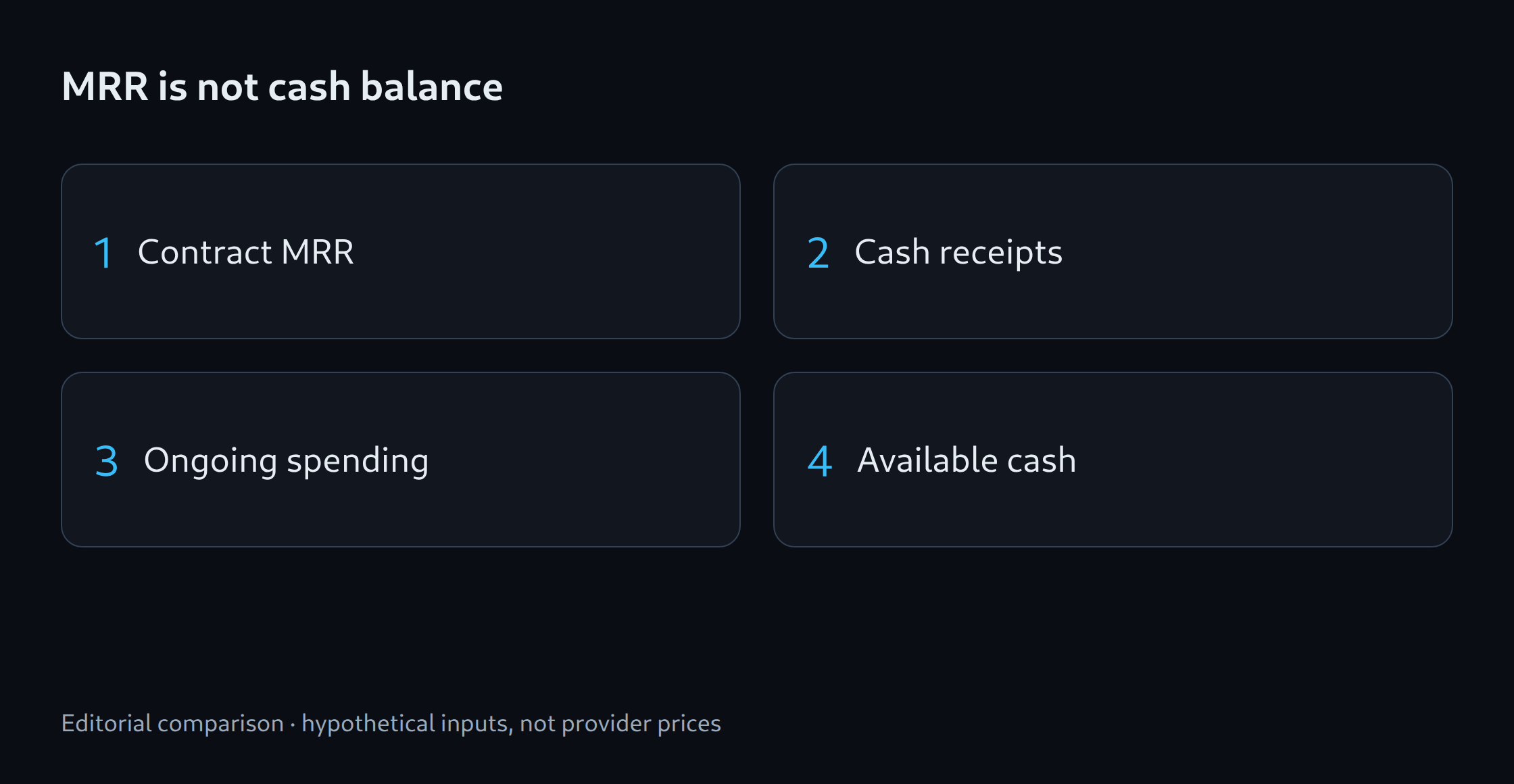
Three measures with different purposes
MRR means Monthly Recurring Revenue: the value of ongoing subscriptions converted to one month. All example amounts below are euros excluding VAT. An annual subscription at €1,020 gives €1,020 ÷ 12 = €85 MRR. The cash receipt is instead a single €1,020 payment. Stripe describes this conversion and settings such as how discounts are treated. MRR therefore does not prove that invoices have been paid. [1]
Liquidity means money available to make payments. A payment provider may transfer customer payments to the bank account later. Revenue recorded in the accounts is another measure: money for a year of service still to be delivered is not automatically all revenue of the payment month. These examples do not replace accounting.
Monthly plans: regular receipts, frequent decisions
At an assumed price of €100 per month, twelve fully paid months bring €1,200 before payment fees. If the subscription ends sooner, later payments disappear. Monthly income can match monthly expenses, but one payment each month creates more separate transactions than an annual payment.
Prepayment does not prevent customers from cancelling at the next available date. A fair comparison uses the same customer group and service. Monthly plans need an assumption about how many subscriptions end each month; annual plans need a separate assumption about renewals after twelve months.
Annual plans: a discount for earlier cash
A 15% discount on twelve months at €100 produces an annual price of €1,020 and €85 MRR. Compared with twelve fully paid monthly instalments, receipts are €180 lower per customer. In return, the money arrives earlier and fewer transactions occur. Whether this trade is worthwhile also depends on how many customers choose and renew each offer.
Assumed ongoing costs of €20 per customer per month add up to €240 for a year. These costs still need funding after prepayment. Unexpected support work, heavier usage and refunds need additional cash. Stripe states that original processing fees are not returned with refunds and further fees may apply. [2]
Lifetime deals: one payment, an open horizon
A lifetime deal costing €300 once creates no ongoing MRR. At a constant cost of €20 per month, €300 covers fifteen months. Customer acquisition, payment fees and other expenses shorten that period. This calculation leaves no profit allowance. It does not predict how long the offer will actually be used.
A one-time offer needs a clear description of the included service, such as a particular software version or a limited usage allowance. Ongoing AI usage can create new costs every month. An unlimited promise for a single payment can therefore keep generating losses. The word lifetime alone does not explain the promised duration or service.
Cash month by month
The linked simulator separates monthly plans from annual plans grouped by start month. Monthly subscriptions end at the start of each modelled month according to the entered cancellation rate. New annual plans pay immediately; twelve months later only the assumed renewing share pays again. Refunds reduce receipts but do not automatically reduce active subscriptions, fees or operating costs. Negative cash flow for a month does not mean an empty bank account: starting cash can absorb the loss. The calculator reports the first negative month-end balance.
Another run with half as many new customers, more cancellations and extra setup costs reveals possible shortages. The calculator uses monthly figures; cash can run short between payment dates even if the month ends positive. Taxes, delayed settlements and later payment reversals are not fully represented. Some prepaid cash is still needed to deliver the promised service.
Related tools
Sources
Sources checked: 25 October 2026.
Questions and answers
Does a lifetime deal count toward MRR?
A one-time payment without a recurring contract does not belong in monthly recurring value. A separate ongoing maintenance plan would be counted separately.
Is an annual subscription automatically more profitable?
No. Discounts, retention, fees, refunds and ongoing delivery costs determine the result. Earlier cash alone does not increase total profit.
Related articles


