English
 Deutsch
 Polski
22, 20 or 48 GB through VRAM Mods: RTX 2080 Ti, RTX 3080 and RTX 4090D for Local LLMs

Management Summary
A graphics-card memory modification adds more data capacity than the original card provided. For AI running on a personal computer, this can make room for larger language models, systems that work with text and answers. The article explains the appeal and limits of these offers. More memory does not automatically improve speed or prove reliability. The actual unit, total cost and return arrangements matter before purchase; some described modifications lack independent evidence of reliable operation.
Contents
VRAM is memory located on the graphics card. Adding more can allow a larger language model to run entirely on the card. It does not automatically make calculations faster. This article examines offers for an RTX 2080 Ti with 22 GB, an RTX 3080 with 20 GB and an RTX 4090D with 48 GB.
The modifications listed here have not been tested for this article. Manufacturer specifications establish the original card; supplier statements initially establish only that an upgrade is offered. An AliExpress listing or a screenshot showing a high memory capacity does not establish error-free operation.
Three modifications with different evidence
| Candidate | Official original capacity | Evidence status |
|---|---|---|
| RTX 2080 Ti 22 GB | 11 GB | Supplier lists upgrade from 11 to 22 GB |
| RTX 3080 20 GB | 10 or 12 GB | Specific modified card not verified |
| RTX 4090D 48 GB | 24 GB | D-version modification not verified |
GPU Solutions lists upgrades from 11 to 22 GB for the RTX 2080 Ti and from 24 to 48 GB for the RTX 4090 in its FAQ. This documents an offered service, not an independent long-term test. It does not establish an RTX 4090 D upgrade. These sources also do not verify a particular modified RTX 3080 with 20 GB.
Capacity that makes a difference
Illustrative calculation: the model, working buffers and running software need a total of 23 GB. Neither 20 nor 22 GB can hold that workload entirely on the GPU. A 24 GB card leaves just 1 GB on paper; display output or other programs may occupy that remainder. A 48 GB card leaves more room. This is not a measurement and assumes the same unit for demand and capacity.
More memory does not automatically increase data-transfer speed or the graphics chip’s computing capabilities. Even a smaller, quantised model file needs compatible software. Quantisation stores model numbers using fewer bits; the operations used to process those numbers must support the particular GPU. A file may therefore fit in memory but still fail to run with the chosen program.
Document the original GPU and modification
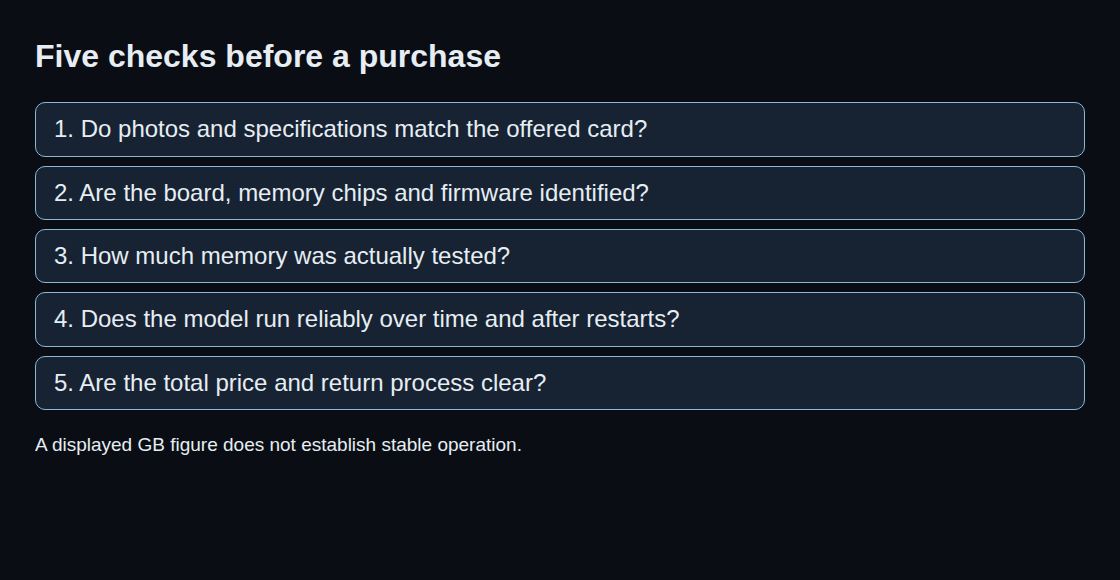
An offer should identify the exact GPU, circuit-board version (PCB), memory chips, card firmware (VBIOS) and cooling. The PCB is the board carrying the components; the VBIOS contains settings for operating the card. Photos and device reports must match the unit being sold. A photo of another card is insufficient.
A test report should cover as much of the test-accessible memory as possible and state how much was actually checked. It should also include repeated model starts, computer restarts and extended calculations with the intended model. Test duration, software version, temperature, clock speed and errors must be recorded. No single test guarantees lasting reliability; results from other units do not replace these checks.
AliExpress and import costs
Price comparisons need the total amount: card or modification service, memory chips, shipping and confirmed additional charges. Delivery date, seller identity and a workable return process also matter. High return-shipping costs can cancel out a low advertised price.
A complete modified card and a modification service are different offers. GPU Solutions states that the booking price covers labour without memory modules and that an itemised quotation follows. Only the price including all necessary parts can be compared meaningfully with a complete card.
Include official alternatives
Factory-standard comparison options include the RTX 3090 with 24 GB, Intel Arc Pro B70 with 32 GB and RTX 6000 Ada with 48 GB. Those capacities alone establish neither speed nor software compatibility. Intel and NVIDIA require different drivers and computing software. The comparison must therefore check whether the specific software version supports the intended model and GPU.
A modification is most relevant when a particular model currently exceeds available memory. The decision depends on documented operation of the actual unit, total price and setup effort. A memory calculator estimates demand; only a hardware test can show whether the card actually works.
Memory planning for model selection: LLM VRAM estimator.
Related tools
Questions and answers
Does a screenshot showing 48 GB prove that a modified GPU works?
A displayed capacity shows only what the driver reports. A memory test documenting the amount checked and extended model runs provide additional evidence. A later failure remains possible even after these tests.
Are all 48 GB RTX 4090D modifications identical?
Circuit board, memory chips, card firmware and cooling may differ. The factory-standard RTX 4090 D has 24 GB. Evidence for a card modified to 48 GB must match the actual unit.
Sources
- GPU Solutions: offered memory upgrades and supplier statements
- NVIDIA: official RTX 4090 D, 24 GB
- NVIDIA: RTX 3090
- NVIDIA: RTX 6000 Ada, 48 GB
- Intel: Arc Pro B70 datasheet, 32 GB
- vLLM: GPU installation
- Ollama: hardware support
- NVIDIA: official RTX 3080 memory variants
Sources checked: 26 October 2026.
Related articles