English
Image Prompts: Clear Instructions and Reliable Quality Checks

Management Summary
An image prompt is the written description used to ask an AI tool for an illustration. In website and publication work, clear instructions about objects, layout and mood help communicate the intended result. The generated image can still contain unwanted details or incorrect proportions. The article explains why specific descriptions and careful viewing work together, and why one improved attempt does not prove a general rule. Precisely measured diagrams may be better built with controlled drawing tools.
Contents
An image prompt describes the intended result but does not guarantee perfect compliance. An explicit ban on labels can still produce an image containing numbers or tags. Clear instructions and inspection of the generated image both matter.
The original workshop report described chains on concrete accompanied by unwanted evidence cards and a ruler. The mood line contained the word forensic. That suggests a plausible association, but it does not establish a cause.
Observation and explanation
In the reported follow-up, the genre word was replaced and specific object exclusions were added at the same time. An improved result cannot therefore be attributed uniquely to either change. Random variation between outputs remains another possible explanation.
Prompt position does not establish a reliable rule either. A prohibition far before a possible cue has not been shown to be weaker than the same prohibition at the end. Word distance is also not a measurement of the model’s internal processing.
The earlier figures covering 31 images, success rates and exact prompt positions are not presented here as a newly verified series. A complete set linking prompts, model versions and every output was unavailable for this review. The practical case motivates better tests; it does not establish a general effect.
A precise description of the intended image
Google’s image-generation documentation recommends specific scene descriptions, context and iterative refinement. For unwanted objects, the guidance recommends describing the intended scene positively. This is a working method, not a guarantee for every output.
The chain motif can, for example, be described without a genre cue:
A restrained, non-photorealistic illustration of exactly two metal chains
on a bare concrete surface, viewed directly from above.
The upper chain has a gap bridged by a thinner link.
The lower chain has an open gap. The remaining surface is empty.
Mood: quiet, exact, spare.
This description specifies count, arrangement, material and empty space. Additional exclusions can clarify the request but cannot replace visual inspection. A comparison is needed to establish whether this version performs better. No new images were generated with this prompt for the revised article.
A prohibition on visible watermarks must also be distinguished from invisible provenance markings. Google states that generated Gemini images include SynthID. A prompt saying “no watermark” therefore does not establish the absence of every provenance marker.
Comparison of separate factors
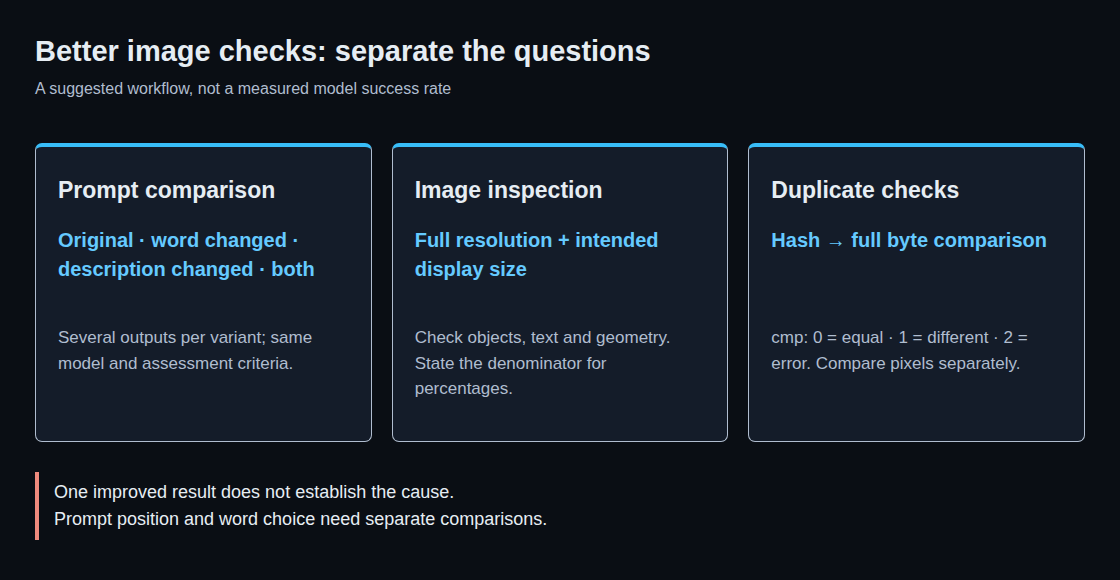
Four variants can investigate the reported case: the original prompt; only the genre word replaced; only the object description clarified; and both changes combined. Model identifier, available settings, reference images and image format should remain as consistent as possible. Each variant needs multiple outputs and predefined criteria, such as “no readable characters” and “exactly two chains”.
The position of the prohibition block is a separate question. That comparison changes only position, not wording at the same time. Repeated runs and assessment without knowing the variant reduce the influence of isolated lucky outputs and expectations. Findings initially apply to the tested task and model version.
Geometry measurements and their limits
Two columns of equal height are a testable requirement. Unequal heights demonstrate an image discrepancy, not an internal rule that load causes deformation. Perspective, top edge, baseline and whether the load is included must be defined before measuring pixels.
For illustrative heights of 282 and 243 pixels, the difference is 39 pixels. Relative to the larger height that is 13.8 percent; relative to the smaller height it is 16.0 percent. A percentage without a reference quantity is incomplete. Controlled SVG or diagram construction is often more suitable for precise technical proportions than a freely generated illustration.
Separate checks for files and image content
A checksum is a short value calculated from the file contents. It helps group potential duplicate files. Equal hashes are not a mathematical proof of equal files; MD5 in particular has known collision weaknesses. SHA-256 is a suitable example for new checking records, followed by a complete byte comparison to confirm equality.
sha256sum -- image-a.png image-b.png
cmp -s -- image-a.png image-b.png
cmp -s returns status 0 for equal files, 1 for different files and 2 for an error. These commands read the named files without changing images. A missing path must not be interpreted as a different image version.
Questions and answers
Does a checksum find identical pixels in another encoding?
Not reliably. Different metadata or compression can produce different file bytes while preserving identical pixels. Comparing decoded pixels checks that case; perceptual hashes compare visual features rather than every file byte and help find similar image content. Similarity is not confirmed identity.
Is a thumbnail enough for approval?
A preview shows composition and readability at the intended display size. Full resolution is also needed to inspect small characters, edges, duplicated objects and geometric discrepancies. The two views serve different purposes.
Does a successful second attempt prove the prompt change worked?
No. One improved image is initially just a useful result. Explaining the cause requires separate changes, multiple outputs and clear assessment criteria.
Related articles