English
 Deutsch
 Polski
Shopify App, WordPress Plugin or Independent SaaS: Where to Start?

Management Summary
Shopify apps and WordPress plugins extend systems already in use, while an independent online service can work across several systems. Using product-data checks for shops, the article explains these three routes to a software offer. Working close to existing shop data can save effort; an independent service needs its own customer acquisition and data imports. The purpose is to match the product to a buyer group and its task. A marketplace listing alone does not guarantee paying customers.
Contents
A Shopify app or WordPress plugin extends a system already in use. A product checker could work where shop data is maintained. Independent SaaS, software operated as an online service, can serve several systems but needs its own route to paying customers. No form wins automatically. The relevant factors are the task, reachable buyers and the work needed for operations and support.
One product, three routes
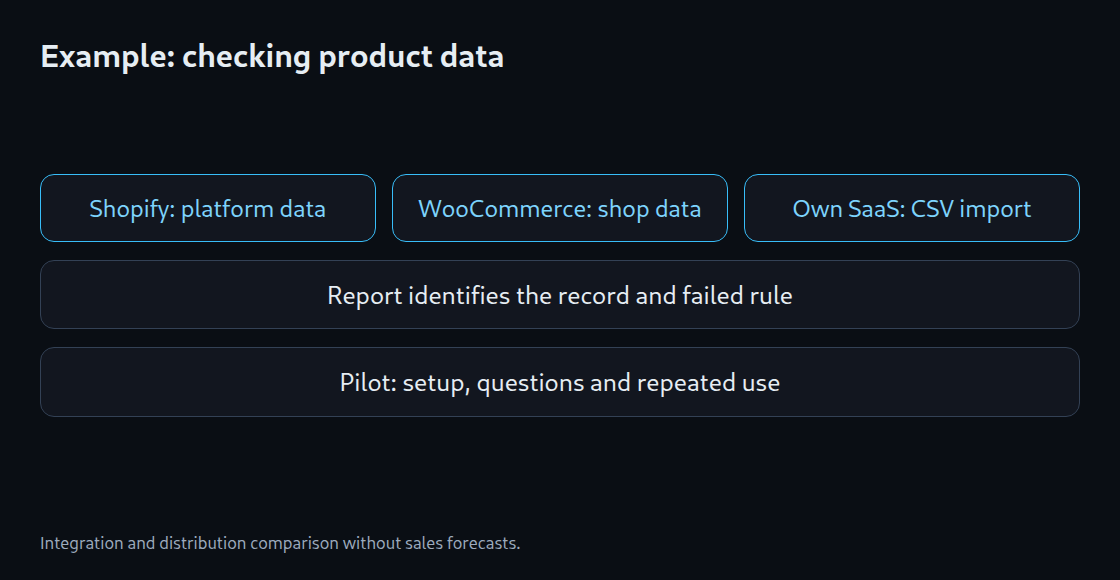
The hypothetical product checks item data: is an item identifier missing, do two variants reuse a supposedly unique code, or does a price violate a predefined rule? Different variant prices alone are not an error. A Shopify app reads permitted shop data through an API, a programming interface. A WordPress plugin needs a specific data source such as WooCommerce; WordPress alone does not define a general shop-product model. Independent SaaS initially accepts a CSV file with agreed columns. Identical checks do not mean identical data is available.
| Route | Customer access | Main work |
|---|---|---|
| Shopify app | Merchants on one platform | Approval, updates for new API versions, installation |
| WordPress plugin | Site owners and agencies | Environment diversity, updates, conflicts |
| Independent SaaS | Direct outreach and partnerships | Sales, initial setup, imports |
Shopify billing infrastructure
Shopify App Pricing supports recurring fees, usage billing and combinations. Shopify provides plan selection and many billing operations. The app must still check whether a valid subscription exists and report billable usage correctly. This description concerns that particular Shopify billing model; support and migration conditions depend on the app’s situation. An App Store listing does not guarantee visibility or paying merchants. [1]
WordPress product form and rules
The WordPress.org directory has specific rules. Local functionality included in the distributed plugin must not require payment to unlock or stop working after a trial period. Additional premium code can be offered separately outside the directory. A plugin may also use a paid external service that provides substantial, documented functionality. A service that merely checks a license key to unlock functionality entirely included locally does not qualify. This is a directory rule, not a general ban on commercial WordPress products. [2]
A plugin encounters different PHP versions, other extensions and hosting limits. A fault on just one installation can take substantial investigation. A central service reduces that diversity but needs its own availability, backup and update work. A Shopify app can also require such a service. An initial CSV import avoids a direct integration, but columns, data types and file freshness still need checking. The customer must also create and upload the file.
A useful selection experiment
The initial comparison starts with a defined buyer group, such as small WooCommerce shops with many product variants. Interviews and a sample report can reveal which errors create work; paid and repeated use provide stronger evidence of buying interest. A pilot implements one route. Records cover setup effort, time to the first understandable report, questions and repeated use. A report should identify a particular record and failed rule rather than merely claim “poor data quality”.
Planning a later switch includes deciding which product data, rules and reports can be exported and in what format. The export must also be importable elsewhere. Active subscriptions and payment authorizations do not automatically move to a new platform with the file; migration needs a separate plan. Reviews and an existing directory listing likewise cannot simply be copied into another marketplace. This does not prevent switching, but makes the work visible.
The decision
A Shopify-specific product can benefit from direct access to shop data. A plugin may fit an agency already supporting WooCommerce installations. An independent import service can reach several source systems if their data fits a shared format. The pilot informs the choice: which version produces useful, understandable reports with manageable setup and support? Starting all three routes at once initially means three integrations and several operating processes.
Related tools
Questions and answers
Does an app directory automatically bring customers?
No. A listing makes discovery possible but does not establish demand. A pilot must show whether the intended buyers use the report and pay for it.
Do plugins and SaaS have identical operations?
No, but combinations are possible. A plugin runs on the customer’s website and can also use an external service. A Shopify app can require its own server service too. With SaaS, the provider operates the central software; the precise workload depends on the architecture.
Sources
Sources checked again: 25 October 2026. The product checker is hypothetical, not a sales or profit forecast.
Related articles