English
 Deutsch
 Polski
Templates, Data Packs or Mini-Tools: Which Digital Product Can Sell Sustainably?

Management Summary
Templates, data packs and small tools are digital products intended to make a specific job easier. Using an agency that serves online shops, the article explains the differences: a template guides data entry, a data pack saves research and a checker finds missing details. The reason to buy is useful work saved, rather than the file alone. Lasting sales depend on demand, updates and support. Cheap copying therefore does not mean income without ongoing effort.
Contents
Digital files are usually cheap to copy. A purchase is more useful when the product reduces a specific task: preparing an import file, finding suitable data or spotting invalid entries. Templates provide a file to fill in, data packs supply selected content, and mini-tools perform a limited task. Each form requires different work after the sale.
One audience
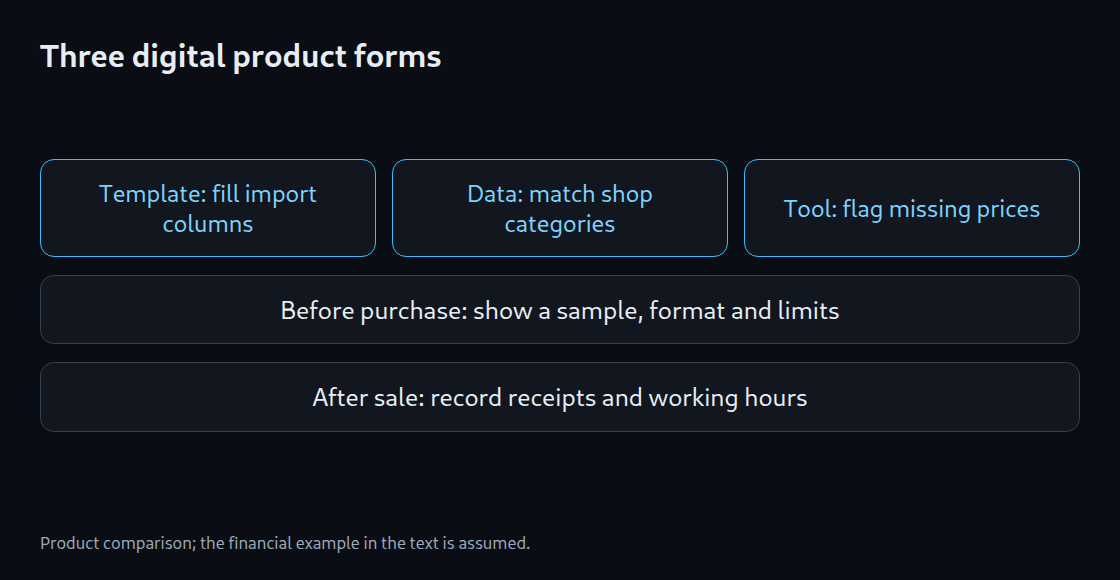
A small agency prepares product lists for online shops. A template could contain columns for item number, price and category, with a completed example. A data pack could match one supplier’s categories to the shop’s categories. A small checker could flag missing prices and duplicate item numbers. These are hypothetical offers; demand has not been measured here.
| Form | Strength | Work and risk |
|---|---|---|
| Template | Quick start in a familiar workflow | Compatibility, explanation, copying |
| Data pack | Verified selection saves research | Freshness, provenance, usage rights |
| Mini-tool | Performs the task | Fixes, platform changes, support |
What the product includes and excludes
A product description names the file format, supported application and included examples. Data packs also need a collection date, source and permitted uses. A checker might specify a limit of 10,000 rows, checks for missing prices and no check of whether a price is correct. The duration of updates and support also needs a clear description. “Lifetime updates” without a defined duration is unclear and can create an expectation of years of maintenance for one payment.
A publicly accessible dataset is not automatically available for resale. An initial trial can use original data or data covered by suitable permission. Records should identify the source, licence and conditions, such as required attribution. Permission must cover the planned redistribution.
Delivery does not establish demand
Shopify’s digital products app can provide a download link after a purchase. Lemon Squeezy acts as a Merchant of Record: the service handles the sale to the customer and takes responsibility for sales taxes on that transaction, among other tasks. These features help with payment and delivery. Whether the file solves a problem and justifies its price remains a separate question. [1, 2]
Show a sample before selling
A sample file shows the result before purchase. A pre-sale description needs a delivery date, supported formats and an explanation of what happens if delivery fails. Unfinished features must remain clearly identified as planned. An initial trial can offer just one product form, making it easier to see which offer actually sells.
In this hypothetical example, the product costs €39 with no additional tax added. Twelve payments produce 39 × 12 = €468 received. Dividing that by 18 working hours gives €26 per hour before deductions. This is neither profit nor an hourly wage: fees, refunds, included taxes and other costs have not been deducted. Extra hours spent on promotion, updates and customer questions reduce the amount per working hour. The calculation does not establish that twelve sales are achievable.
Repeat purchases
A new dataset or additional check can justify another purchase. A different file colour alone usually solves no new problem. A subscription needs a specific recurring service, such as a verified dataset every quarter. A one-off payment is often easier to explain for a template that remains useful without changes. None of the three forms is always best: the relevant factors are the problem solved, evidence of demand and the full maintenance workload.
Related tools
Questions and answers
Is a data pack automatically passive income?
No. Outdated entries need correcting, usage rights need documenting and customer questions need answers. The workload depends on the dataset and promised service.
Does a pre-sale prove a sustainable business?
No. A pre-sale initially shows that customers pay for a particular promise. Whether the delivered product helps, how many refunds occur and whether purchases continue becomes clear later.
Sources
- Shopify: Digital products
- Lemon Squeezy: Merchant of Record
- data.europa.eu: data sources, licences and reuse rights
Sources checked again: 25 October 2026.
Related articles