English
What a Sitemap Promises and What the Addresses in It Deliver

Management Summary
A sitemap is a list of website addresses offered to search engines to help them discover published content. It is especially useful for large sites or pages that are difficult to reach through links. The article explains why a usable list must lead to the intended pages and why checking a handful of entries says little about the whole site. A sitemap supports discovery, but does not guarantee inclusion in search results. Accurate addresses and meaningful update dates make its information more useful.
Contents
A sitemap supplies URLs for search engines to discover. It can help particularly with large or poorly linked collections. Submission does not guarantee crawling or indexing, and search engines can also discover pages through links without a sitemap.
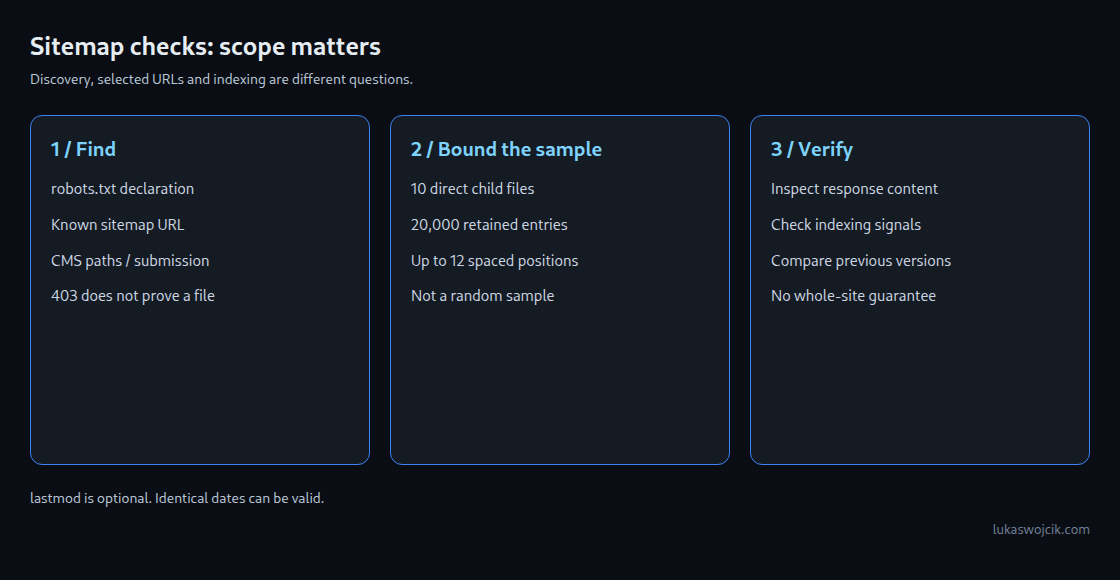
Three questions need separate answers: Is the sitemap accessible and readable? Which URLs occur in the portion actually read? What happens when selected URLs are fetched? Keeping these questions separate prevents a limited sample from becoming a verdict on an entire website.
Finding a sitemap
A Sitemap: entry in robots.txt provides an explicitly published location. Known CMS paths such as /sitemap.xml or /wp-sitemap.xml, a sitemap index and a directly known URL offer other routes. Google also accepts submission through Search Console. Discovery therefore has more than two routes; failure at a conventional path does not prove that no sitemap exists.
A 403 response establishes that this request was refused. It does not establish whether a valid file exists behind the response or whether Googlebot can access it. Those conclusions require separate evidence.
The index and the inspected scope
An XML URL list contains page entries; a sitemap index points to sitemap files. Protocol limits are 50,000 URLs or 50,000 sitemap references, respectively, and 50 MB of uncompressed data per file. Google does not support a sitemap index nested inside another sitemap index.
A tool reading ten child files has not completely checked an index containing, for example, 22 files. Counts of recognized entries, retained entries and pages actually fetched must also remain separate. A test limit does not describe the total size of a website.
What a sample establishes
In a constructed example: seven of twelve checked URLs redirect and five return 404. That establishes twelve noteworthy responses in this selection. It establishes neither a website-wide error rate nor the outcome of every search-engine request. Access rules are one possible cause of a 403; a definite diagnosis requires more data.
For permanently published content, sitemaps should generally contain the desired canonical destination URLs: the preferred addresses when several URLs show the same or very similar content. Redirects and outdated URLs merit investigation. However, absence of a canonical link pointing to the page itself is not itself an indexing prohibition; a present canonical is only a signal. Status 200 can accompany an error or blocking page. Response content and, where available, Search Console provide additional evidence.
lastmod: optional and based on content
lastmod is optional. An unknown modification date may be omitted; an invented recent date would be worse. For Google, the relevant date is the last significant change, for example to main content, structured data or relevant links. Rebuilding a cache or merely updating a copyright year does not justify a new content modification date.
Identical dates can reflect a genuine shared update. Many different dates do not establish accuracy. Verification requires earlier content versions or reliable change records. A single current fetch cannot establish when the page last changed.
The linked auditor and its limits
The XML Sitemap Auditor provides a bounded inspection. The implementation checked on 25 October 2026 initially selects the first location when robots.txt lists several; an explicitly supplied URL takes precedence. Without those declarations, several conventional paths are attempted. A status-200 response can stop that search even if subsequent inspection does not recognize sitemap XML.
- At most ten direct child files of an index are read; further index levels are not traversed.
- At most 20,000 recognized URL entries are retained for subsequent analysis.
- Up to twelve evenly spaced positions are selected from that retained portion. This is not random sampling or a representative extrapolation.
- Each page sample examines at most 65,536 bytes. JavaScript is not executed.
- Robots meta tags and HTML canonicals are detected with restricted text patterns. Different attribute ordering can be missed;
X-Robots-Tag, bot-specific meta tags and HTTP Link canonicals are not comprehensively checked.
A “clean” result therefore means only that these checks found no corresponding issue. It means neither fully validated XML nor guaranteed indexability. Important URLs need targeted verification even when the sample looks unremarkable.
Questions and answers
Can a sitemap be hosted elsewhere?
The protocol describes authorization through a sitemap declaration in robots.txt on the affected website host. Google also supports verified cross-site submission. An arbitrary link does not replace all applicable ownership and scope requirements.
What evidence belongs with a result?
Timestamp, exact starting URL, client, selection method, request limits, status, redirects and response content. Claims about changes additionally require an earlier comparison state. A handful of successful requests cannot approve an entire collection.
Related articles