English
The first ten paying SaaS customers: demo, paid pilot or free entry?

Management Summary
The first paying customers provide early evidence that online software solves a worthwhile problem. The article compares three routes: a product demonstration, a limited paid trial and free entry. These offers help a new software business demonstrate value and discover willingness to pay. The suitable route depends on the effort needed to reach the first useful result. Registrations alone are weak evidence; payments and repeated use say more, though ten customers do not establish lasting demand.
Contents
Ten initial payments answer a different question from a thousand registrations: which workflow matters enough to receive a budget? A small customer group allows direct conversations and tightly scoped experiments. The right entry depends on whether value appears immediately or requires setup and trust.
Three entry points, three kinds of evidence
A demo, meaning a product demonstration, fits a business-to-business (B2B) workflow that needs explanation. A presentation with realistic sample data and a clear next step matters more than a generic tour. An informal presentation without a decision date provides weak evidence.
A paid pilot limits duration, data scope and success criteria. A four-week test could cover one export workflow and a fixed setup fee. Custom development receives a separate budget so that the pilot does not disguise a service business as a product.
Free entry fits an immediately useful core feature. Activation means solving a real problem, such as completing an export; a registration alone does not qualify. Trials also need clear expiry and billing rules. Stripe documents several trial configurations. [2]
A shared funnel instead of incomparable success counts
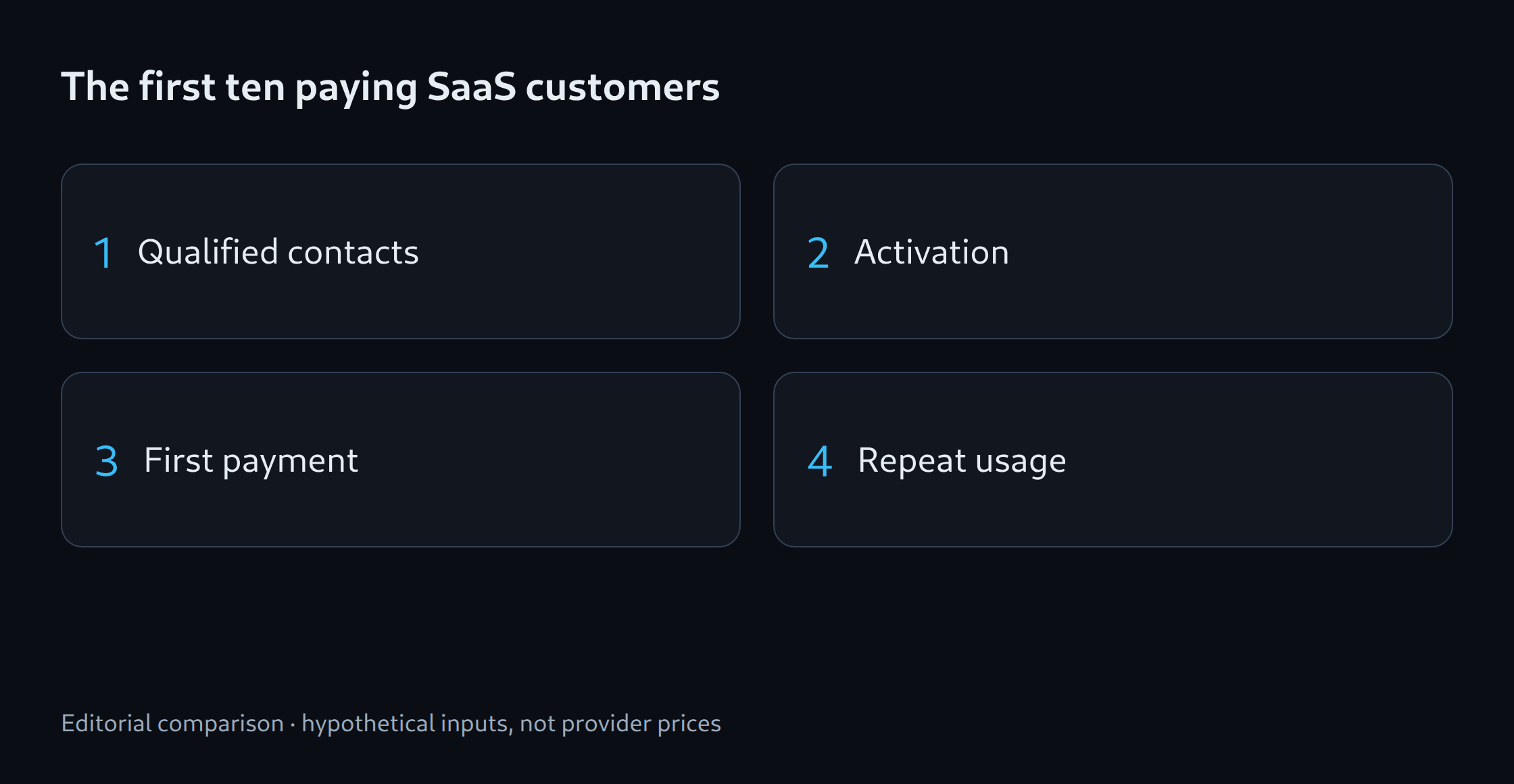
A funnel tracks how many interested people move from one step to the next. Comparable measures are suitable contacts, the first useful result in the product, the first payment and repeat use after four weeks. A suitable contact has the chosen problem and could become a customer. Attending a demo is only a sales step; activation still requires a problem actually solved. A signed pilot agreement is not proof of use either. Contacts from the same period and channel form a separately measured group, also called a cohort. In a paid pilot, the first payment may precede activation.
Founder time belongs in the cost. Ten hours of conversations, setup and follow-up constitute acquisition spending even without an advertising invoice. Paul Graham describes personal work with early customers as a useful part of launching. That does not mean the same time commitment remains affordable with many more customers. [1]
Worked example: ten customers require a mechanism
This simplified example covers free entry and uses one currency. Every input is assumed: 2,000 suitable visits at a 5% signup rate produce 100 registrations. Half reach the first useful result, leaving 50. If 20% of that group pays, the calculation gives ten paying customers. Marketing spending of 400 currency units plus ten sales hours at 40 totals 800. Dividing by ten gives a customer acquisition cost, or CAC, of 80 per customer.
A net price of 29 minus variable monthly costs of nine leaves 20 per customer each month to cover other costs. This is the contribution margin. With no cancellations, also called churn, and no additional costs, four monthly contributions recover the initial acquisition cost of 80. Halving payment conversion increases CAC to 160 and payback to eight months. The calculator exposes this dependency; actual sales remain whole numbers and fluctuate.
A two-week experiment with a stopping rule
Week one gathers conversations about one problem, the existing substitute and the budget owner. Week two tests one entry route with a fixed offer. Predetermined limits prevent endless unpaid assistance: maximum setup effort, a minimum number of suitable contacts and a review date.
Success requires paid use and identifiable value. Few first useful results may indicate product or setup difficulties. Useful results without payment may reflect price, the target audience or a free tier that already meets the need. Conversations must test these explanations. Additional traffic does not automatically solve either problem. Further development should remove the specific obstacle observed, such as a setup step that is often abandoned.
Related tools
Sources
Sources checked: 26 October 2026.
Questions and answers
Is free entry always cheaper than a demo?
No. Support, setup and missing conversions can outweigh saved conversation time. A comparison needs fully recorded acquisition costs per first payment.
Are ten customers enough to prove a market?
Ten customers provide initial evidence for a narrow problem. Repeat usage, renewals and further independently acquired customers remain necessary.
Related articles