Automated Price and Inventory Monitoring for Meta Ads via Python & Scripts

Contents
Running paid acquisition campaigns on Meta Ads (Facebook and Instagram) without real-time inventory and competitive price synchronization frequently leads to severe budget waste. When algorithmic ad delivery promotes out-of-stock stock keeping units (SKUs) or products priced uncompetitively against market benchmarks, click-through rates drop, bounce rates increase, and Return on Ad Spend (ROAS) collapses. Deploying an automated Python monitoring pipeline that continuously queries backend ERP/e-commerce inventory alongside competitor price scraping feeds—and communicates directly with the Meta Marketing API—enables the programmatic pausing and resuming of specific ads or ad sets without manual intervention.
1. Architectural Framework: Decision Engine & API Logic
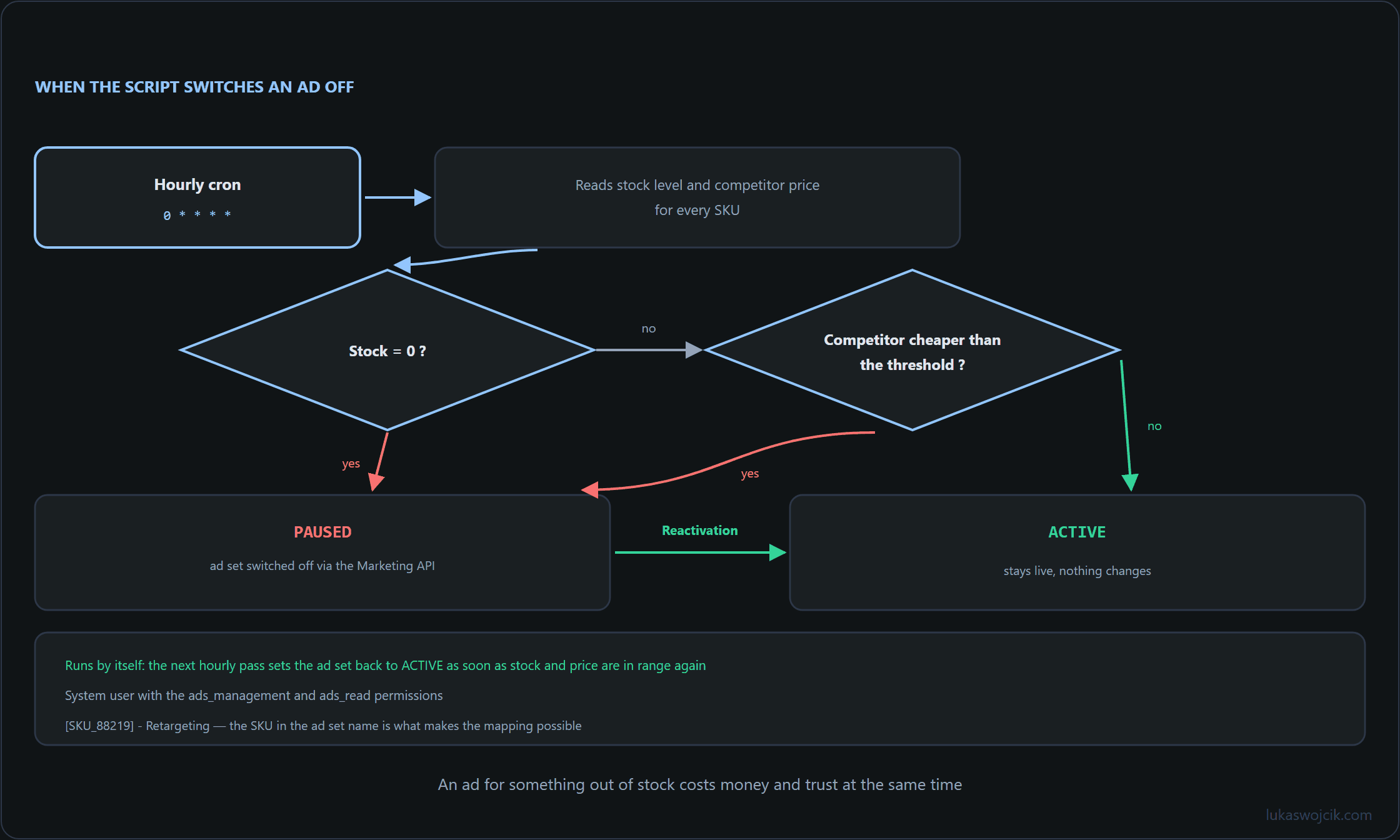
An automated ad control system relies on a decoupled Python microservice executing scheduled validation loops. The operational architecture is built upon three core rules:
- Absolute Inventory Zero-Stock Rule: If an SKU’s available stock drops to
0, any active Meta ad or ad set mapped to that specific product ID must be transitioned to thePAUSEDstate immediately. - Competitive Price Margin Threshold: If a competitor’s scraped price for an identical SKU is more than 8% lower than the internal catalog price, conversion probability drops significantly. Affected ads must be paused until algorithmic repricing restores price competitiveness.
- Automated Reactivation: Once stock is replenished or pricing is re-aligned with market benchmarks, the pipeline must automatically update the Meta entity status back to
ACTIVE.
2. Step-by-Step Meta Marketing API Preparation
To enable programmatic ad status modification, secure authentication and entity mapping must be configured within the Meta Business Manager:
- System User Provisioning: Within Meta Business Manager, navigate to Users > System Users and create an Admin System User. Generate a permanent access token with the
ads_managementandads_readpermission scopes. - SKU-to-Ad Mapping Convention: To avoid expensive database lookups, implement a strict naming convention in Meta Ads. Append the SKU identifier directly into the Ad Name or Ad Set Name using brackets (e.g.,
[SKU_88219] - Retargeting - Dynamic Card). - Graph API Versioning: All HTTP requests must target the stable Meta Graph API endpoint (v20.0 or later) using JSON-encoded request payloads.
3. Step-by-Step Python Monitoring Script Implementation
The following production-grade Python script queries an internal product feed, evaluates stock and competitor pricing rules, and updates Meta ad statuses via REST API calls:
import os
import requests

# Configuration & Credentials
META_ACCESS_TOKEN = os.getenv('META_ACCESS_TOKEN', 'YOUR_SYSTEM_USER_TOKEN')
AD_ACCOUNT_ID = os.getenv('AD_ACCOUNT_ID', 'act_1234567890')
GRAPH_API_VERSION = 'v20.0'
BASE_URL = f'https://graph.facebook.com/{GRAPH_API_VERSION}'

# Sample data structure returned by internal ERP / Competitor Scraping Engine
product_feed_state = [
    {'sku': 'SKU_88219', 'stock': 0, 'price': 129.99, 'competitor_price': 129.99},
    {'sku': 'SKU_44102', 'stock': 14, 'price': 199.99, 'competitor_price': 175.00}, # Uncompetitive (>8% diff)
    {'sku': 'SKU_99301', 'stock': 45, 'price': 89.99, 'competitor_price': 89.99}
]

def get_target_ad_status(item):
    """Evaluates whether an SKU should be active or paused."""
    if item['stock'] <= 0:
        return 'PAUSED', 'Out of stock'

    price_diff_ratio = (item['price'] - item['competitor_price']) / item['competitor_price']
    if price_diff_ratio > 0.08:
        return 'PAUSED', f'Price uncompetitive ({price_diff_ratio:.1%} above benchmark)'

    return 'ACTIVE', 'Optimal state'

def update_meta_ad_status(ad_id, new_status):
    """Updates the status of a specific Meta Ad."""
    url = f'{BASE_URL}/{ad_id}'
    payload = {'status': new_status, 'access_token': META_ACCESS_TOKEN}
    response = requests.post(url, data=payload, timeout=10)
    return response.status_code == 200

def run_monitoring_pipeline():
    """Main execution loop scanning ads and applying status rules."""
    ads_url = f'{BASE_URL}/{AD_ACCOUNT_ID}/ads'
    params = {
        'fields': 'id,name,status',
        'filtering': '[{"field":"status","operator":"IN","value":["ACTIVE","PAUSED"]}]',
        'access_token': META_ACCESS_TOKEN
    }

    response = requests.get(ads_url, params=params, timeout=15)
    if response.status_code != 200:
        return

    ads_data = response.json().get('data', [])

    for item in product_feed_state:
        target_status, reason = get_target_ad_status(item)
        sku_tag = f'[{item["sku"]}]'

        for ad in ads_data:
            if sku_tag in ad.get('name', '') and ad.get('status') != target_status:
                success = update_meta_ad_status(ad['id'], target_status)
                if success:
                    print(f'Transitioned Ad {ad["id"]} ({ad["name"]}) to {target_status}. Reason: {reason}')

if __name__ == '__main__':
    run_monitoring_pipeline()
4. Step-by-Step Automated Cron Scheduling & Alerting
To operate autonomously without manual oversight, the script must be scheduled on a staging server and connected to alerting webhooks:
- Server Cron Deployment: On a Linux server or Raspberry Pi, open the cron schedule via
crontab -eand configure hourly execution:0 * * * * /usr/bin/python3 /opt/scripts/meta_price_monitor.py >> /var/log/meta_monitor.log 2>&1 - Webhook Alert Integration: Add an HTTP POST request within the status update loop to dispatch Slack or PagerDuty alerts whenever an ad status state transitions, ensuring performance marketing teams remain informed of pricing anomalies.
5. Summary & Architectural Value
What this tutorial achieves: The successful deployment of an automated Python monitoring pipeline that continuously evaluates SKU inventory levels and competitor price benchmarks, dynamically pausing and resuming Meta Ads via the Graph API.
Resulting value: Wasted ad spend on out-of-stock products is completely eradicated. Advertising budgets are automatically protected against uncompetitive market pricing, preventing negative ROAS cycles. Furthermore, automated reactivation upon inventory restocking ensures zero lag in campaign delivery, maximizing overall acquisition efficiency.
Related articles