English
 Deutsch
 Polski
Zero-Server-Side Browser Tools: Designing Secure Utilities in Vanilla JavaScript

Contents
- Zero-Server-Side Browser Tools: Designing Secure Utilities in Vanilla JavaScript
- 1. Eliminating Backend Exposure Through Client-Side Architecture
- 2. Leveraging Native Web APIs: TextEncoder, TextDecoder, and Web Crypto API
- 3. Architectural Patterns for Privacy-First Toolbox Utilities
- Summary
- Questions and answers
- Sources
Zero-Server-Side Browser Tools: Designing Secure Utilities in Vanilla JavaScript
Modern web engineering increasingly requires tools that process sensitive Personally Identifiable Information (PII) without transmitting a single byte over the network. Designing zero-server-side utilities in pure Vanilla JavaScript ensures compliance with strict regulatory frameworks like GDPR and ePrivacy by eliminating backend PII exposure entirely. Operating purely within the browser sandbox guarantees absolute data confidentiality and zero-latency execution.
1. Eliminating Backend Exposure Through Client-Side Architecture
Traditional web tools often use REST API endpoints for cryptographic hashing, data parsing or text transformations. This creates privacy risks: server access logs, load balancer traces and application telemetry can accidentally retain raw user data. Moving all computation to the user’s device makes the browser a self-contained, isolated processing environment.
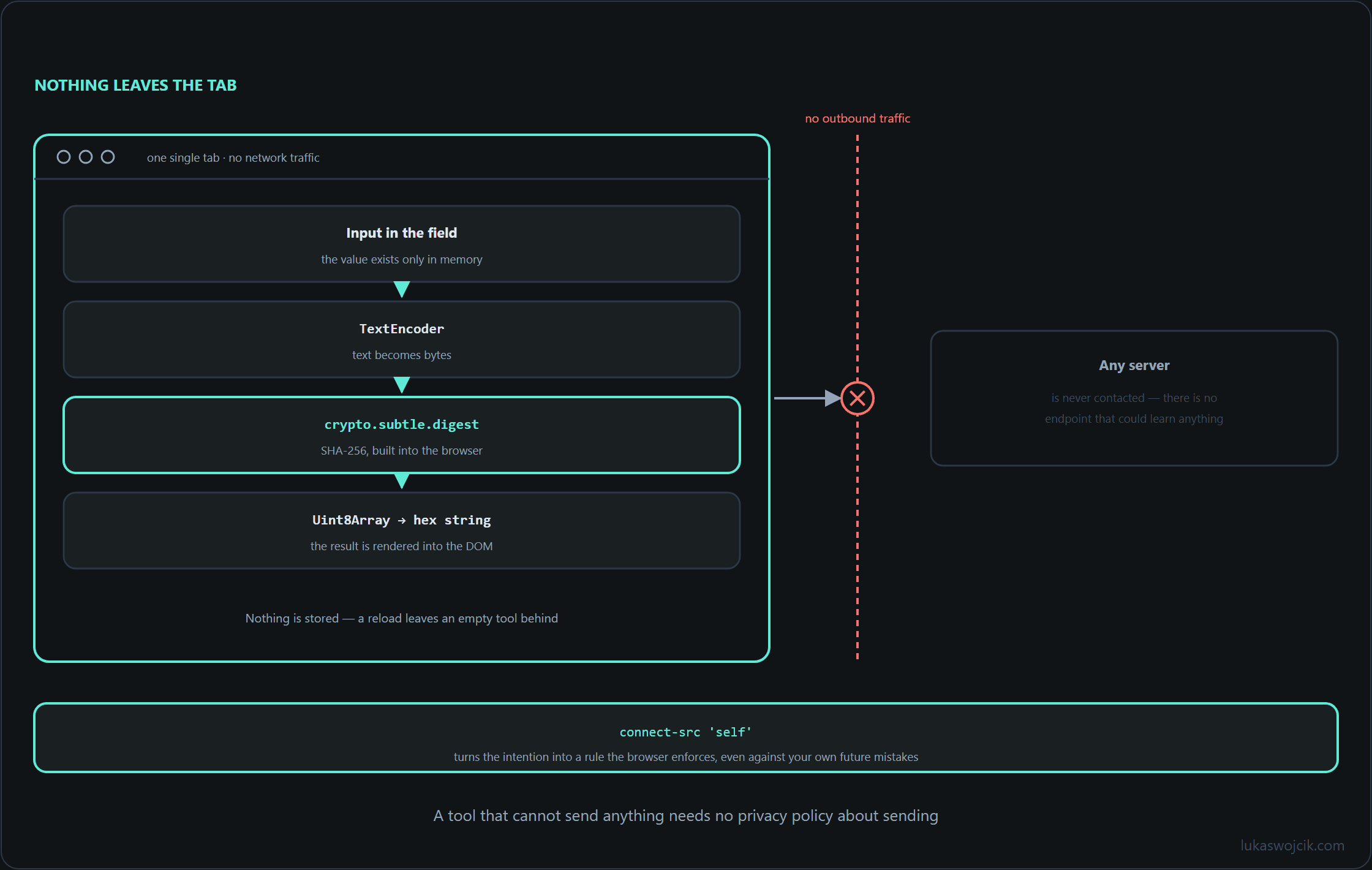
- Zero-Network Footprint: Event listeners trigger local memory transformations without initiating HTTP requests, preventing accidental interception via man-in-the-middle (MitM) attacks or server breach exploitation.
- Stateless Sandbox: Since no database persistence or remote session storage is utilized, clearing the browser tab memory permanently purges all processed inputs.
2. Leveraging Native Web APIs: TextEncoder, TextDecoder, and Web Crypto API
Modern browser engines provide highly optimized, native APIs that outperform external JavaScript cryptography libraries while maintaining superior security standards:
- TextEncoder & TextDecoder: These interfaces handle character encoding conversion directly at the engine level, transforming DOM strings into UTF-8
Uint8Arraybyte streams without memory bloat. - Web Crypto API (
window.crypto.subtle): Offers asynchronous, hardware-accelerated cryptographic operations. Generating SHA-256 digests or HMAC signatures occurs inside secure browser threads, preventing thread-blocking in high-volume data loops.
// Example: Zero-Server-Side SHA-256 Hashing using Native Web Crypto API
async function generateClientSideHash(plainText) {
  const encoder = new TextEncoder();
  const data = encoder.encode(plainText.trim().toLowerCase());
  const hashBuffer = await crypto.subtle.digest('SHA-256', data);
  const hashArray = Array.from(new Uint8Array(hashBuffer));
  return hashArray.map(byte => byte.toString(16).padStart(2, '0')).join('');
}
3. Architectural Patterns for Privacy-First Toolbox Utilities
Constructing enterprise-grade client-side utilities requires strict architectural boundaries:
- Content Security Policy (CSP) Hardening: Implementing strict CSP headers that deny outbound connection directives (such as restricting
connect-src 'self') mathematically prevents third-party injection scripts from exfiltrating local DOM variables. - DOM Lifecycle Decoupling: User inputs should be processed within isolated Web Workers when handling large datasets, keeping the user interface responsive while preventing third-party trackers from monitoring main-thread execution frames.
Summary
Zero-server-side browser tools represent the gold standard for privacy-preserving web utilities. By combining native Web Crypto API capabilities with strict Vanilla JavaScript execution pipelines, developers can build powerful analytical and cryptographic utilities that eliminate server-side PII risks by design.
Questions and answers
Can the absence of network traffic from a browser tool be made evident to a visitor who will not read the source code?
Yes, in three ways, from the strongest guarantee to the most visible demonstration.
The strongest is the policy itself: connect-src 'none' in the response header means the browser refuses every connection a script on the page tries to open through fetch, XMLHttpRequest, a WebSocket or a beacon, regardless of what the script contains. Image requests and form submissions fall under their own directives, img-src and form-action, which belong in the same policy. That is enforced by the browser rather than promised by the author, and it can be read in one request by anyone who knows where to look — including an auditor who does not trust the author at all.
The second is the absence of third-party sources: no analytics, no font from a foreign host, no library from a content delivery network. A page that loads only from its own origin runs no foreign code that could try to send anything in the first place.
The third is the browser’s own network tab: opened while the tool is in use, it shows no request after the page has loaded. That is the demonstration most people will actually perform, and it is why the first two matter: they make the demonstration hold on every future visit rather than on the one that was watched.
Sources
Related articles