English
 Deutsch
 Polski
How Cookieless Pings Work in Google Consent Mode
Part 2 of 4 in the series Wiring consent correctly

Contents
When deploying Consent Mode v2, data architects must choose between two distinct implementation frameworks: Basic and Advanced. The critical difference lies entirely in how the system handles users who deny consent or ignore the banner.

Basic Consent Mode (Hard Blocking)
In a Basic implementation, Google tags are completely blocked from executing until the user explicitly grants consent.
- How it works: The Tag Management System is configured to act as a strict gatekeeper. If the user clicks “Deny,” the tags remain dormant.
- The Result: Zero data—not even a network request—is sent to Google. While this is the absolute safest route for strict compliance, it results in a massive data blackout. All visibility into unconsented users is lost, which makes accurate modeling impossible.
Advanced Consent Mode (Cookieless Pings)
This is the setup Google strongly recommends and where the true engineering power of Consent Mode shines.
- How it works: Google tags load immediately when the page opens, but they are dynamically restricted based on the default consent state. If the user denies consent, the tags do not read or write any cookies. Instead, they send anonymized, cookieless “pings” to Google’s servers.
- The Result: These pings carry non-identifying functional data (e.g., timestamps, user agents, referrers, and basic event data). Because no personal identifiers or cookies are utilized, this method respects user privacy choices while still supplying Google’s backend with the raw, aggregated signals necessary for machine learning.
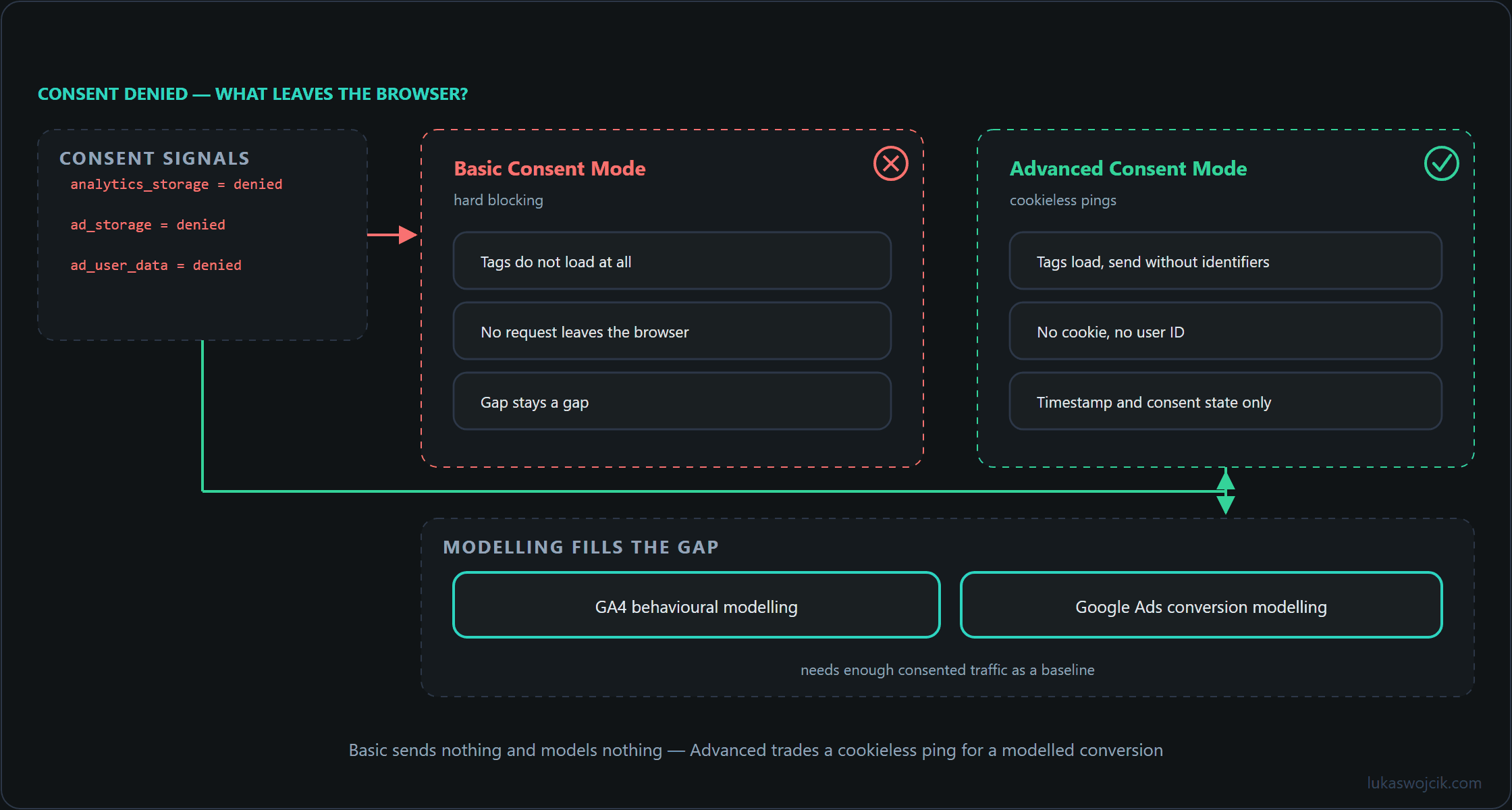
How GA4 and Google Ads Model Data with Advanced Consent Mode
The cookieless pings collected via Advanced Consent Mode form the mathematical foundation for Google’s machine learning models. Without these pings, Google has no baseline to extrapolate from. Here is exactly how the platforms translate those anonymous signals into actionable reporting and bidding data.
GA4 Behavioral Modeling
When a user denies analytics_storage, GA4 cannot generate or read a standard Client ID cookie to stitch their pageviews into a coherent session.
To solve this, GA4 utilizes Behavioral Modeling. The system analyzes the complete, observable journeys of the consented users to train its machine learning models. It then applies these models to the cookieless pings generated by the unconsented ones. The algorithm probabilistically estimates how many unique users visited, how many sessions occurred, and which events were triggered. In the GA4 interface (with the reporting identity set to “Blended”), this prevents a massive, artificial drop in the traffic metrics and preserves the accuracy of the overall conversion rates.
Google Ads Conversion Modeling
If a user clicks an ad but denies ad_storage and ad_user_data, Google Ads cannot use traditional tracking cookies (like the GCLID or DCLID) to attribute their subsequent purchase back to the initial click.
However, because Advanced Consent Mode allows a cookieless conversion ping to fire, Google knows a purchase did occur. Google’s engine uses Conversion Modeling to analyze aggregate data—such as time from ad interaction, device type, browser, and geographic region—to probabilistically link the anonymous conversion ping back to an ad click.
This mechanism is the lifeblood of Smart Bidding. Algorithms like Target CPA (tCPA) or Target ROAS (tROAS) require a steady stream of conversion data to optimize bids. Without Conversion Modeling, the algorithm would blindly assume the ads stopped working, causing ad delivery to throttle and campaign performance to collapse.
Questions and answers
Is there a case where Basic Consent Mode is genuinely the right choice rather than a compromise?
There are two, and they are worth naming precisely because most basic implementations are neither of them.
The first is a legal position. Where a review has concluded that no request at all may leave the browser before consent, a stricter reading than the one advanced mode assumes, basic is the only implementation that matches the decision, and the data loss is the accepted price rather than an accident. The second is volume: below the modeling thresholds, advanced mode buys reporting benefits that never materialize. The pings still feed the ad platforms, so advanced mode keeps its value wherever there is ad spend; on a site without any, there is little for it to improve.
Outside those two, basic is usually not chosen at all. It arrives by accident, when a blocking trigger is added to a Google tag that would have handled consent itself: the container is then configured as advanced and behaves as basic. That is the case worth checking for, and it takes one look at the network tab with consent declined.
Wiring consent correctly
- How to Implement Google Consent Mode v2
- How Cookieless Pings Work in Google Consent Mode
- GA4 Consent Mode v2: The gcd Parameter, CMP Race Conditions and Server-Side Debugging
- How to Pass Consent Status to Server-Side GTM
Related articles