English
 Deutsch
 Polski
Matomo Tracking API: Server-Side Hits, Mandatory Parameters and the Mistakes That Still Return 200

Management Summary
Matomo’s tracking interface lets business applications report purchases and other activity directly to website analytics. This is useful for confirmed transactions that are known in company systems but not reliably captured in a browser. The connection can improve reporting coverage, provided each activity reaches the intended website and is assigned the correct time and visitor. A successful delivery response only confirms communication; incorrect details can still leave misleading or missing results in the reports.
Contents
Matomo can record a page view, event or goal through an HTTP request to matomo.php. Server-side tracking also covers activity outside the browser, such as a confirmed order or subscription cancellation. A hit means one tracking request; a visit can contain several hits.
HTTP is the request-and-response protocol used on the web. The API is Matomo’s interface for receiving data from software. A response code such as 200 or 204 reports the outcome at that interface; the stored action and its assigned site still need checking. A queue holds tracking requests for later processing.
A successful HTTP response does not prove correct recording in the intended site. Normal responses often contain a transparent GIF; send_image=0 requests HTTP 204 without an image. Transport, processing and attribution need separate checks, especially with excluded traffic or a tracking queue.
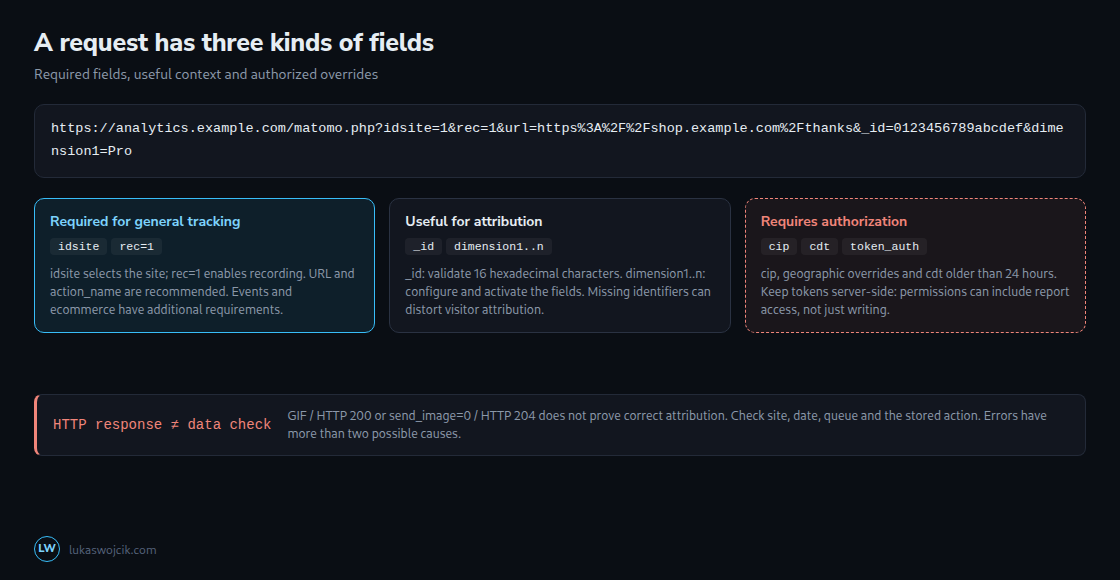
Required fields and action-specific parameters
The general API requires idsite and rec=1: the site identifier and the recording switch. url and action_name are recommended, not general mandatory fields. A meaningful page URL and title still make reports easier to interpret.
Additional requirements depend on the action: events need non-empty e_c and e_a; configured goals use idgoal. Ecommerce orders need the ecommerce fields, including order ID and revenue. Text values need URL encoding so that characters such as spaces or ampersands are not mistaken for separators in the request. A valid page-view request is not automatically a valid purchase request.
Visitor identity and visit boundaries
The documented _id format is exactly 16 hexadecimal characters: digits 0–9 and letters a–f. UUIDs and full MD5 hashes are unsuitable input formats. However, the inspected Matomo 5.x implementation can truncate a longer _id before decoding rather than reject it. The sender should validate the documented format instead of relying on that behavior.
Without a usable visitor ID, Matomo can use a temporary configuration identifier based on attributes such as IP address, browser and language. Identical server attributes can merge unrelated activity. This does not force every hit into one visit for an entire day: identification and visit boundaries differ, with a default inactivity timeout of 30 minutes. A high event count alone cannot distinguish a batch job from bot traffic.
Dimension ID and scope
A dimension is an additional reporting field, such as a subscription tier. Its scope determines whether the value belongs to a whole visit or a single action.
dimension1 refers to dimension ID 1 configured for the selected site. The dimension must exist and be active; the number does not create a new field automatically.
A visit-scoped dimension retains the last supplied value for that visit. An action-scoped dimension stores a value for the individual action. A current subscription tier can describe a visit; a tier selected during one event can describe that event. Both scopes allow reports to be filtered to matching visits or actions, for example those with a particular subscription tier.
Authorization, timestamps and retention
cip overrides the IP address; geographic overrides and older timestamps also require authorization. cdt accepts a UTC datetime (the common time reference without a local timezone offset) or a Unix timestamp (seconds since 1 January 1970 UTC). A date within the last 24 hours does not normally require a token solely because of cdt; an older date does. Missing authorization can cause an error, but HTTP 400 is not a complete or universal diagnostic rule.
A token is a secret access credential. A tracking token is not a write-only credential. Depending on permissions, token_auth also retrieves reports or performs administrative operations. A dedicated account should have only the required site-level write access. Matomo 5 tokens inherit account rights; Matomo 6 additionally supports a token access-level cap. Tokens belong in server-side secrets and HTTPS POST bodies, not browser code or URL logs. Tokens restricted to secure requests require the supported POST mechanism.
Importing earlier activity requires checking how long individual tracking records (raw data) are kept. The inspected 5.x implementation rejects dates beyond its configured deletion cutoff, including the deletion schedule interval. Invalid or future dates can fall back to the request time, so the stored date needs verification. Historical reports then need reprocessing; this cannot restore raw records already deleted.
Diagnosing missing or misassigned hits
| Cause | What is seen |
|---|---|
| Missing rec=1 | Recording is not enabled. |
| Wrong idsite | A valid but wrong site ID can misattribute data; an unknown site can cause an error. |
| Invalid or missing _id | Visitor attribution can change; the sender needs to check for 16 hexadecimal characters. |
| Old cdt without authorization | Dates older than 24 hours require authorization; the response and stored date need checking. |
| Inactive or unknown dimension | The site, dimension ID and activation need checking. |
| Queue or exclusion | Queue delays, bot handling and exclusion rules can explain a missing action. |
A visits-log entry confirms storage of the displayed action. Absence alone does not prove rejection: the site, date, time zone, segment, availability of log views and tracking queue need checking. A small test in a separate test site helps. Temporary tracker debug logging on a self-hosted Matomo installation (On-Premise) or queuedtracking=0 can isolate processing problems; tokens and visitor data must not be exposed during diagnosis.
Questions and answers
Where does a server get a valid _id when the same visitor is also tracked in the browser?
The JavaScript tracker provides getVisitorId() through a callback, a function run when the tracker processes the queued instruction, in the _paq queue after initialization. This avoids depending on cookie names or internal layouts. An approved browser-to-server handoff can attach that ID to the triggering action. Matching identifiers help attribution but do not override visit boundaries or privacy settings.
For authenticated accounts, Matomo recommends uid rather than forcing a visitor ID through cid. A stable internal identifier avoids unnecessarily sending an email address. Hashing a predictable customer number is not anonymization and may be reversible by enumeration. Identifier use must follow the measurement design and required consent; cookieless measurement does not automatically justify a permanent customer identifier.
Why do server-side hits all show the same location?
A direct backend request usually carries the sending server’s network address. Its location can describe the server or remain inaccurate. Authorized cip can supply a separately established visitor address; trusted-proxy configuration also affects address extraction. A proxy forwards requests between systems. Headers are request metadata; forwarded address fields are trustworthy only when their source and the proxy configuration have been checked. Browser language and the geolocation provider can affect the result, so a data-centre location is a clue rather than a certainty.
Related articles