English
 Deutsch
 Polski
From Free Online Tool to SaaS: Which Feature Justifies a Subscription?

Management Summary
A free online tool often performs a single check. SaaS is continuously provided online software that can be sold as a subscription. Using a website checker, the article explains what can justify that step: recurring checks, understandable alerts about new problems and recorded results. The reason to pay is repeated work saved. An account alone does not supply that benefit, and the price must also cover support and operation. The example is a possible product, not evidence of existing demand.
Contents
A free calculator answers a question. A paid product takes responsibility for a task. An account alone is not enough. A subscription needs recurring value, such as automatic checks with a clear alert when new errors appear. A paid download button rarely supplies that reason to buy.
The example is a hypothetical website checker. A free version checks a pasted file once in the browser. A possible SaaS, meaning continuously provided online software, compares recurring checks, reports new findings and records resolution. This does not introduce a paid service on this website.
Four extensions compared
| Feature | Reason to buy | New obligation |
|---|---|---|
| Saved projects | Avoid repeating settings | Export, deletion, access protection |
| History | Separate new errors from old ones | Stable, explained checking rules |
| Monitoring | Notice issues without individual checks | Reliable runs and alerts |
| Team and programming interface (API) | Send results to other programs automatically | Access permissions, usage limits and assigned responsibilities |
From finding to action
A hundred warnings save little work if their meaning remains unclear. A paid workflow might report only new critical findings, show the last successful run and assign responsibility. Suppression needs reasons and expiry dates so that problems do not disappear permanently.
A server-side checker must not let a submitted address trigger requests to internal services, such as an administration page on its own network. This attack is called SSRF. Address checks, controlled redirects and appropriate network restrictions are therefore part of the protection. [3] A robots.txt file is a crawling instruction, not access protection. Protected data needs other controls. These limits belong in the pilot. [2]
What a small subscription must cover
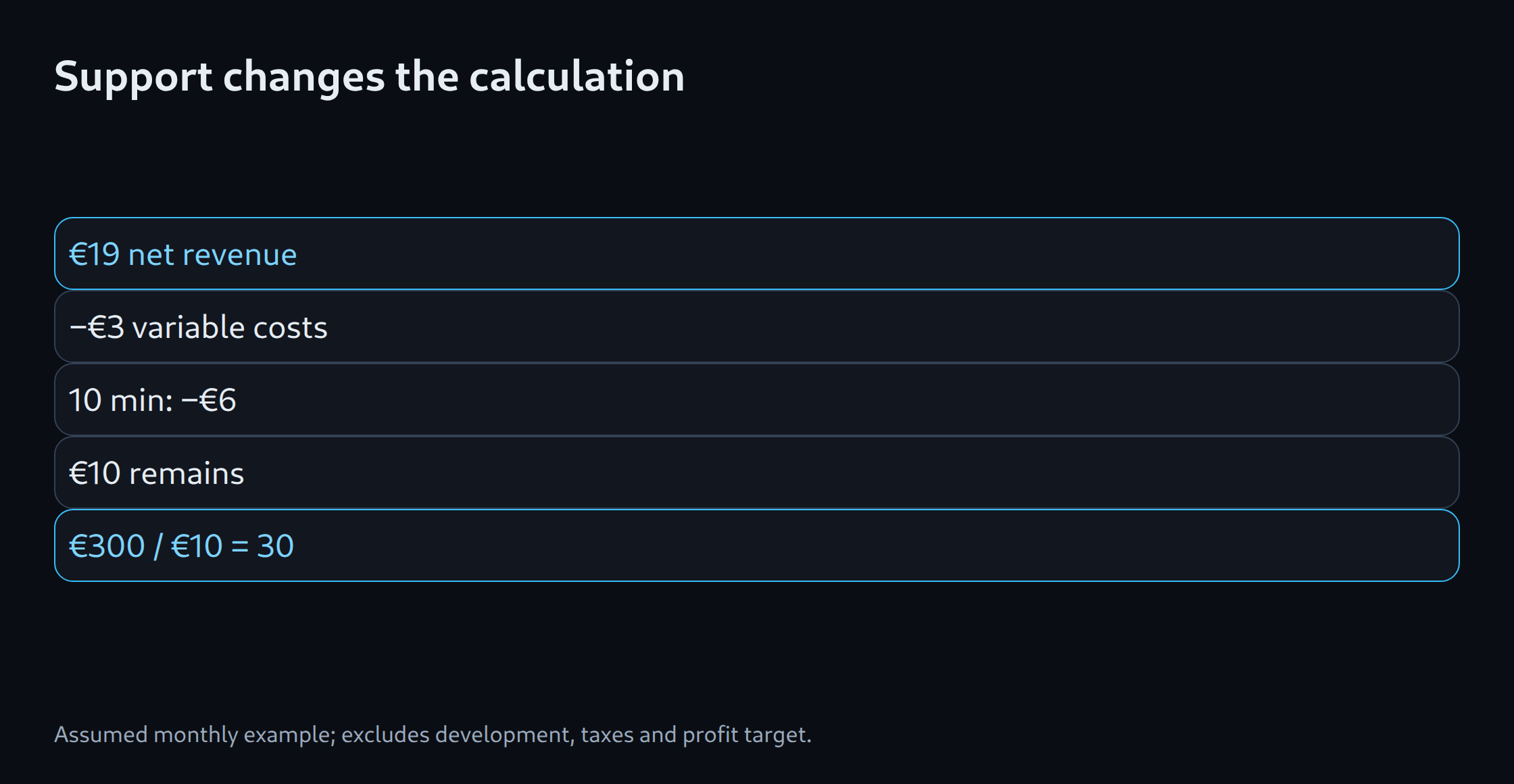
All net figures below are assumptions, not vendor prices: €19 monthly revenue, €3 for payments and variable infrastructure, and ten minutes of support valued internally at €36 per hour. Support costs €6, leaving €10 before fixed costs, development and taxes.
With assumed fixed monthly costs of €300, 30 comparable customers are required. Twenty minutes of support costs €12, leaves €4 and raises the break-even point to 75 customers. Clear findings and useful instructions can reduce support questions. That leaves more money from the same subscription price to cover fixed costs.
A meaningful usage unit
Monitored projects or completed checks are easier to explain than internal API calls. Stripe documents usage billing; the product must define which operations count. Repeats caused by internal errors should not count as a second service delivered to the customer. [1]
A bounded pilot includes one project, a check cycle, a change report and an agreed exit. Another run needs a concrete reason, such as a new website release or an agreed weekly check. The free single check can remain available; payment covers the recurring checks, alerts and recorded results.
Related tools
Questions and answers
Is saved history enough for a subscription?
Only when comparison repeatedly saves relevant work. Storage alone does not establish recurring value.
Does the example forecast 30 customers?
No. It calculates break-even under assumed costs without proving demand.
Sources
- Stripe: Usage-based billing
- Google: Robots.txt limitations
- OWASP: preventing server-side request forgery (SSRF)
Sources checked: 26 October 2026.
Related articles