English
 Deutsch
 Polski
Micro-SaaS with n8n, Make or Custom Code: What Operation Really Costs

Management Summary
n8n and Make are platforms for connecting work steps into automated processes. Small online products can build on them or use custom software. Through an example that checks product data, the article explains the differences in operating effort. A platform can simplify getting started, while custom code offers different control over the result. The meaningful cost is that of a reliably completed customer task, including support and recovery. A quick prototype does not reveal all that work.
Contents
An initial automated sequence of steps, or workflow, becomes visible quickly. A sellable product also needs separate data and access for each customer, correct billing, understandable error handling and help when something goes wrong. Comparing n8n, Make and custom code therefore requires the same customer task rather than a count of integrations.
One reference workflow
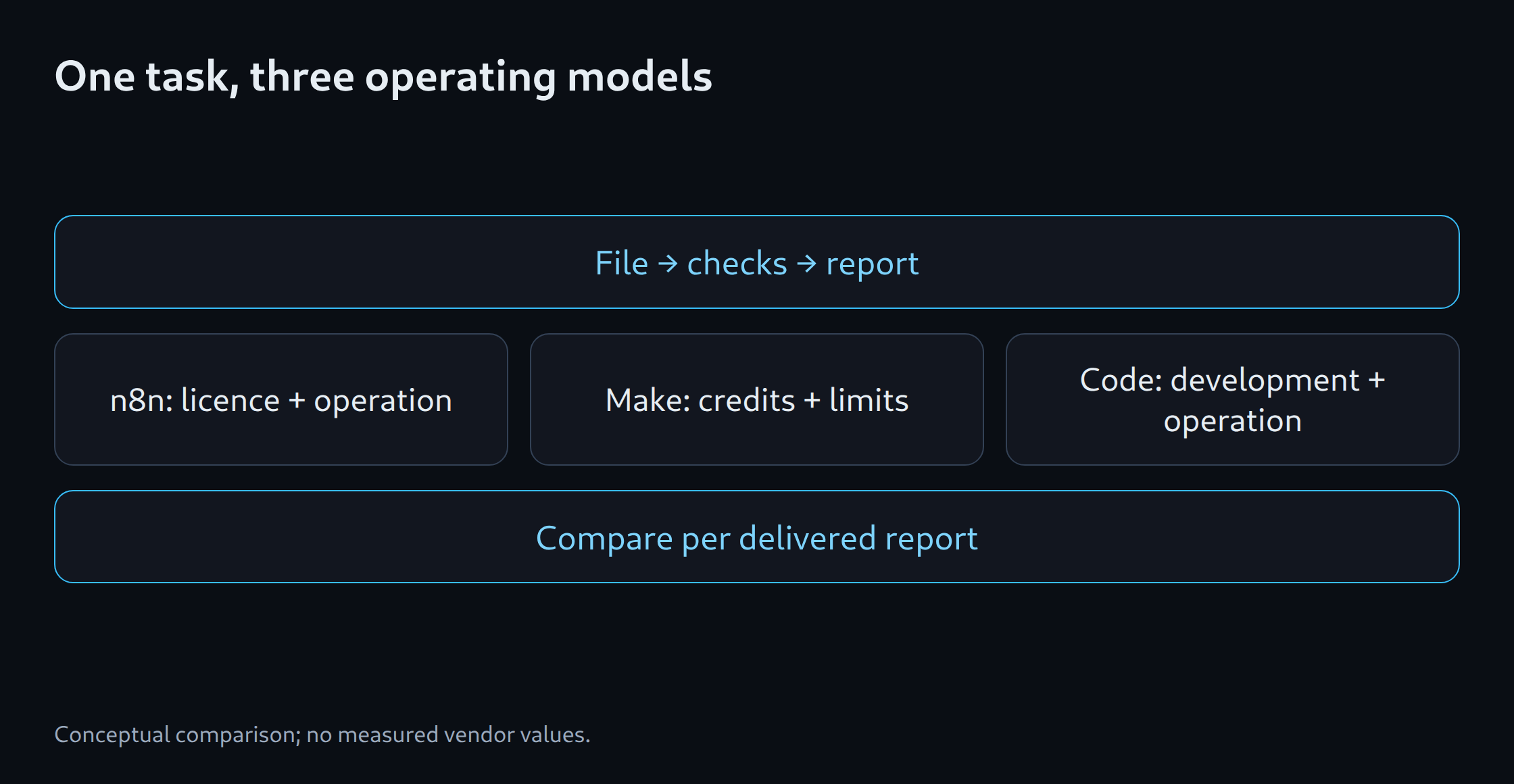
The assumed product accepts a product file, validates required fields, compares prices with a previous baseline and delivers a report. Every route uses identical sample files, expected results and size limits. Three completed implementations were not tested here; this is a design and evaluation protocol.
| Route | Strength | Check |
|---|---|---|
| n8n | Visible workflows, infrastructure control when self-hosted | Licensing, updates, access credentials and separate customer data |
| Make | Managed platform and quick integrations | Billing units, data volume, limits and moving to another provider |
| Custom code | Precisely defined processing and tests | Development, operation, software components and responding to outages |
Licensing before architecture
Current n8n guidance allows internally built customer workflows on a self-hosted Community instance. Its licence FAQ also permits connected customer accounts when customers cannot create or change workflow logic. Customer-owned credentials alone therefore do not imply an Enterprise requirement. A key question is who can design the automation rules. Letting customers do that through a custom interface can still require a commercial licence. Hosting n8n as a service, offering it under another brand (white-labelling) and licensed features have further restrictions. The actual use must meet the applicable terms. [1, 4]
Consumption per customer task
Make bills through credits, meaning units of the purchased usage allowance. Consumption depends on the modules and processing; AI and code steps can count differently. A statement such as “ten steps” is not a cost forecast. [2]
Assuming eight billable actions per record across 500 records gives 4,000 actions before retries or branches. This is synthetic volume arithmetic, not a measured Make bill or a general rule for credit conversion.
Failure handling defines the service
Evaluation needs an empty file, missing fields, a timeout after saving a result, a duplicated job and revoked access. A stable job identifier only helps if the server records status and results against it and coordinates concurrent retries. For example, after a connection fails, the completed report is delivered again without repeating the work or payment. This behavior is called idempotency. Stripe documents it for supported payment requests; the product’s own job processing must implement it too. [3] Operational logs need to associate errors with the right customer without unnecessarily keeping complete customer files.
The protocol records development hours, successful jobs, retries, platform consumption, support and recovery time. Only a delivered complete report counts as service. Custom code also carries update, monitoring and on-call costs.
Choosing a route
A platform can simplify a bounded integration pilot. Specific validation rules, large datasets or strict isolation justify comparing custom code. A hybrid can keep customer jobs and billing in the backend while using a platform for selected integrations. The common reference task, rather than tool preference, supplies the decision.
Related tools
Questions and answers
Is self-hosted n8n automatically free for SaaS use?
Not every use is automatically free. The current Community licence can permit internally built customer workflows; a customer-facing workflow builder or other excluded uses need an appropriate commercial agreement.
Was a speed winner measured?
No. The article defines a comparable evaluation protocol rather than reporting runtime tests.
Sources
- n8n: Commercial licensing
- Make: Pricing and credits
- Stripe: idempotent requests
- n8n: detailed licence FAQ
Sources checked: 26 October 2026.
Related articles