English
 Deutsch
 Polski
Subscription, Credits or Payment per Outcome: Pricing an AI SaaS

Management Summary
Online software with AI can be sold through a monthly subscription, prepaid units or a charge per completed task. The article compares these models using document checks. They distribute costs and predictability differently between provider and customer. Heavy use can make a low-priced flat plan cost more than it earns. Clear service allowances and effective spending limits help avoid surprises. A completed report is an observable result, but not a guarantee of business success.
Contents
The cost of an AI feature can rise with usage. Long documents, retries and additional checks require more computing resources. With a fixed monthly price, heavy users can cost more than the subscription brings in. Usage charges can reduce that mismatch, but make the bill less predictable.
One application, four models
The example product checks documents. A report becomes billable after all agreed checks are complete and the result is saved. Rules must also define which defects require correction or a refund. A single model call is not enough: one report may require several attempts. Stripe documents billing for measured usage. The product must define what counts as a billable report. [1]
| Model | Benefit | What needs defining |
|---|---|---|
| Flat subscription | Predictable budget | Heavy users change costs |
| Credits | Units that can be prepaid | Price per task and a stop rule |
| Per outcome | Payment for an agreed report | Completion, defects and refunds |
| Base fee plus usage | Base price plus additional reports | More explanation and billing logic |
An explicitly assumed example
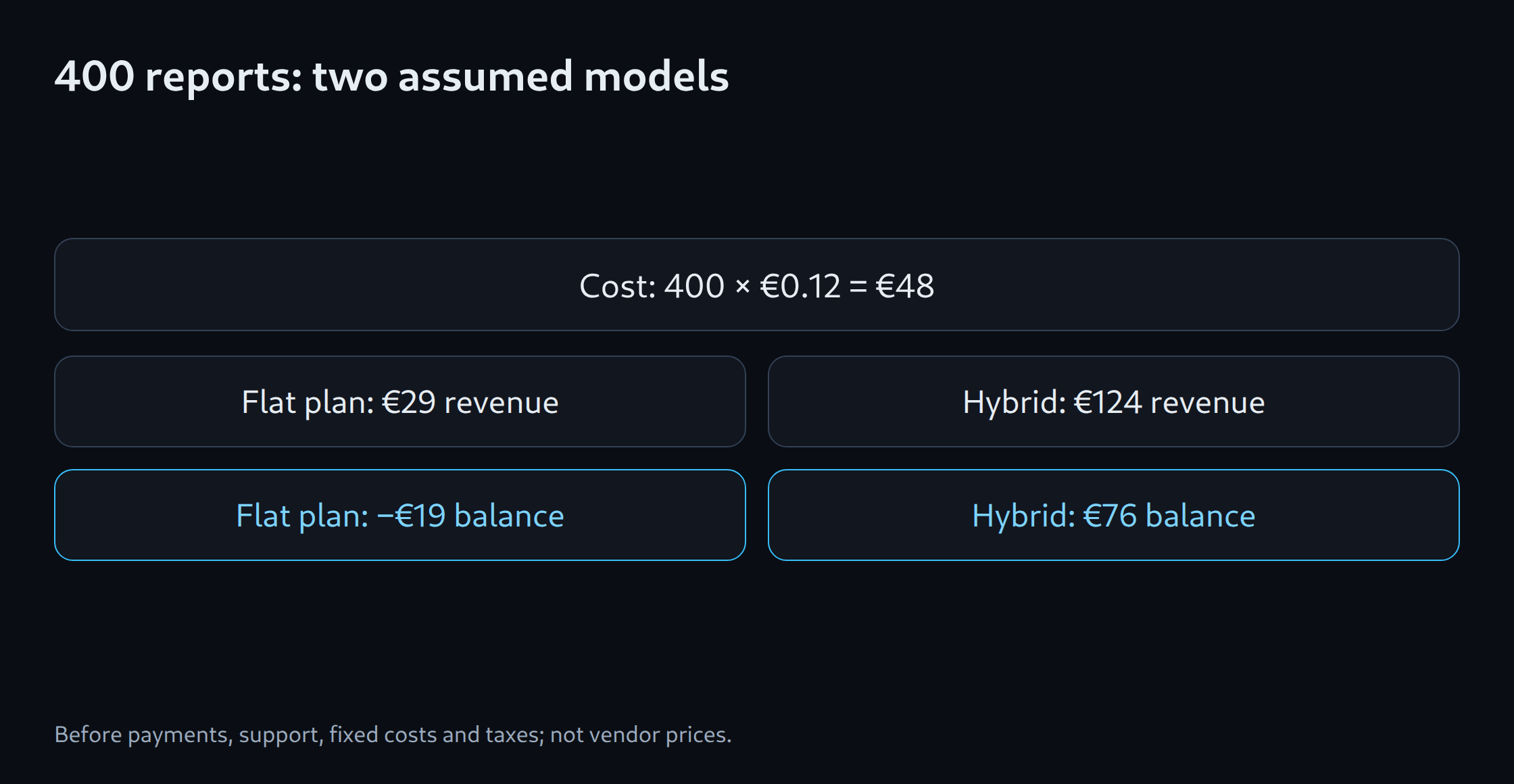
All amounts are assumed monthly figures excluding VAT, not vendor prices. Each report adds €0.12 to costs; a flat plan costs €29. At 50 reports, €23 remains before payment fees, support and fixed costs. At 400 reports, variable costs are €48, producing a −€19 balance before other costs.
An assumed hybrid costs €19 including 50 reports, then €0.30 for each additional report. At 400 reports, revenue is €19 + (400 − 50) × €0.30 = €124. Subtracting €48 in variable costs leaves €76. Payment fees, support and fixed costs still need paying, so €76 is not profit. This is not a recommendation for that price: it shows how additional reports change the amount left over.
Credits without surprises
A credit is an internal billing unit. A clear offer might charge one credit for a report up to a stated page count. Longer documents or extra checks need a price visible before the task starts. Rules must also explain whether failed attempts consume credits and when refunds apply. Credits cap spending only if no further paid tasks start once the balance is empty. Automatic top-ups remove that boundary unless a separate maximum applies.
An outcome is not business success
A saved report containing the agreed checks can be verified. Increased customer revenue also depends on data, implementation and the market. Charging for business success therefore requires rules for attributing that success to the product and proving the result. Selecting a pricing structure described by Stripe does not answer those questions. [2]
Introducing the model
A limited pilot records costs per finished report and customer account, including failed attempts and manual correction. The most expensive tasks and most active accounts matter alongside the average: a low average can hide individual loss-making accounts. A monthly budget needs a defined response: stop new tasks, queue tasks, or charge extra only after approval. Tasks already running can still incur costs. A warning alone does not enforce a spending cap.
Related tools
Questions and answers
Are credits always cheaper than subscriptions?
No. Price depends on usage, conversion and included service. Credits are initially a billing unit.
Is the hybrid price a recommendation?
No. Every example price is assumed solely to illustrate cost behaviour.
Sources
Sources checked: 25 October 2026.
Related articles