English
 Deutsch
 Polski
What Can Gemini 4 Argon Do? Practical Uses and Limits

Management Summary
Gemini 4 Argon is an AI model intended for demanding information tasks. In document work and software development, it can help compare material, prepare changes and connect information from different media. The article explains where this deeper assistance may be useful and why it is not automatically the best choice for routine work. More extensive processing can increase waiting time and cost, while the output still needs checking. Its value lies in useful work saved rather than complexity alone.
Gemini 4 Argon is Google’s model for work that needs more than a short answer: examining extensive documents, changing software across several steps, or bringing together information from text, images, audio and video. Google’s model card also names mathematical and scientific problems. None of these capabilities guarantees a correct result. Practical value depends on the task, the available tools and an output that can be checked. [1][3]
This overview reflects the documentation available on 26 October 2026. It does not claim independent comparative benchmarks or completed client projects with Argon.
Where Gemini 4 Argon is available
Google says Argon has been available in the Gemini app for Google AI Pro and Ultra subscriptions since 13 October. Google AI Studio and the Gemini API provide developer access under the model ID gemini-4-argon. The model card also lists business offerings, Antigravity and AI Mode in Search. Availability, usage limits and interface features differ across these routes. [1][2][4]
The app or AI Studio suits a single trial, such as comparing two reports. An API is a programming interface: another program sends data to Argon and receives the result. That is useful when new reports need the same checks every day and the results must be saved automatically. The choice describes the workflow, not superior output quality from one interface.
Four practical areas of use
Software development: Argon can draft proposed changes across several files. A useful task includes the affected code, software versions, expected behaviour and existing tests. For a bug, the goal might be that an empty input must not crash the program. Executed tests and inspection of the changes establish whether the proposal works. Google identifies complex software engineering as a target area. [1] [3]
Documents and research: Several reports, contracts or technical specifications can be compared. A table of claims, source locations and contradictions is often more useful than a smooth summary. The API accepts PDF input. Citations in the generated answer still need checking against the original pages; fluent writing does not establish a reliable source. [1][3]
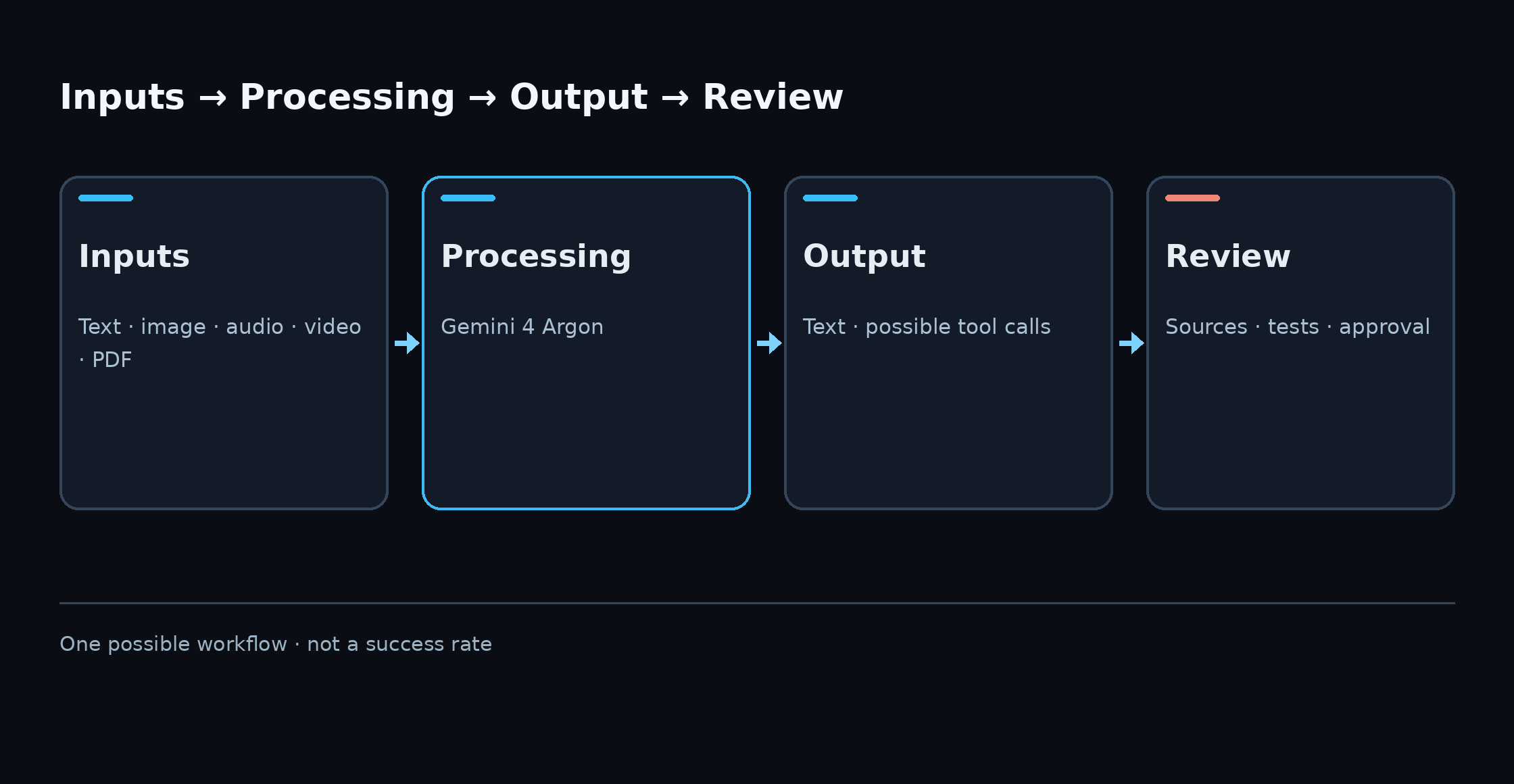
Combining text, images, audio and video: The model page also permits PDF input. One example pairs a screen recording of a faulty process with a written description of the expected behaviour. Argon returns text. According to the current API page, the model itself does not generate images or audio files and does not support a Live API session. [1]
Combining several steps: Argon can propose tool calls and return results in a defined format, such as fields named source location, amount and contradiction. Supported tools can search, read web pages or execute code. The surrounding application determines which calls actually run, according to its settings and permissions. A proposed action is therefore not yet a completed action. [1]
How much fits in one request
Tokens are units into which the model divides text and other inputs; one token is not necessarily one word. Google specifies a shared ceiling of 1,048,576 tokens for input, internal thinking and the answer. Ordinary requests have a default output limit of 65,536 tokens, which also counts thinking. The visible answer may therefore be shorter. Larger outputs require the documented background process called long decode; the shared overall ceiling still applies. [1] [2]
A large context allows many documents to be supplied together. It does not guarantee a complete analysis. Specific subquestions help: for example, which delivery dates appear in reports A and B, and on which pages? The answer can then be checked directly against both source locations.
Limits, latency and cost
The model card lists invented or incorrect claims, often called hallucinations. Slow responses and timeout failures are also possible. The stated knowledge cutoff is March 2026; some subject areas may be less current. A question about a later event therefore needs fresh sources and verification of the cited evidence. [3]
Google lists introductory API prices through 30 November 2026 of US$2 per million input tokens and US$10 per million output tokens. Announced rates from 1 December are US$4 and US$20 respectively. Internal thinking tokens are billed as output too. At the introductory rates, 100,000 input tokens plus 10,000 billable output tokens cost US$0.30, excluding other fees. Repeated beginnings of requests may cost less through automatic implicit caching. Argon does not support an explicitly created cache. There is no free API tier; app subscriptions have separate prices. [2]
Deeper reasoning and long contexts can increase processing time and expense. The API offers low, medium and high thinking levels, with medium as the default. For frequent routine work, the same sample task should be compared across settings and against a smaller model. Error rate, latency and total workflow cost matter more than a general model ranking. [2]
A reproducible first test
A short evaluation using approved sample data offers more evidence than a promotional example. Three tasks cover distinct strengths: a known software bug with executable tests, two documents containing a deliberate contradiction, and a chart with questions about axes and scale. Expected facts, permitted sources, elapsed time and cost can be specified in advance.
For code, useful evidence consists of passing tests and a readable comparison of changed lines, called a diff. For documents, correct page references and detected contradictions matter. For a chart, a claim such as “doubled” must match the displayed values and axis scale. A second check against the input is especially important when errors could have professional or financial consequences.
Gemini 4 Argon is therefore most relevant to demanding analysis and drafts whose results can be verified. The same model effort may be unnecessary for a short routine question. The task and review process determine the value.
Questions and answers
Can Gemini 4 Argon generate images?
The current API model page lists images as input but does not list image generation for this model. Argon produces text. Other Gemini models or product features may differ.
Is the million-token context also the normal answer length?
No. Input, internal thinking and the answer share 1,048,576 tokens. The ordinary output limit of 65,536 tokens also counts thinking. The visible answer is therefore not automatically 65,536 tokens long. Larger outputs require the separate background process and remain within the shared overall ceiling.
Are model answers enough for recent facts and consequential decisions?
Recent facts require current, checked sources. The model card gives a March 2026 knowledge cutoff and notes possible hallucinations. Consequential work requires checking the evidence and the result.
Sources
- Google AI for Developers: Gemini 4 Argon model page
- Google AI for Developers: latest model, API, pricing and migration
- Google DeepMind: Gemini 4 Argon model card
- Google Blog: Gemini app availability, 13 October 2026
Sources checked: 26 October 2026. Product claims and prices come from Google. No independent performance or quality measurement is claimed.
Related articles