English
 Deutsch
 Polski
Crossfades: curves, timing and fade length

Management Summary
A crossfade lowers one audio passage while raising another, helping edits and musical transitions sound smooth. The right shape and duration depend on how the overlapping sounds fit together. Similar recordings can become louder when combined, while poorly aligned sounds may partly cancel and become thin. A longer fade can also soften a drum attack. Understanding these effects helps preserve rhythm and sound quality; no single fade setting suits every recording.
Jump to the interactive example ↓
Contents
A crossfade turns one audio passage down while bringing another up. It can smooth an edit, but it can also make the overlap quieter, louder or thin-sounding. The result depends on the gain curves and on how the two waveforms combine. “Different recordings” does not automatically mean that their signals are unrelated.
First check the cut
An abrupt jump between sample values can produce a click. A zero crossing is a useful starting point because the waveform is near zero there. It is not a complete guarantee: two passages can meet at the same value but move in different directions. Stereo channels can also cross zero at different times.
A short fade changes the level gradually instead of switching it instantly. The fade still needs enough neighboring audio and a suitable edit position. A long overlap can soften a drum attack or mix two musical events that should remain separate. Removing a click and preserving the intended sound are both part of the check.
Linear and equal-power fades solve different cases
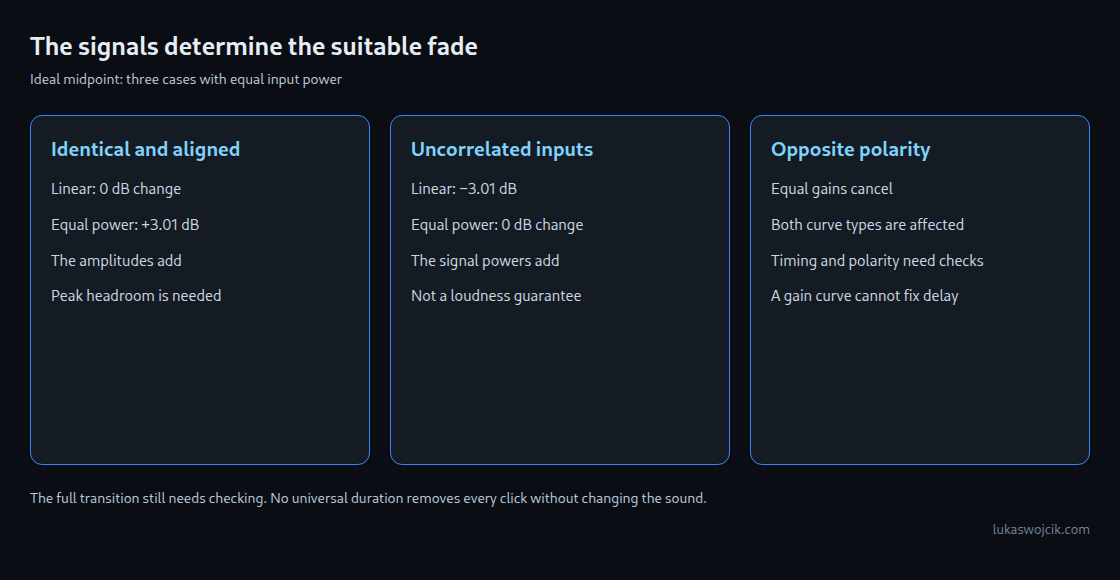
At the middle of a linear crossfade, each side has a gain of 0.5. Identical, aligned signals add back to their original level. Uncorrelated signals have no consistent waveform relationship over the measured interval. For two such signals with equal power, their powers add instead: the result is half the original power, a drop of about 3.01 dB.
At the middle of a quarter-sine equal-power fade, each gain is about 0.707. Uncorrelated inputs of equal power then retain their expected combined power. Identical aligned inputs instead add to about 1.414 times the original amplitude, a rise of 3.01 dB. A track already close to full scale therefore needs peak headroom.
| Signals in the overlap | Linear midpoint | Equal-power midpoint |
|---|---|---|
| Identical and aligned | 0 dB change | +3.01 dB |
| Uncorrelated, equal power | −3.01 dB | 0 dB change |
| Identical but opposite polarity | Ideal cancellation | Ideal cancellation |
These are signal-power comparisons, not promises about perceived loudness. Real music changes over time, and the inputs may have different levels. A single midpoint reading cannot describe the whole transition.
The missing case: signals can cancel
Correlation describes how the two waveforms move together. A value of +1 means matching movement, 0 means no correlation over the measured interval, and −1 means opposite movement. Two microphones on the same source or two layers of a sound can have positive or negative correlation. Their level error is not confined to 0–3.01 dB.
For example, delaying a 500 Hz sine by 1 ms shifts it by half a cycle. Equal gains then cancel that frequency at the midpoint. Switching from linear to equal-power gains does not repair the timing mismatch. With broadband material, a delay can produce a series of frequency-specific dips called comb filtering.
For inputs with no DC component (no constant offset from zero), equal power and correlation ρ, the output power relative to either input is g1² + g2² + 2ρg1g2. Here g1 and g2 are the gains applied to the two inputs. The last term explains the difference: it adds power for positive correlation and subtracts it for negative correlation. At exact opposite polarity and equal gains, the ideal sum is zero.
What the FFmpeg check measured
FFmpeg 7.1.5 was tested at 44.1 kHz with one-second crossfades. A constant signal on one input and zero on the other isolated each gain curve. The resulting gains were used to calculate the identical and uncorrelated cases. This checks the filter’s gains; it is not a listening test or a measurement of FL Studio.
| FFmpeg curve | Identical inputs, midpoint | Uncorrelated equal-power inputs |
|---|---|---|
tri, linear |
0.00 dB | −3.01 dB |
qsin, quarter sine |
+3.01 dB | 0.00 dB |
hsin, half sine |
0.00 dB | −3.01 dB |
squ, square root |
+3.01 dB | 0.00 dB |
cub, cubic |
−12.04 dB | −15.05 dB |
log, logarithmic |
+5.48 dB | +2.47 dB |
exp, exponential |
−43.98 dB | −46.99 dB |
The displayed values are rounded. Discrete sample positions make the two gains at the chosen midpoint differ slightly; the linear identical-signal result was about −0.00020 dB before rounding. The ideal equations describe continuous curves, while the implementation uses individual samples.
Cubic or exponential shapes can intentionally create a dip. They are not automatically invalid crossfades: FFmpeg’s own examples use exponential curves. They simply do not maintain constant level in the two cases shown here.
Fade length needs a separate decision
There is no universal fade duration that removes every click without changing the sound. A few milliseconds may be a useful starting point for a small edit. Bass phase, transient shape, neighboring material and the amount of overlap can require another choice. Pitch alone does not determine a sufficient fade duration.
Likewise, a particular test showing 6 dB less high-frequency energy whenever the fade length doubles is not a general law for every curve and recording. The useful check is the actual transition: click, level change, lost attack and phase cancellation.
FL Studio documents a 10 ms “Out only” declicking default. Manual Audio Clip Fades disable that declicking mode. The 200 ms “Crossfade” declicking option uses audio around sliced boundaries and is not the same operation as a normal overlap crossfade. These settings therefore cannot be assigned the click levels measured by another program.
A practical sequence
- The edit position is checked in both channels, including values and waveform direction.
- The overlap contains the intended audio. A linear curve is a starting point for matching aligned material; an equal-power curve is a starting point for largely unrelated passages of similar level.
- The full transition is checked for a level bump, a dip or a thin tone. Timing and polarity are examined before a cancellation problem is treated as a gain problem.
- The duration is adjusted while preserving attacks and musical timing. The final output is checked for peak overload.
A fade changes the signal’s amplitude over time and can change its spectrum. It does not by itself move audio before its original start. Pre-ringing from some filters is a separate effect. Encoder delay at a file boundary is also separate; a header checker cannot prove that a player makes a gapless transition.
Questions and answers
Are two layers of one sound always uncorrelated?
No. Shared source material, timing and polarity determine their relationship. A duplicated layer can be nearly identical; a delayed copy can cancel selected frequencies.
Does cutting and rejoining a clip require a crossfade?
An unchanged, sample-exact join already preserves the original sequence. A crossfade becomes relevant when an edit changes that sequence or when overlapping source handles are used. Adjacent parts of a take are not automatically identical throughout an overlap.
Is a one-millisecond dip inaudible?
That cannot be promised from a level calculation alone. A brief change can affect a transient or create a spectral artifact even when it is not heard as a sustained reduction in volume. The material and listening conditions matter.
Related articles and tool
Learn by trying
Why does the middle of a fade get louder or quieter?
Switch between linear and equal-power gains. Whether the signals are identical or uncorrelated also matters.
- Gain A
- Gain B
- RMS relative to one signal
Mathematical RMS model of equally loud signals. Identical: A+B. Uncorrelated: √(A²+B²). Curve shows resulting RMS through the fade, not sample peaks. Partial correlation, phase cancellation and perceived loudness are not modelled.
This module runs in your browser and does not send or store your input.
Learn by trying
One minute: can you spot the mistake?
An equal-power fade of two identical, in-phase signals is at its midpoint. Does RMS stay constant?
At the midpoint both gains are 1/√2. Identical, in-phase signals add amplitudes to √2: +3.01 dB. For equally strong uncorrelated signals this curve holds 0 dB in the RMS model.
Related articles