English
 Deutsch
 Polski
AI Agent or Traditional Automation: What Will Businesses Actually Pay For?

Management Summary
The article compares fixed automation with AI agents for handling customer enquiries. Fixed rules follow predefined steps; an AI agent chooses the next step within allowed limits. In the example of a trade business, these approaches organise email details and prepare replies. Their purpose is to reduce work while maintaining reliable results. Greater independence alone does not create value, especially when corrections add effort. Binding commitments still require human approval in the example.
Contents
An AI agent is not needed for every automation. A fixed workflow can check whether an address is missing and mark the enquiry for completion. AI can instead extract details from differently worded emails. That AI step can also sit inside a fixed workflow. Here, an agent means a system whose model chooses subsequent steps and tools within permitted limits, such as an additional document search. The practical question is whether the job is completed reliably at an acceptable cost.
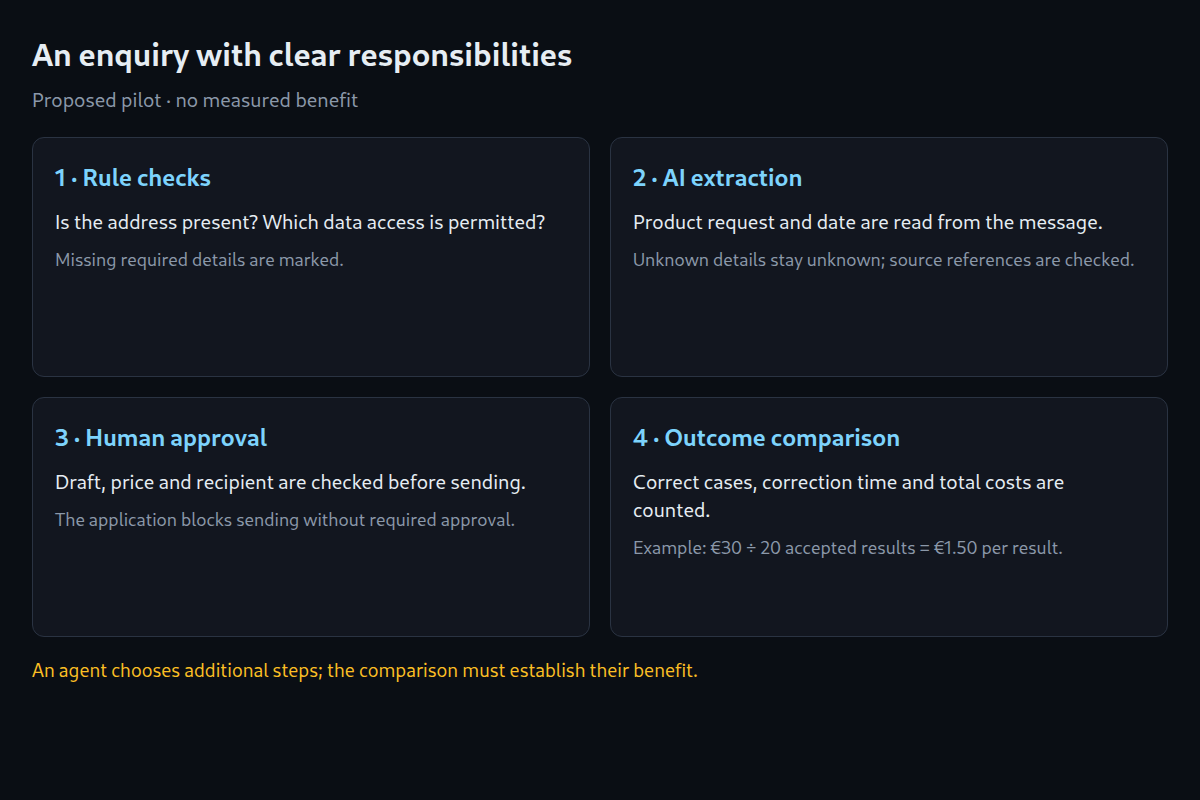
One task: an incoming enquiry
A fictional trade business receives enquiries with dates, addresses, product requirements and attachments. The proposed workflow copies details into fields, marks gaps and prepares a reply. For example, “date” stays unknown if the message provides none. Prices, binding commitments and sending require human approval in this example. This is a proposal, not a tested product.
| Approach | Suitable work | Weakness |
|---|---|---|
| Fixed rules | Required fields, state, deadlines | Inconsistent free text |
| AI extraction | Details copied into fixed fields | Invented or misassigned values |
| Agent with tools | Bounded multi-step work with varying inputs | Extra decisions and loops |
| Human approval | Binding commitments and exceptions | Waiting and labour |
When a draft counts as acceptable
Acceptance criteria are set before testing: for example, the correct address and product request, with a missing date explicitly marked. Each important value has a source location, such as the relevant email line. The source must actually support the value; a reference alone is insufficient. Customer attachments remain data. An attachment requesting the transfer of all customer data must not grant new permissions. The application must enforce allowed destinations, access and approval; instructions to the model alone are insufficient.
Make offers predefined workflows as well as AI agents. Availability does not establish time savings for this example business. Costs include the platform and model, plus setup, checking and corrections. Failed attempts still cost money even when customers pay only for successful outcomes. [1]
A comparison protocol
The comparison starts with a small set of artificial enquiries or cases carefully cleared of personal details. A subject specialist defines expected values before testing. Cases include complete, conflicting and incomplete messages and attachments with misleading instructions. Every variant receives the same cases and permitted access. A further group of initially withheld cases checks whether improvements also work on unfamiliar examples.
The record counts correct results, missing fields, incorrect values and forbidden actions. It also includes correction time, total handling time and costs of failed attempts. An illustrative calculation is €30 in total costs divided by 20 accepted results: €1.50 per accepted result. These are example numbers, not measurements of this workflow. Repeated runs can reveal variation in model responses. Serious failures, such as sending without approval, stop the pilot. Changes to the model, instructions or tools require new checks; earlier cases remain available for comparison.
What the customer buys
Less handling time at the same quality is one possible reason to pay. A pilot using actual work requirements must establish whether a business values that benefit. Outcome billing needs agreed definitions of success, corrections and retries: a generated draft is not yet an approved reply. Stripe describes outcome-based pricing, but that does not replace a separate quality check. [2]
A combination is reasonable for this example: rules track progress and permitted access, AI extracts details, and people review binding actions. An agent becomes useful when its choice of additional steps produces a measurable improvement in the comparison. That might mean less manual work, more correctly completed cases or shorter waiting times. Added costs and failures belong in the same comparison.
Related tools
Questions and answers
Does more autonomy automatically mean more value?
No. An independently generated draft saves little if corrections take longer than the previous process. Accepted results and the entire effort, including errors, determine usefulness.
Can the model commit to prices?
Not in this proposed pilot. The system prepares drafts. Price commitments and sending happen only after the specified approval, and the application must actually enforce that boundary.
Sources
- Make: AI agents and pricing
- Stripe: AI pricing models
- Make Academy: Planning the AI agent
- Anthropic: Building effective agents
Sources checked again: 25 October 2026. The business example and cost calculation are hypothetical.
Related articles