English
 Deutsch
 Polski
AI Models for Coding: GPT and Claude versus DeepSeek and Qwen

Management Summary
AI models can propose software changes and help complete programming tasks. The article considers GPT, Claude, DeepSeek and Qwen as support within real development projects. The purpose is to reduce work while keeping software reliable. A quickly generated suggestion is not enough: new faults and corrections can cancel out the benefit. The useful comparison therefore concerns the finished change, the time spent and total costs rather than a favourable vendor score alone.
Contents
A coding model helps when its change works in the existing project. Writing one function differs from fixing a fault spread across several files. An agent connects the model to tools, such as file reading and test execution. This comparison, dated 26 October 2026, proposes a test plan for GPT-6 Astra and GPT-6.1 Sol, Claude Opus and Sonnet 5.5, Gemini 3.8 Flash, DeepSeek V4.1 Flash and Qwen3.8-27B. No original success rates are reported.
Cloud candidates and open weights
The listed cloud models can be accessed through programming interfaces and connected to tools. OpenAI describes Astra for demanding work; Anthropic describes Opus 5.5 for longer workflows involving code and tools. Gemini 3.8 Flash supports function calling and code execution, among other features. These are available capabilities, not evidence of which model best fixes a particular project fault. [1, 4, 6]
DeepSeek and Qwen publish model weights, the stored numbers that make up their models. Qwen documents execution software and conditions for its published tests. Different numeric formats or agent programs can produce different results. Quantisation saves memory by storing numbers more compactly. A local run using such a variant therefore does not automatically reproduce the manufacturer’s test. [7, 8]
What the comparison should measure
| Task | Measurements for every model | Additional records |
|---|---|---|
| Small function | Correctness and time to usable output | Model startup separate from response time |
| Project bug | Change and unchanged passing tests | Exact model and software versions |
| Agent work | Tool steps, failures and total cost | Permitted tools and available memory |
| Code review | Known faults found and false alarms | The same defect list for every candidate |
A concrete test plan for the project
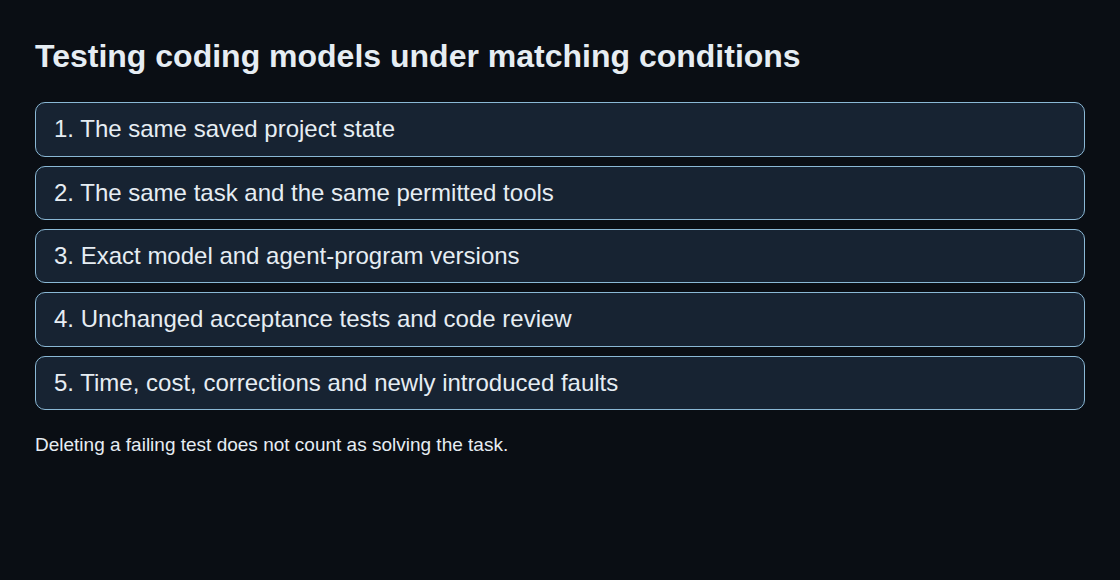
The proposed test plan contains six tasks: fixing a reproducible bug, adding a small feature, adapting a programming interface, restructuring code without an intended behaviour change, adding a useful test and finding known defects in a code review. Every run starts from the same saved project state, or commit. Independent acceptance tests remain unchanged. Removing a failing test does not count as fixing the fault.
The log records which tasks were solved and whether previously working behaviour broke. Such newly introduced faults are called regressions. Unnecessary file changes, correction work, duration and cost also count. Tokens are the text units used for billing by many APIs; equal token counts do not cost the same across providers. Repeated runs reveal variation. Different agent programs produce a comparison of complete systems, not just models.
When local operation matters
A local model is an option when source code must remain within the organisation. Both model calls and tools must operate locally for that to hold. Ollama requires compatible model architectures and file formats; a familiar model name is insufficient. The model and the project text being considered also need enough memory. In MoE models such as DeepSeek, only parts of the model are used at each computation step. The remaining parts still need storage and must remain available, so active parameters are not a complete memory budget. [7, 9]
Switching models follows a criterion defined beforehand. For example, after two attempts, the same task still fails an unchanged acceptance test. Another candidate can then receive the same task. A cloud switch is an option only if transmitting the affected code is permitted. This is a proposed procedure, not evidence of a higher cloud success rate.
Related tools
Questions and answers
Is a high coding benchmark score sufficient?
A vendor score applies to the tasks, tools and settings used in that evaluation. A project test instead checks the changes actually needed. Repeated runs and independent code review complement automated tests.
Does Ollama automatically keep code local?
Tools can transmit code too. The selected model, where it runs and every connected function matter. Ollama offers local and cloud features; its name alone does not guarantee local-only processing.
Sources
- OpenAI: model catalogue
- OpenAI: GPT-6.1 Sol
- Anthropic: model overview
- Anthropic: Claude Opus 5.5
- Anthropic: Claude Sonnet 5.5
- Google: Gemini 3.8 Flash
- DeepSeek: V4.1 Flash model card
- Qwen: Qwen3.8-27B model card
- Ollama: local and cloud operation FAQ
- OpenAI: API pricing
- DeepSeek: models and pricing
- Google: document processing
Sources checked: 26 October 2026.
Related articles