English
 Deutsch
 Polski
AI Models for Research and Documents: Gemini, GPT and Claude versus Open LLMs

Management Summary
AI models such as Gemini, GPT and Claude can help with research and large collections of documents. In office or editorial work, these systems are intended to find important facts and summarise them clearly. The article explains what useful assistance requires: statements need to be accurate, sufficiently complete and supported by the right source material. Fluent writing alone is not enough. The benefit is work saved without allowing mistakes or missing information to distort decisions.
Contents
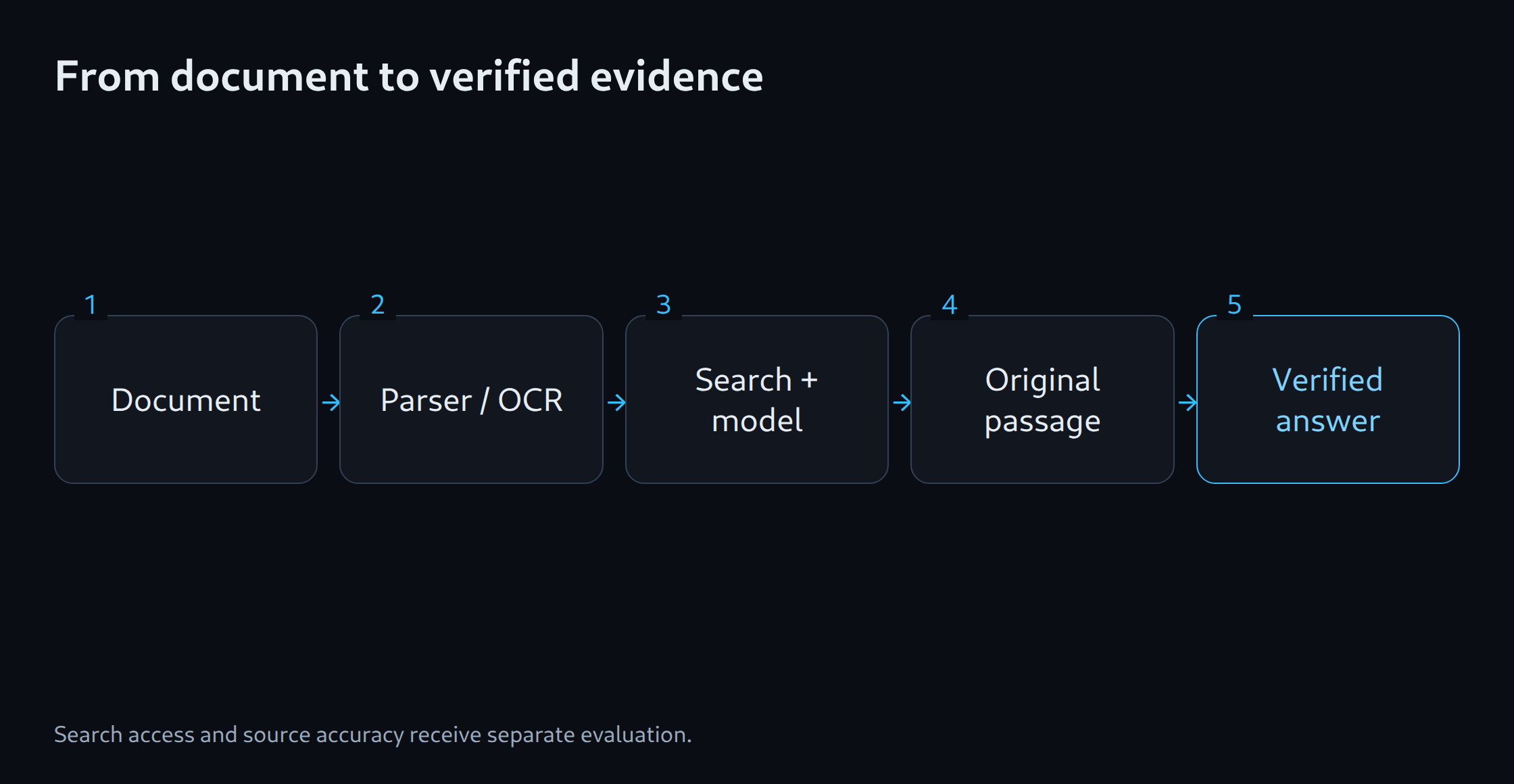
A readable summary can omit important details or cite the wrong sources. Every step matters: reading the file, recognizing text and images, finding relevant passages and checking claims against the original. This comparison describes documented features of Gemini 3.8 Flash, GPT-6.1 Sol, Claude Opus/Sonnet 5.5, DeepSeek V4.1 Flash and Qwen3.8-27B. It does not report an original quality test of these models. Sources were checked on 25 October 2026.
Gemini and document ingestion
Gemini 3.8 Flash documents support for PDF, text, image, video and audio inputs. File search and web search are additional supported tools. Search grounding means basing answers on retrieved sources. The application needs to provide and use those tools. For PDFs, Gemini can also process visible tables and illustrations; file size, page count and input limits still apply. Support for a file format does not establish that every footnote was read correctly. [3, 7]
GPT and Claude under the same protocol
GPT-6.1 Sol, Claude Opus 5.5 and Sonnet 5.5 support text and image inputs. [1, 2] A fair comparison requires the same documents and questions. The test record also needs to identify the search tools used. An answer following web search cannot be directly compared with one based only on model knowledge. Separate tests can reveal whether an error arose during source retrieval or while reading and summarizing.
Additional components for open models
DeepSeek V4.1 Flash and Qwen3.8-27B publish model weights for text and image processing. Weights are the stored parameters of a trained model. Downloading weights does not provide a complete document search system. A parser reads file structure; OCR converts scanned writing into text. A search index makes a collection searchable, and retrieval selects relevant passages. Not every workflow requires all these steps. [4, 5] Fully local processing requires these supporting services to run locally too. Ollama also offers cloud models and web search, so the program name alone does not establish a local data path. The model and runtime must both support the required image processing. [6]
| Comparison point | Cloud workflow | Local workflow |
|---|---|---|
| Ingestion | Supported upload / API input | Parser, OCR and vision support |
| Knowledge access | Configured file or web search | Own index and retrieval |
| Source evidence | Comparison with the original passage | Comparison with the passage in the local file |
| Freshness | Date of retrieved source | Index update date |
A test with verifiable answers
A proposed test package contains a short report, a long PDF with tables, a scan and two versions containing conflicting information. One task could ask for revenue from a particular table row, together with its page and row location. Other tasks assess summaries, contradictions and a question whose answer is absent from the documents. Expected facts and source locations are recorded before testing. This package is a proposal, not a completed experiment reported here.
The record counts correct statements, missing required facts and invented evidence separately. An unavailable answer must remain identifiable as unavailable. Checking a quoted number also requires its unit, period and table heading. A link to the correct website is insufficient when the figure appears only in another edition or is absent altogether. Repeated runs can also reveal whether results remain consistent.
The editorial shortlist
Gemini is a candidate for mixed files because of its documented input formats. GPT and Claude are further candidates for the same document test. Models with published weights allow a self-hosted workflow when hardware, software and usage terms permit. That establishes neither better quality nor automatically confidential processing. A sound choice considers correct answers, omissions, runtime, cost and the actual data path.
Related tools
Questions and answers
Does a large context window replace search?
The context window limits how much material a model can consider in one call. Search selects relevant passages from a larger collection. Even a document that fits entirely within the window may be interpreted incorrectly. A large window therefore replaces neither source selection nor answer checking.
Are generated citations automatically reliable?
No. A citation can point to the correct file while failing to support the claim. Important numbers and quotations require comparison with the specific page, table or passage in the original.
Sources
- OpenAI: GPT-6.1 Sol
- Anthropic: Claude model overview
- Google: Gemini 3.8 Flash
- DeepSeek: V4.1 Flash model card
- Qwen: Qwen3.8-27B model card
- Ollama: FAQ and local/cloud operation
- Google: document understanding
Sources checked: 25 October 2026.
Related articles