English
 Deutsch
 Polski
Compare AI Model Costs: Cloud APIs or Local DeepSeek and Qwen?

Management Summary
Businesses can use AI as a rented service or run suitable models such as DeepSeek and Qwen on owned computers. The article explains the costs of these two routes for everyday AI work. Owned equipment needs purchasing, electricity and maintenance; an external service charges for use. The comparison helps assess the business case. What matters is the cost of an acceptable result, including retries and correction work, rather than the cheapest individual request.
Contents
A low price for a model request does not guarantee a cheap completed task. Incorrect answers can require more attempts and manual correction. This comparison uses API prices checked on 25 October 2026. API here means a cloud provider’s programming interface. Assumed costs for models running on owned hardware are shown separately.
A transparent rate comparison
Tokens are the units into which a model splits text, such as words or word fragments. Different models can count the same text differently. The example nevertheless assigns identical quantities to every provider: one million input tokens without a cache discount and 200,000 billable output tokens, spread across many short requests. Internal reasoning tokens belong in output when the provider bills them. The table shows USD excluding taxes, tools, cache-write charges, special discounts and regional surcharges. OpenAI uses the standard short-context rate. [10]
| Model | Input / output per million | Example total |
|---|---|---|
| GPT-6 Astra | 10 / 50 USD | 20 USD |
| GPT-6.1 Sol | 2 / 10 USD | 4 USD |
| Claude Opus 5.5 | 4 / 20 USD | 8 USD |
| Claude Sonnet 5.5 | 2 / 10 USD | 4 USD |
| Gemini 3.8 Flash | 0.75 / 3.75 USD | 1.50 USD |
| DeepSeek V4.1 Flash, peak | 0.30 / 1.20 USD | 0.54 USD |
| DeepSeek V4.1 Flash, off-peak | 0.15 / 0.60 USD | 0.27 USD |
Each total is the input rate plus 0.2 × the output rate. For GPT-6.1 Sol, 2 + 0.2 × 10 = 4 USD. Claude rates come from its model overview. Google lists 0.75/3.75 USD for Gemini 3.8 Flash through 31 December 2026 and 1.50/7.50 USD afterwards; the same example would then cost 3 USD. DeepSeek’s API name deepseek-flash currently points to V4.1-Flash-1017. Peak hours are Monday to Friday, 01:00–04:00 and 06:00–10:00 UTC, excluding Chinese public holidays; all other hours are off-peak. This table compares rates at equal token counts, not equal amounts of text, quality or speed. [3, 11, 13]
No universal rate for open weights
A self-hosted Qwen model has no API charge per token. Hardware, electricity and maintenance work cost money instead. Published model weights are the model’s stored numerical values; suitable software and enough memory are also needed. DeepSeek publishes weights too. The linked MoE model contains many subnetworks, only some of which are active for each processing step. A small active parameter count therefore does not mean that only that small portion needs storage. The complete version may require substantially more hardware than a smaller local model. [7, 8]
A hypothetical monthly example assigns €50 to hardware, €20 to electricity and €30 to maintenance work, totalling €100. With 1,000 usable results, the average cost is €0.10 each. If the same total cost yields only 500 usable results, that rises to €0.20. These amounts are not measurements of DeepSeek or Qwen. Comparison with the USD table requires the same tasks, quality requirements and currency.
Including quality in the calculation
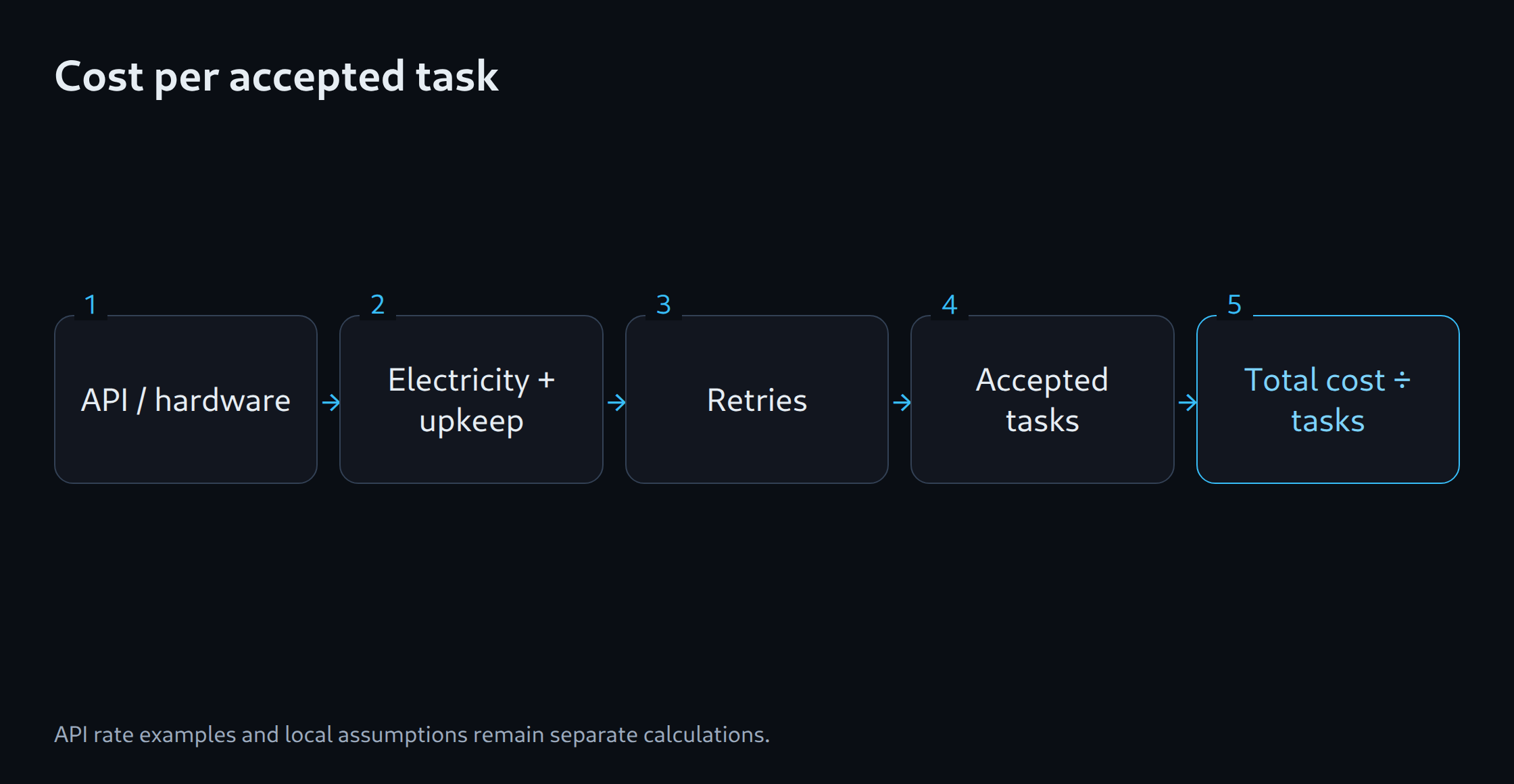
The useful measure is total cost divided by usable results. The test defines usable in advance, such as correctly extracted invoice fields. All attempts and time spent checking and correcting belong in the cost. With zero usable results, no finite cost per success can be calculated. A more expensive model can cost less overall if it needs less correction. A smaller model may suffice for simple tasks. Both possibilities need testing on the same tasks.
A mixed deployment
A mixed setup can process simple tasks locally and defined difficult cases in the cloud. The record identifies the model, version and actual service for each task. Using Ollama alone does not prove local processing: Ollama also supports cloud models and web search. The destination of the specific request matters. [9]
The linked calculator spreads hardware purchase cost over months and adds electricity and maintenance. API quantities and prices are entered separately. Its currency field labels the calculation; it does not automatically convert euros into USD. It does not measure quality losses or correction time either. The test log helps record results but does not run model tests. Those measurements turn assumptions into a comparison for the actual task. Prices and model versions can change.
Related tools
Questions and answers
Are the example totals monthly subscription prices?
The totals describe assumed API token quantities under the specified rate conditions. Chat subscriptions and local operating costs use different calculations.
When is a local model cheaper?
Utilisation, allocated hardware cost, electricity, maintenance and accepted results determine the answer. A low electricity rate alone is insufficient.
Sources
- OpenAI: model catalogue
- OpenAI: GPT-6.1 Sol
- Anthropic: Claude model overview
- Anthropic: Claude Opus 5.5
- Anthropic: Claude Sonnet 5.5
- Google: Gemini 3.8 Flash
- DeepSeek: V4.1 Flash model card
- Qwen: Qwen3.8-27B model card
- Ollama: FAQ and local/cloud operation
- OpenAI: API pricing
- DeepSeek: models and pricing
- Google: document understanding
- Google: Gemini API pricing
Sources checked: 25 October 2026.
Related articles