English
 Deutsch
 Polski
Which AI Models Fit German, English and Polish?

Management Summary
AI models can help write and translate text, but strong English does not automatically mean equally good German or Polish. This matters for editorial teams and businesses publishing in several languages. The article explains how to choose suitable support: facts must be preserved and wording should sound natural. The practical benefit is less work before a text is ready to publish. A good English result alone therefore does not justify choosing the same model for every language.
Contents
A model can write well in English yet need more corrections to Polish word forms or German technical terms. An overall model ranking therefore does not determine the best fit for a three-language editorial team. This article proposes a comparison; it contains no original model measurements. GPT, Claude, Gemini, DeepSeek and Qwen serve as examples, checked against manufacturer documentation on 25 October 2026.
Multilingual capability is not a quality guarantee
OpenAI and Anthropic list multilingual capabilities. That does not establish a ranking for German, English and Polish. Freely available model files also need suitable language tests. A checkpoint is a particular saved model version. A repeatable trial also records the execution software and quantization: storing model numbers at lower precision to save memory, which can change the results. [1, 3, 7, 8]
The same tasks in every language
| Language | Material | Acceptance criterion |
|---|---|---|
| All three languages | Technical explanation and short FAQ | Technical terms, clear references, neutral style |
| All three languages | Product description and summary | Precise claims, natural wording, no additions |
| All three languages | Translation and interface labels | Word forms, vocabulary and natural syntax |
| Across languages | The same checked facts | Identical figures, qualifications and claims |
A repeatable language comparison
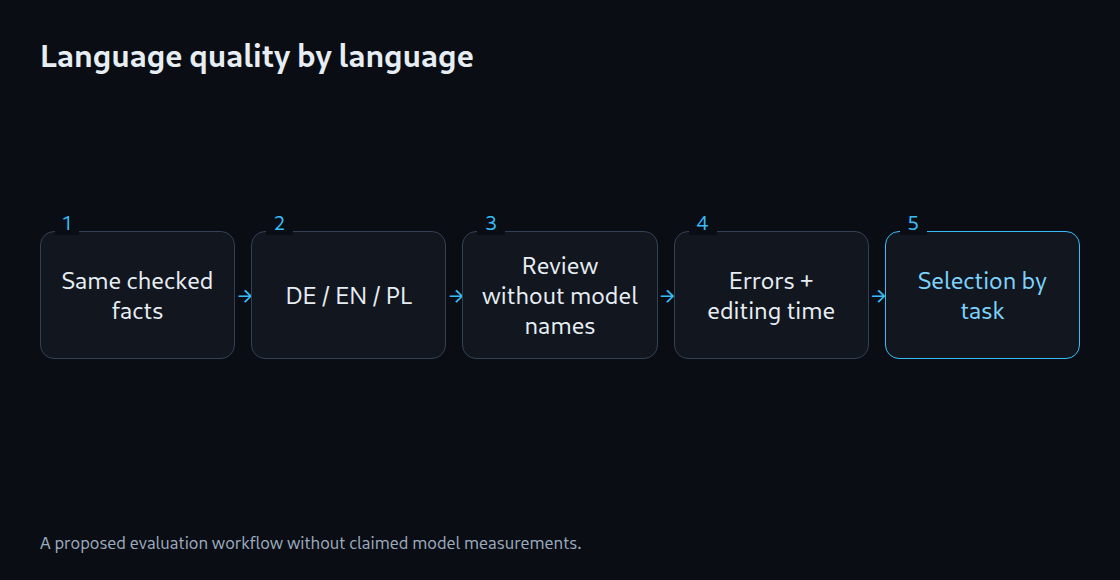
A small initial test could contain twelve tasks per language. This is a proposal, not a representative measurement. Every language receives the same task types and content of comparable difficulty; comparing only German technical texts with English summaries would be unfair. Each task specifies checked facts, approved terms, an audience and a target length. Some tasks request a new text and others a translation. Translation source languages should vary so that English is not always the starting point.
Evaluation separates factual errors, omitted qualifications, grammar, terminology and unsupported additions. For example, “up to 30 days” must not become “30 days”. Smooth wording does not offset that error. Qualified reviewers assess outputs without visible model names and in mixed order. Multiple responses per task reveal variation. Error type and severity matter alongside the time needed to produce an acceptable final version. Raw error counts or editing minutes alone are not comparable across different text lengths.
Fair cloud and local comparison
Example candidates include GPT-6.1 Sol, Claude Sonnet 5.5 and Gemini 3.8 Flash through their respective programming interfaces. GPT-6 Astra and Claude Opus 5.5 can provide further comparisons. Qwen3.8-27B offers downloadable model files; local suitability depends on memory and supported software. Self-hosting DeepSeek-V4.1-Flash requires substantially more infrastructure than a small desktop model. These examples are neither a complete list nor proven language-quality winners. [2, 4–8]
The test log records the model identifier, test date, input, output length and supported reasoning-effort settings. Local execution also records software version, hardware, context length and chat template. Context is the input and conversation history being processed; the chat template specifies the format of those messages. Q8 and Q4 broadly indicate different precision levels for model numbers, so the exact file variant and method belong in the log. Switching creates a new test condition. Ollama is execution software and also supports cloud models: its name alone does not prove local processing. [9]
Selection by task
An editorial team can use different models by task and language. A cheaper model is suitable only after it meets the required quality. Results therefore remain separate by language and task type: serious errors, editing time, response time and cost up to a usable result. A single average could hide weak Polish answers behind strong English answers. Review by a qualified person remains necessary even after good test results.
Related tools
Questions and answers
Does an English benchmark establish Polish quality?
No. A benchmark is a defined set of test tasks. An English test does not automatically establish whether Polish word forms, technical terms and meanings remain correct. Suitable Polish material is needed for that assessment.
Should all three languages use the same model?
A shared model simplifies the workflow. Different models can also work if the same facts, terms and acceptance criteria apply. The decision follows results for the particular task and language.
Sources
- OpenAI: model catalogue
- OpenAI: GPT-6.1 Sol
- Anthropic: Claude model overview
- Anthropic: Claude Opus 5.5
- Anthropic: Claude Sonnet 5.5
- Google: Gemini 3.8 Flash
- DeepSeek: V4.1 Flash model card
- Qwen: Qwen3.8-27B model card
- Ollama: FAQ and local/cloud operation
- OpenAI: API pricing
- DeepSeek: models and pricing
- Google: document understanding
Sources checked: 25 October 2026.
Related articles