English
 Deutsch
 Polski
Retroactive and Forward-Only Analytics Changes: Keeping a Year-over-Year Comparison Valid

Management Summary
A year-over-year analytics comparison is useful only when the numbers describe comparable things. Changes to measurement rules may regroup old records or affect only new activity, making a reporting change look like business growth or decline. This matters when evaluating annual performance or allocating budgets. Knowing when a change actually became active and which reports it affected helps distinguish these effects. Where a common basis cannot be reconstructed, the break in comparability should remain visible.
Contents
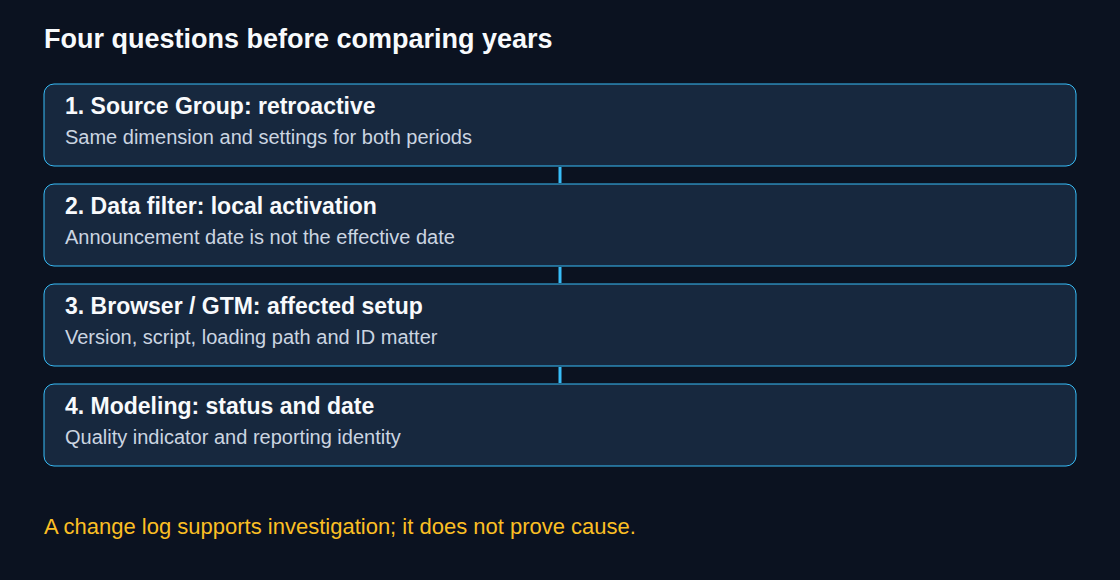
A year-over-year comparison is meaningful only when measurement remains sufficiently comparable across both periods. Changes to source classification, data filters or modeling can shift that foundation. Three questions matter: what changes, when the change affects the actual dataset, and whether older data is also presented differently.
A product announcement does not automatically answer all three questions. Release, activation in a property and the first visible effect can occur on different dates. A change log connects those dates to evidence; the log does not prove campaign performance.
Retroactive: the same dimension for both periods
Google announced the Source Group dimension on June 11, 2026. The field consolidates different source labels for a platform and, according to the release notes, is populated retroactively. Older and newer periods can therefore be analyzed using this dimension.
This does not imply complete availability of every historical value or automatic validity of a year-over-year comparison. An old export of raw sources and a new report of source groups use different definitions. A defensible comparison uses the same dimension, scope and report settings for both periods. New grouping rules or longer retention cannot recreate event data that has already been deleted.
Forward-only: an active data filter
GA4 data filters affect incoming events. An active exclusion filter permanently removes matching data from processing; previously stored data remains unchanged. Disabling the filter later does not restore excluded events. Hostname filters were also announced on June 11, 2026, but the relevant date for a particular time series is actual activation, not the announcement.
The hostname documentation allows 24–36 hours after activation before filtering begins. An immediate, clearly visible step is therefore not a reliable expectation. The shape and size of a change also depend on the affected metric and traffic volume.
A new attribution rule: evidence for the rollout
Attribution means assigning a conversion to an earlier advertising interaction under defined rules. On March 3, 2026, Meta announced a narrower definition of click-through attribution for website and in-store conversions: link clicks count toward click-through attribution, while other qualifying interactions move into engage-through attribution. The rollout was scheduled to start later in March, with different effective dates across ad accounts.
March 3 is therefore not a universal break point for every account. The announcement also does not establish a universal rule about historical reports remaining unchanged or being restated. Saved exports, actual account settings, attribution windows and available rollout notices matter for a comparison. A decline in one attribution column may reflect a definition change, but proves neither unchanged nor deteriorating campaign performance.
Browsers and Tag Manager: effects depend on the setup
Safari 26.0 was released on September 15, 2025. Its enhanced protection restricts known fingerprinting scripts from accessing certain interfaces and navigation information. Possible measurement effects depend on the scripts actually used, browser version and settings. Adoption of new versions can spread a change over time; a particular curve shape, such as a gradual slope, is not guaranteed.
The GTM change dated July 9, 2026 was not an optional migration. Google corrected container behavior for unsupported loading paths such as /gtag/js: the ID used determines restrictions. Standard installations using Google-provided snippets were unaffected according to the release notes. A useful log entry therefore includes the affected loading path and ID type.
Modeling: a record of status and effective date
GA4 behavioral modeling estimates missing observations from available data. Whether a property qualifies for it depends on Google’s requirements, sufficient data and report settings. Meeting published minimum volumes does not guarantee eligibility. After a loss and later recovery of eligibility, modeled data may be available only from the date of renewed eligibility.
The state is not inherently invisible: the data-quality icon reports modeling status and, where applicable, an effective date; some views also display banners. A year-over-year record needs these details, reporting identity and the specific report. A seasonal metric change alone does not establish that modeling switched.
A log that supports investigation
Product changes, local releases and demonstrated effects need separate date fields. Existing version and change histories help reconstruct events; a shared log adds the analytical context to those records.
Example structure — not a measured time series

Announcement | local activation | first confirmed effect
Change       | affected metric / dimension / data source
Scope        | historical restatement: yes / no / unknown
Evidence     | version, export, status indicator, settings
Assessment   | comparison group, uncertainty, alternative causes

2026-06-11 Source Group: retroactive according to Google
2026-06-11 Hostname filter: effective locally after activation
2026-07-09 GTM: affected non-standard loading paths only
Both comparison periods also need a record of timezone, currency, counting rule, attribution window, filters and data snapshot. If a common definition cannot be reconstructed, the periods remain separately labeled. An explicit measurement boundary is more defensible than a numerically smoothed comparison with unsupported assumptions.
Questions and answers
Can a filter’s effect be estimated in advance?
In Testing state, GA4 labels matching data through Test data filter name without applying active exclusion. Google recommends waiting 24–36 hours before validating a hostname filter. Tagged events show the affected traffic during that test period.
For example, 10 percent tagged events does not automatically mean 10 percent fewer sessions, users or revenue. Events within the same session can be affected differently, and traffic or event mix can change. Extrapolation to the previous year requires additional assumptions and a suitable comparison basis. The test does not supply an exact correction factor for every metric.
Do stable shop orders prove a measurement-only change?
No. Orders and advertising spend are useful cross-checks, but total orders also include other channels. Changes in organic traffic, prices, delays or product mix can offset one another. Comparable groups of visitors or purchases over matching time windows, with documented definitions, provide a stronger investigation. Even then, an attribution change initially remains a hypothesis.
Does splitting by browser version separate a measurement change from a real trend?
The split can narrow a hypothesis, but does not automatically establish cause. Updated devices may have a different user mix; genuine business developments can affect segments differently. Controlled tests in the affected browser context and reasonably comparable groups provide additional evidence. A simultaneous movement across all segments is not a prerequisite for a real trend.
Sources
- Google Analytics: What’s new in Google Analytics
- Google Analytics: Data filters
- Google Analytics: Filter web hostname traffic
- Google Tag Manager: Release notes
- Google Analytics: Behavioral modeling for consent mode
- WebKit: Features in Safari 26.0
- Meta: Simplifying Ad Measurement for a Social-First World
- Google Analytics: Data retention
Related articles