English
 Deutsch
 Polski
Meridian in Analytics 360 and GeoX: Mix Modelling With Intervals and Geo Experiments

Management Summary
Advertising budget decisions need an estimate of what spending actually changes. Meridian uses historical totals to model that relationship, while GeoX compares planned changes across regions. These approaches help businesses assess marketing effects without treating every reported sale as caused by advertising. The article explains how models and regional experiments can complement each other. Their value depends on suitable data and comparisons, and their results remain estimates rather than exact answers.
Contents
Meridian and GeoX address an important measurement question: how does advertising change business outcomes against a comparison scenario? Meridian estimates channel effects from aggregate data. GeoX supports planned interventions in selected regions and their evaluation. Both provide estimates with uncertainty; credible causal interpretations depend on appropriate assumptions.
Google announced the integration of Meridian into Analytics 360 on 20 May 2026. The current Analytics documentation describes Meridian-based budgeting as a limited alpha for selected Analytics 360 customers. That does not establish general availability for every paid account. The open-source Meridian framework and GeoX library can be used independently of this interface.
What the Analytics 360 integration provides
The integrated budgeting tool combines historical total conversions and costs across advertising channels. Google states that attribution results are not an input. Data comes from linked products and imported campaign records; budgeting results include paid channels. Projections and scenarios explore the possible effects of a different allocation. The planning tools do not automatically change budgets in connected advertising accounts.
The alpha requires a linked Google Ads account, configured conversions, and at least two years of cost, conversion and revenue history. The current guide also describes estimates from conversion-lift studies and industry benchmarks as inputs to the model. A custom Meridian model, the integrated alpha and the separate DDA-based budgeting model are therefore different offerings. Not every capability of the open framework is necessarily available through the interface.
What an interval means
A point estimate summarizes a result with one number. An interval adds how uncertain that estimate is under the chosen assumptions. The prior describes assumptions before the observed data are incorporated; the posterior is the updated distribution after those data are included. Meridian uses Bayesian credible intervals: a 90% interval contains 90% of the corresponding posterior distribution, conditional on the data, model and priors. It does not guarantee protection from omitted influences or an unsuitable model.
Wide intervals can make a budget decision difficult. Narrow intervals, however, do not automatically establish accuracy. A strong prior can keep an estimate narrow even when the data contributes little new information. Convergence, model fit, a plausible baseline and comparison of the prior with the posterior all belong in the assessment.
Limited independent variation makes channel effects harder to separate. Constant total spending does not necessarily mean constant exposure: regional differences, reach, frequency and advertising prices may matter. Conversely, more history may provide little separation if several channels always rise and fall together. A blanket rule that unchanged spending always produces a wide interval would be incorrect.
Attribution and the baseline answer different questions
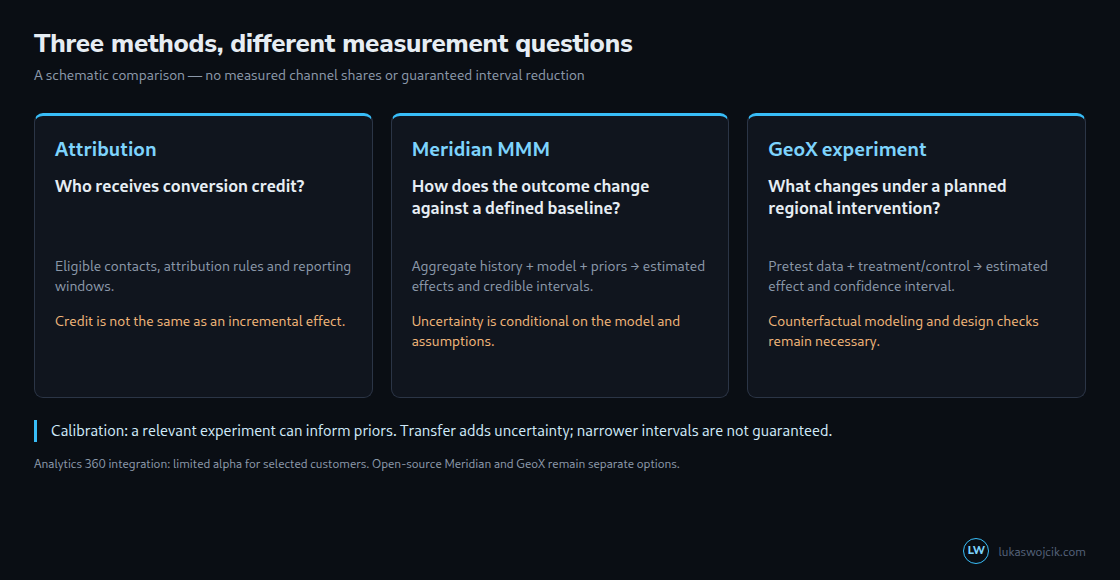
Attribution distributes credit for recorded conversions across eligible contacts under a model and a time window. A marketing mix model estimates the change in an outcome against defined counterfactual conditions. These quantities do not become directly comparable merely by placing them on the same percentage axis. Attribution reports can also include modeled values; a displayed point estimate does not establish an exact or causal measurement.
The MMM baseline is the estimated outcome with the modeled interventions set to specified baseline values. In Meridian, those values are zero for paid and organic media; other interventions use configured values. The baseline is neither a list of purchases without advertising contact nor a synonym for Direct or Organic traffic. A purchase preceded by an ad could still have occurred in the counterfactual scenario. Whether the baseline is the largest component depends on the business and model.
What GeoX actually compares
GeoX supports selection of treatment and control regions, study design and analysis. In its documented time-based regression, the relationship between the groups is learned from the pretest period. During the test, the control group helps predict what the treatment regions would have produced without the intervention. The estimated effect is the difference from that predicted counterfactual, not the raw difference between two regions of unequal size.
| Design | Treatment regions | Control regions | Question |
|---|---|---|---|
| Holdback | New campaign receives spend | New campaign stays off | Incremental effect of a new intervention |
| Go-dark | Existing advertising is stopped | Existing advertising continues | Contribution of the existing advertising |
| Heavy-up | Existing advertising receives more spend | Existing budget continues | Additional effect of the budget increase |
A heavy-up effect compares additional spending with the existing level. That differs from the effect of the entire channel against zero spending. Planned interventions strengthen causal interpretation, but do not remove problems from unsuitable controls, simultaneous changes, measurement errors or spillover. GeoX also uses a statistical model and reports an estimate with a confidence interval.
Multiple treatment cells can share one control group. This can improve operational efficiency, but maintaining statistical power requires more regions and budget. Current GeoX documentation recommends a single-cell design for a single question. Multiple active cells are each evaluated against the shared control; a direct significance test between those active cells does not follow automatically.
How an experiment informs the prior
An experiment can inform a channel-specific prior distribution. The metric, campaign scope, regions, time period and spending must match the MMM question. Older or shorter experiments introduce additional uncertainty when transferred. Meridian’s CalibrationBuilder accounts for differences including spending, recency and duration; automation does not replace the substantive assessment.
The current guide recommends the builder for experiments with a zero-spend counterfactual. A heavy-up result instead measures the increase over existing spending and should not be inserted uncritically as the same ROI prior. A suitable experiment can narrow intervals or shift estimates. Narrowing exactly one channel is neither guaranteed nor the sole measure of quality.
Other metrics in Google’s announcements
Qualified Future Conversions are predictive signals. Google describes an AI-based connection between early actions, such as branded searches, and expected later conversions. Predicted sales are not purchases already observed. Interpretation depends on the metric’s definition and prediction horizon, and on availability in the particular account.
Campaign Type Attribution allocates conversion credit within a campaign type; current Google documentation names Demand Gen. A larger reported share is therefore not an experimentally established additional sale. Attributed Branded Searches, also described as Branded Searches, attributes brand searches to preceding eligible ad contacts. This is an ongoing attribution metric, not a Search Lift experiment. Definitions, time windows and reporting coverage must match before figures are compared.
When the data and effort fit the decision
For a custom Meridian model, Google’s rough guidance is at least two years of weekly geo-level data or three years of national data. Actual needs depend on the number of channels, variation, confounders and model complexity. The integrated alpha’s specific eligibility requirements need a separate check.
A geo experiment is not automatically informative at a small budget either. Planning needs to establish whether enough comparable regions and signal exist to detect an economically relevant effect. The minimum detectable effect, or MDE, and target statistical power should be specified before the test. For example, a study can be designed to detect a 5% increase with an 80% chance if that increase really exists under the planning assumptions. An inconclusive result does not prove that advertising has no effect.
Questions and answers
Why can an experiment help more than further unchanged months?
A planned intervention adds information about how outcomes respond to a budget change. Its value depends on study quality and transferability. Additional historical data can also help, but does not guarantee separation of closely correlated channels.
What limits regional experiments?
- Spillover: travel, commuting and imperfect targeting can mix exposure between treatment and control regions. The contrast often weakens, but the direction of bias is not universally guaranteed.
- Measurement: conversions need consistent geographic assignment and an unchanged definition. Missing or misassigned records can bias results.
- Regions and history: too few or poorly matched regions may provide insufficient information. Pretest and placebo checks help evaluate designs.
- Lag: delayed conversions and advertising carryover need to be reflected in the intervention and analysis windows. One fixed duration does not fit every campaign.
Which costs belong in the plan?
Implementation and analysis costs matter alongside additional heavy-up spending and potentially lost outcomes during a shutdown. An estimated conversion effect is not automatically the monetary value of those costs. Spending saved, margins and longer-term consequences require a separate economic assessment.
Sources
- Meridian
- Google: Analytics 360 announcement, 20 May 2026
- Google: Cross-channel budgeting
- Google: Meridian-based budgeting (alpha)
- GeoX: Types of experiments
- GeoX: Time-based regression
- GeoX: FAQ
- Meridian: Prior calibration
- Meridian: CalibrationBuilder
- Meridian: Data collection
- Meridian: Amount of data needed
- Meridian: Model health checks
- Meridian: Incremental outcome and baseline
- Google: Qualified Future Conversions
- Google: Attribution reports
- Google: Branded searches
Related articles