English
 Deutsch
 Polski
meta_query in WP_Query: Understanding Joins, Indexes and Query Costs

Management Summary
WordPress can filter content using extra information attached to posts, such as product characteristics or numeric values. This makes flexible listings possible, but complex filters may force the database to do substantial work and slow down the page. The appropriate improvement depends on how the site actually searches and sorts its content. Faster search structures or reusable results can help; heavily used filters may need a different data arrangement. Speed improvements must preserve the intended selection.
Contents
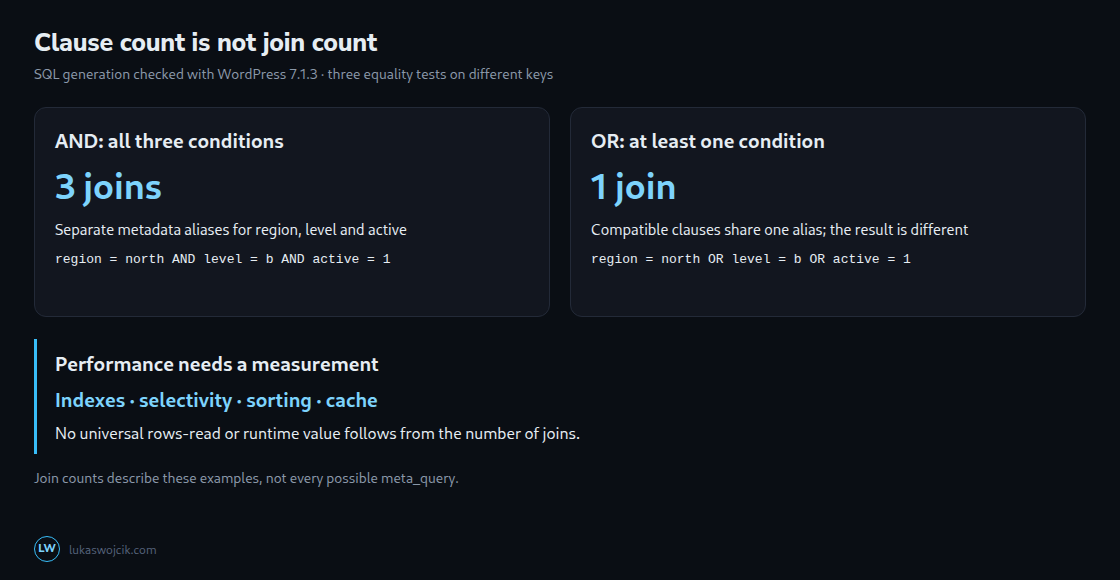
A filter with three custom fields can produce three joins to wp_postmeta. A join connects rows from tables; an alias gives one use of a table a distinct name. The number of joins depends on the conditions and their relationship, not simply on the number of fields.
Metadata stores extra information about a post, usually as a field name and value. WP_Query builds WordPress post queries, and SQL is the database query language. An index is an additional lookup structure that helps find rows without inspecting every row. A cache stores earlier results for reuse.
The practical question is how much work the actual query performs. Data distribution, indexes, result size, sorting and cache hits all affect the cost. A large metadata table is a reason to measure, not proof that every filter is slow.
What WP_Query Builds from the Array
For three equality tests on different keys connected by AND, WordPress normally uses three metadata aliases. Compatible sibling clauses can share an alias: the same three tests connected by OR use one join in the tested WordPress 7.1.3 core. That changes the meaning from “all conditions” to “at least one condition”; replacing AND with OR is not a valid performance fix. The SQL below is a simplified AND example with descriptive aliases.
SELECT wp_posts.ID FROM wp_posts
  INNER JOIN wp_postmeta pm1 ON wp_posts.ID = pm1.post_id
  INNER JOIN wp_postmeta pm2 ON wp_posts.ID = pm2.post_id
  INNER JOIN wp_postmeta pm3 ON wp_posts.ID = pm3.post_id
WHERE post_type = 'post' AND post_status = 'publish'
  AND ( pm1.meta_key = '_region'  AND pm1.meta_value = 'north' )
  AND ( pm2.meta_key = '_level'   AND pm2.meta_value = 'b' )
  AND ( pm3.meta_key = '_active'  AND pm3.meta_value = '1' )
GROUP BY wp_posts.ID
ORDER BY wp_posts.post_date DESC
The example contains three joins and four table references including wp_posts. Grouping by the post ID prevents repeated IDs when multiple matching metadata rows exist. Neither the SQL text nor the clause count proves that 500,000 rows must be read to return 40 posts. A reproducible dataset and execution plan are needed for such a claim.
Standard Indexes and Possible Extensions
A primary key uniquely identifies a row. A prefix index stores only the beginning of a text value. The database optimiser chooses the lookup and join order; an execution plan describes those choices.
The standard WordPress schema has a primary key on meta_id, an index on post_id and a prefix index on meta_key with a standard limit of 191 characters. No meta_value index is created by core. The LONGTEXT type does permit prefix indexes; a suitable additional index can help selected workloads, but cannot be prescribed without checking values, key lengths, write cost and database version.
The optimiser may start with posts or with a metadata key that narrows the result to relatively few rows. A lookup by post_id is one possible plan, not a fixed sequence. The relevant quantities include matching rows per lookup and the fraction surviving each condition. There is no universal minimum of 30 metadata rows per post.
Operators and Their Possible Costs
| Clause | Possible work |
|---|---|
'compare' => '=' | String equality; join reuse depends on the surrounding clauses. |
'compare' => 'LIKE' | WordPress wraps the value in %…%, searching for it anywhere in the text. A normal lookup based on the beginning of the value is unsuitable, while indexes on other conditions can still help. |
'type' => 'NUMERIC' | Converts the text to a signed integer with CAST(… AS SIGNED); a raw text-value index does not directly serve that numeric expression. Other indexes can still be used. |
'compare' => 'NOT EXISTS' | Missing-key test via LEFT JOIN and IS NULL; indexed lookups and early termination may help. |
'relation' => 'OR' | At least one condition must match; compatible clauses may share a join. |
'orderby' => 'meta_value' | May require an extra sort; memory use, disk use and temporary tables depend on the plan. |
Using filesort means an additional sorting step rather than index order. Despite the name, sorting can remain in memory. Disk use depends on the result, settings and database implementation. Using temporary means that a temporary table is used during processing. Neither label alone predicts a timeout; elapsed time and the actual plan determine whether optimisation is needed.
A LEFT JOIN keeps the post row even when no metadata row matches. IS NULL can then select the posts without that match. A missing key can be found with LEFT JOIN and IS NULL. An index can accelerate the search for a matching row, and an optimiser can stop searching after a match rules out that candidate. The claim that indexes cannot help prove absence is therefore wrong. The relevant WordPress operator and generated SQL must still be inspected.
Choosing Metadata, Taxonomy or a Dedicated Table
Taxonomies suit shared classifications such as regions or product groups. The standard relationship table has a composite primary key on (object_id, term_taxonomy_id) and a separate index on term_taxonomy_id; it also contains term_order. A taxonomy query can still require multiple joins or subqueries. A faster result is not guaranteed by the table name.
Metadata remains reasonable for many small or infrequently used filters. Frequently queried numeric ranges and ordered values may benefit from a dedicated table with typed columns and suitable indexes. The decision should follow the data model and measured workload. Reading metadata after a post lookup may use an object cache or a batch query; it is not universally one SQL lookup per field.
Measuring Instead of Guessing
After a normal WP_Query call, $query->request exposes the constructed SQL; the call may already have executed that SQL. The posts_request filter provides a point before the main post query is sent. A plain EXPLAIN of the complete SELECT shows the estimated plan, not a measured runtime. Database-specific execution-analysis commands actually run the query and belong on a suitable test copy.
EXPLAIN: estimated plan
key       chosen index
rows      estimated examined rows
filtered  estimated surviving percentage (MySQL)
Extra     additional operations
rows is an estimate, and MySQL’s filtered estimates the percentage surviving a condition. Join order and surviving intermediate rows matter. Multiplying every rows value, or adding a fixed cost per join, does not establish the actual total read count. A useful comparison records database version, schema, indexes, representative data, query parameters and timing, with cached results available (warm cache) and without them (cold cache).
Questions and answers
Does a leading underscore in the key, as in _region, make the query faster?
No performance property follows from the underscore. WordPress normally treats an underscore-prefixed metadata key as protected and hides it in the classic Custom Fields interface; filters can change that behaviour. This is an application convention, not a database permission or special index feature.
Does a persistent object cache help against an expensive meta_query?
A cache hit can genuinely avoid the main SQL query. WordPress added WP_Query result caching in 6.1, with persistent object caching keeping results available across separate web requests. Whether the query can be cached, the cache_results setting, removal of cached entries and marking outdated results unusable still matter. When WordPress marks post caches outdated, it changes a shared version marker. This can make cached query results unusable beyond the edited post. Direct SQL updates can instead bypass that step and leave outdated results in the cache.
Three independent filters with five selectable values each have 125 combinations when all three are set. Only requested combinations need to be computed, and popular combinations may achieve a high hit rate. Frequent updates can reduce reuse without making caching automatically useless.
Both cold and warm performance matter. A query plan helps explain a cache miss; observed traffic and hit rates show how often that cost occurs. Page caching also depends on URL and query-string handling, invalidation and configuration. Neither object caching nor a schema change should be selected from an unmeasured worst-case illustration.
Related articles