

 English
 Deutsch
 Polski
GA4 Source Group: Platform Grouping and Reporting Limits

Management Summary
GA4 Source Group brings recognised versions of a source name together under one platform. For example, different labels referring to Facebook can be viewed as a group instead of scattered entries. This makes website traffic reports easier to interpret when assessing the contribution of a platform. Grouping does not repair wrongly labelled campaign links or decide whether a visit belongs to a particular marketing channel. The field's availability also differs across reporting tools.
Contents
Several source values can describe the same platform. A report containing facebook, fb and Meta-facebook therefore needs a choice: inspect the individual labels or compare the platform as a whole. These labels may come from campaign tagging as well as referrals; their existence does not prove that the tagging is correct.
On 11 June 2026 Google announced Source Group to consolidate common platform variants and updated Source Platform classifications alongside it. The feature helps platform-level comparisons. It does not replace a campaign naming scheme or validate the existing channel report.
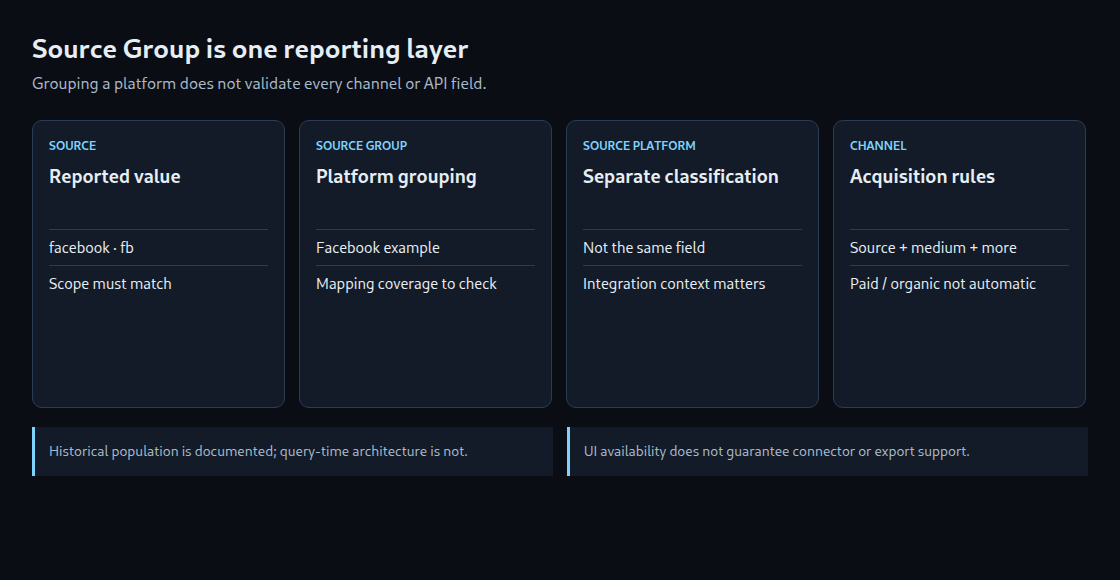
Four fields answer different questions
| Field | Question | Important boundary |
|---|---|---|
| Source | Which source value is reported? | First-user scope describes the first acquisition; session scope describes an individual visit; event scope describes the attribution of an event. |
| Source Group | Which standardized platform grouping applies? | A grouping does not explain every input or mapping rule. |
| Source Platform | Which source-platform classification applies? | It is not interchangeable with Source Group. |
| Default channel group | Which acquisition channel matches the applicable rules? | Source, medium, campaign and integration data can all matter. |
Google’s release gives facebook, fb and Meta-facebook as variants consolidated into Facebook. It also describes groupings for other major platforms and AI sources. The examples are not a complete published lookup table. A particular domain alias should be checked against actual report values before being treated as a guaranteed mapping.
The same platform can contribute to paid and organic channels. The medium is often important, but it is not the only possible channel input. Source categories, campaign conditions and platform integrations also influence classification. A neat platform group therefore does not prove that every underlying campaign has the right channel.
Retroactive does not mean unlimited or immutable
Google states that Source Group is populated retroactively. That supports analysis of available historical data. The release does not specify that grouping is calculated only at query time, nor promise complete coverage of every historical date and report surface.
A year-over-year comparison still needs consistent scope, definitions, filters and available data. A prior export and a newly generated report may use different classifications. A saved snapshot of the grouped result, its extraction date and report settings makes later changes easier to investigate.
Campaign naming remains useful
Standard platform groupings do not document the meaning of internal campaign names. A source such as nl might mean a newsletter, a country or a partner code. Its intended meaning belongs in a naming dictionary, with an owner and explicit source/medium conventions.
A local grouping should be labelled as local. A small exact-match table is easier to audit than a broad substring rule that assigns any value containing facebook to Facebook. The latter can also capture an unrelated label such as not-facebook.example. Unmatched values should remain visible for review.
Availability in reporting tools needs its own check
A field appearing in the Analytics interface does not automatically establish support in every API or connector. The native Google Analytics connector in Looker Studio/Data Studio uses the Analytics Data API. The public Data API dimension list checked on 24 October 2026 did not document a sourceGroup field. Current property metadata and the connector’s field list provide the relevant implementation check.
If the field is supported, an existing chart still needs the intended dimension selected; a chart based on Session source does not become a Source Group chart by itself. If the field is absent, adding a guessed API name is not a solution. A clearly identified local grouping or a supported export can serve a different, documented reporting need.
The documented BigQuery export schema did not list source_group on the same date. However, that export contains more than raw values: collected traffic information, session last-click attribution and first-user acquisition are distinct records. A warehouse grouping must choose the appropriate scope and cannot claim to reproduce Google’s undisclosed mapping exactly.
A discrepancy needs more than one explanation
- The comparison starts with the same property, date range, metric, acquisition scope and filters.
- A detail table retains the source and reported group together where that combination is supported. Unknown and unassigned values remain visible.
- Pagination, omitted rows and the data-quality indicators are checked before summing. An
(other)row can conceal individual aliases. - A mapping audit checks which group each source value receives, not just the total. Two wrongly swapped labels can preserve the grand total.
- Session and user metrics require attention to deduplication and dimension boundaries. A mismatch alone does not prove that Google failed to recognize a spelling.
Hostname filters change collection, not source labels
The same June release introduced hostname exclusions. Since September, hostname filters also support an include-only operation. An active data filter affects incoming data permanently and does not clean historical records retroactively. Testing mode helps validate the selected hosts before activation.
The include-only feature explicitly does not filter Measurement Protocol events; empty hostnames are excluded by that operation. This is therefore not complete protection against every source of unwanted events. Source grouping and hostname filtering solve different problems and need separate change records.
Questions and answers
Does Source Group fix inconsistent UTM parameters?
It can consolidate recognized platform variants in the grouped view. It does not establish the intended meaning of every campaign label, repair missing parameters or prove correct attribution. Consistent future tagging remains valuable.
Can a local lookup table replace the Google field?
It can implement a documented business grouping. Its name, rules and version should distinguish it from Google’s dimension. A test should retain unmatched inputs and ensure that a join does not duplicate records.
Is every difference between the interface and BigQuery caused by Source Group?
No. Scope, identity, attribution, modeled data, filters and aggregation can differ. A source-group comparison is meaningful only after those boundaries have been made explicit.
Related articles




One comment
Update: When this article appeared, the hostname filter could only exclude. Since 21 September 2026 it has a second mode, “Include”: the list then names the permitted domains, and events with any other hostname, or an empty one, are dropped; events sent through the Measurement Protocol are exempt. What stays the same is the timing: this filter, too, applies only from the moment it is created. The rules in detail are covered in a separate article: GA4 Hostname Include Filter.