English
 Deutsch
 Polski
Key Events and Conversions in GA4: What the Two Metrics Actually Mean

Management Summary
In Google Analytics 4, key events mark website actions considered important to the business. Conversions created from them support shared measurement with Google Ads and advertising decisions. This distinction explains why the two figures need not match even when data collection works correctly. Different selected actions, counting rules and reporting dates can produce different totals. Linking an advertising account does not automatically turn every key event into a conversion, and both measures can include estimated results.
Contents
Key events and conversions can describe the same business action, but the metrics are not interchangeable. Both can involve attribution and modeled data. The useful distinction concerns the configured action, reporting scope and counting rules—not a supposedly raw counter versus a modeled one.
From an event to a conversion
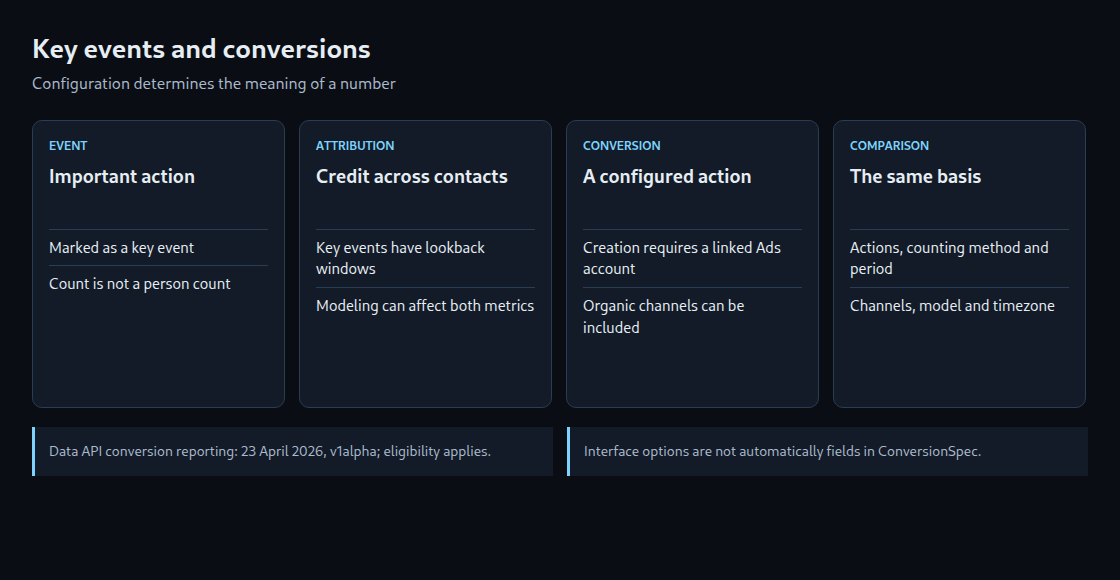
A key event is an event marked as important in Analytics. A conversion based on that event supports shared measurement across Analytics and Google Ads. Creating a new conversion from a key event requires a linked Ads account; linking alone does not convert every key event automatically. Creation is available through Analytics or Ads.
Key-event counts are not counts of people. Repeated actions and the selected counting method matter. Key events also support marketing analysis; conversions can include organic channels. A strict division into internal website figures and paid-advertising figures would therefore be misleading.
Attribution and modeling are different
Attribution assigns credit to earlier contacts, such as a search result visit or an ad click before a purchase. Key-event reports have attribution settings and a lookback window, which limits how far back an eligible contact can lie. Event-scoped source dimensions can show fractional credit. For example, one purchase can contribute 0.4 to one source and 0.6 to another, rather than count as two purchases. User- and session-scoped traffic dimensions do not change with the reporting attribution model.
Modeling estimates information that cannot be directly observed. Google documents modeled key events in reports, so key events are not an automatically unmodeled baseline. An attribution model and the estimation of missing observations answer different questions.
What the April 2026 API release added
Google’s Data API changelog dates conversion-reporting support to 23 April 2026. The v1alpha runReport method can retrieve Conversion performance data. Availability is subject to property eligibility.
ConversionSpec documents conversionActions and attributionModel, with DATA_DRIVEN or LAST_CLICK. The interface also offers conversion-time or interaction-time reporting, but that does not establish a third time-basis field in ConversionSpec. Request fields and report metadata need checking against the actual API version.
A comparison that can be interpreted
A useful comparison records the selected events or conversion actions, counting method, attribution model, eligible channels, windows, reporting period and timezone. It also distinguishes all conversions from a narrower selection: All conversions includes primary and secondary actions.
A synthetic example shows why dates matter. A click on Monday followed by a purchase on Thursday contributes to Monday under interaction-time reporting and Thursday under conversion-time reporting. Different daily values do not alone prove lost tracking. The example explains a time basis; it is not a measurement from a live property.
Unsupported reports are not evidence of hidden mixing
Google documents situations where key-event reporting remains necessary, including attribution paths and unsupported app or advertising-product dimensions. This describes reporting coverage. It does not establish that a report silently mixes both metrics under an undisclosed heading. The selected report and metric remain essential context.
A maintainable extraction
An extraction should retain the request, retrieval time, API version, response metadata and original response. All response pages must be accounted for before replacing a complete stored period. Recent periods may need refreshing because processing and attribution can revise historical values.
Raw snapshots help diagnose a change, but do not guarantee that a field rename or changed meaning affects only one line. Downstream calculations also need validation. Refresh periods should follow the applicable windows and processing behaviour; figures need not only increase.
Practical check before comparing reports
A before-and-after configuration record helps identify changed definitions. The GA4 Property Configuration Comparator provides a separate configuration comparison; a clean comparison within its scope does not prove identical tagging or collected data. The GA4 API Response Inspector supports inspection of a report response. Neither tool replaces checking the metric, complete response and business outcome.
GA4 Property Configuration Comparator
Questions and answers
Does a missing conversion mean no important action occurred?
No. A recorded key event need not have a conversion created from it. Eligibility and report coverage also matter. The absence of a particular conversion report is not evidence of zero business outcomes.
Which metric is appropriate after a website redesign?
The metric must match the question. Confirmed outcomes, event counts and people are different measures. A comparison over time needs stable collection, event definitions and counting settings; the name key event alone does not make two periods comparable.
Sources
- Release date and v1alpha eligibility
- ConversionSpec fields and paginated reporting
- Key-event attribution and lookback windows
- Modeled key events and subsequent processing
- Cross-channel coverage, time basis and All conversions
- Linked Ads required for creation; Analytics and Ads creation
- Key-event reporting, specific selection and marketing uses
Related articles