English
 Deutsch
 Polski
Meta Attribution Change of March 2026: Link Clicks, Engage-Through and the One-Day Window

Management Summary
Attribution is the rule for giving advertising credit for a later purchase. Meta's March 2026 change separates link clicks from reactions, saves and other engagement, using different time periods for that credit. This matters when comparing campaign performance before and after the change: reported results can move even if actual orders do not. The applicable account settings and rollout determine the effect. Adding the new categories does not reliably rebuild the old measure, so business trends need comparison with real orders.
Contents
On 3 March 2026, Meta announced a new attribution boundary for website and in-store conversions: click-through would include link clicks, while other clicks would be considered under engage-through. Attribution assigns a conversion to an earlier ad interaction. It does not by itself establish additional purchases caused by advertising.
The rollout was scheduled to begin later in March, at different times across accounts. The help page checked on 24 October still notes that some accounts may use earlier definitions. That does not establish one universal changeover date for every report.
The action matters, not its position on the ad
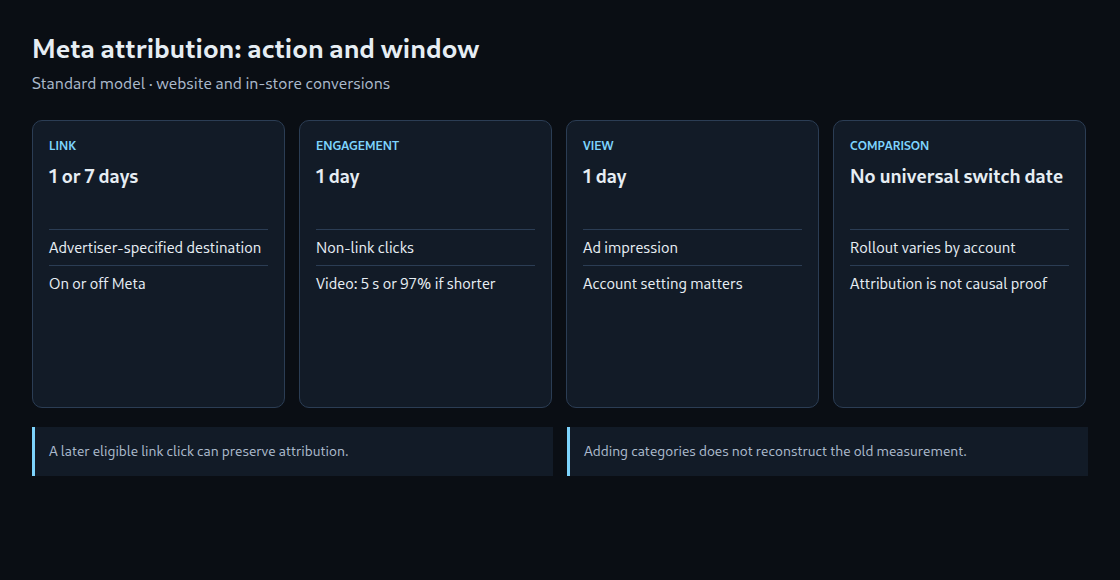
A link click leads to an advertiser-specified destination on or off Meta technologies. “Goes somewhere” is therefore not a sufficient rule: the ad configuration and destination action matter. An image, headline or profile reference cannot be assigned to a category solely by its position. Link clicks and outbound website clicks are different metrics.
Standard attribution offers one or seven days for link clicks, one day for view-through and one day for engage-through. Meta states a default of seven-day click plus one-day view and engagement. The ad set’s actual setting remains decisive; other models and certain campaign types follow different rules.
Engage-through covers non-link clicks such as reactions, shares and saves. For video, five seconds of playback qualifies; videos shorter than five seconds require 97% of their length. Five seconds is the playback threshold, whereas one day is the subsequent attribution window.
When a conversion can lose attribution
This simplified example assumes a previous seven-day click window, the new one-day engagement window and no other eligible ad contact. Event collection and identity matching are assumed to succeed.
| Contact sequence | Previous rule | New rule |
|---|---|---|
| Comment on day 0, purchase on day 3 | Inside the assumed click window | Outside the engagement window |
| Link click on day 0, purchase on day 3 | Inside the seven-day click window | Still inside the seven-day click window |
| Comment on day 0, additional link click on day 2, purchase on day 3 | Eligible contact exists | The link click can still qualify |
An older comment alone may therefore no longer qualify. That does not mean automatic removal from every Meta result: another link click or eligible contact can support attribution. An event in Events Manager and an attributed conversion in Ads Manager are also different observations.
The total does not reconstruct the old report
Click-through plus engage-through does not automatically equal the previous click total. The windows differ, and the video threshold also fell from ten to five seconds, allowing additional video contacts to qualify. Neither the ad type nor the current engagement share reliably predicts the direction or size of the overall change.
In particular, a large one-day share does not reveal the unobserved delay distribution on days two to seven. Two campaigns can have the same one-day count and completely different later patterns.
Comparisons need documented measurement settings
The announcement does not establish that every historical report remains available unchanged under the old definition. Comparisons therefore need the account, evidence of its changeover, model, windows, metric, period, timezone and reporting date basis. Saved exports and current comparison views help make differences visible.
Meta lists attribution windows, timezones, conversion versus exposure dates and collection faults among reasons for discrepancies with other tools. Stable orders alongside falling Meta attribution justify investigation; they do not isolate the rule change’s effect. Campaign mix, demand, tracking and delivery can change at the same time.
Cost metrics and advertising impact are separate questions
Meta announced no billing change from this update. That does not guarantee unchanged spending or delivery: the attribution model also informs optimization. CPA is advertising spend divided by the number of attributed conversions. At a mathematically fixed spend of €1,000, CPA rises from €10 to €12.50 when attributed conversions fall from 100 to 80. The calculation alone says nothing about additional or lost orders.
Advertising impact requires a suitable comparison-group study, such as a carefully designed lift test comparing outcomes in groups with and without the advertising under study. Its conclusions also depend on study design and uncertainty. Standard attribution describes rule-based credit, not the causal effect of each contact.
Questions and answers
Does every decline since March result from the update?
No. The account’s actual rollout state, collection faults and business changes need checking first. The calendar month alone does not establish a cause.
Is every profile interaction engage-through?
A fixed classification by image area or profile row is unsuitable. The ad’s defined link and destination action matter.
Can addition restore the old total?
Not generally. Different windows and the changed video threshold prevent a simple reconstruction. Unknown gaps should remain explicitly unknown.
Related articles