English
 Deutsch
 Polski
Release Metadata 2026: Assigning ISRC, UPC/EAN and ISWC, Writing Them into Files and Checking Them Step by Step

Management Summary
Music release codes identify different things: ISRC names a particular recording, UPC or EAN identifies a release product, and ISWC identifies the musical work behind the recording. These distinctions help distributors and catalogues keep singles, albums and new versions correctly associated. An unchanged recording keeps its ISRC when moving onto an album or to another distributor. Accurate accompanying information matters as much as the code: a correctly formatted number alone proves neither assignment nor music rights.
Contents
- Three identifiers for three levels
- 1. ISRC assignment and documentation
- 2. When a version needs a new ISRC
- 3. Recording the accompanying data
- 4. A product code for each release edition
- 5. An ISWC for the musical work
- 6. ISRC storage in audio files
- 7. What a check proves
- Questions and answers
- Sources and further detail
A recording can appear first as a single and later on an album. The same recording keeps its ISRC, while the album receives its own product code. The ISWC identifies the underlying musical work. Keeping these three levels separate prevents confusion during release.
Codes complement the title, artist and version details. A correctly formatted code proves neither an actual assignment nor rights to the music. This guide explains assignment, file fields and checks. The FFmpeg behavior was checked again on 25 October 2026 using newly generated test tones.
Three identifiers for three levels
| Code | Identifies | Example |
|---|---|---|
| ISRC | A particular sound recording or music video | The same single recording on an album |
| GTIN / UPC / EAN | A release product or edition | Separate numbers for CD and vinyl |
| ISWC | The underlying musical work | Different recordings of the same unchanged work |
A new performance of the same song needs its own ISRC. If the musical work remains unchanged, the same ISWC association can remain. An adaptation of the work needs separate assessment. Conversely, the same recording can appear on several releases while keeping its ISRC.
1. ISRC assignment and documentation
The responsible ISRC agency allocates a prefix: the first five characters. Examples include BVMI in Germany, LSG in Austria, IFPI Switzerland in Switzerland and ZPAV in Poland. Within the allocated number range, the recording rights owner or an authorized long-term exclusive licensee assigns complete codes to recordings.
An ISRC consists of its prefix, a two-digit year of reference and a five-digit designation code. The year refers to assignment, not recording. Sequential designation codes are recommended; the essential requirement is that the same prefix and reference year never produce duplicate complete ISRCs. A self-selected prefix is not allowed.
Without a dedicated prefix, an appointed ISRC Manager can handle assignment, such as a distributor set up for that role. The assigned codes must be communicated to the rights owner and retained in subsequent deliveries. Receiving a recording does not itself justify assigning a new code. Existing ISRCs need checking before a new assignment.
The ISRC is assigned after creative work is complete. Delivery uses the twelve characters; the word “ISRC” and hyphens help human-readable presentation. Lower-case letters can be converted to upper case before checking. The handbook code AA6Q72000047 is a fictitious example, not a code for a real release.
2. When a version needs a new ISRC
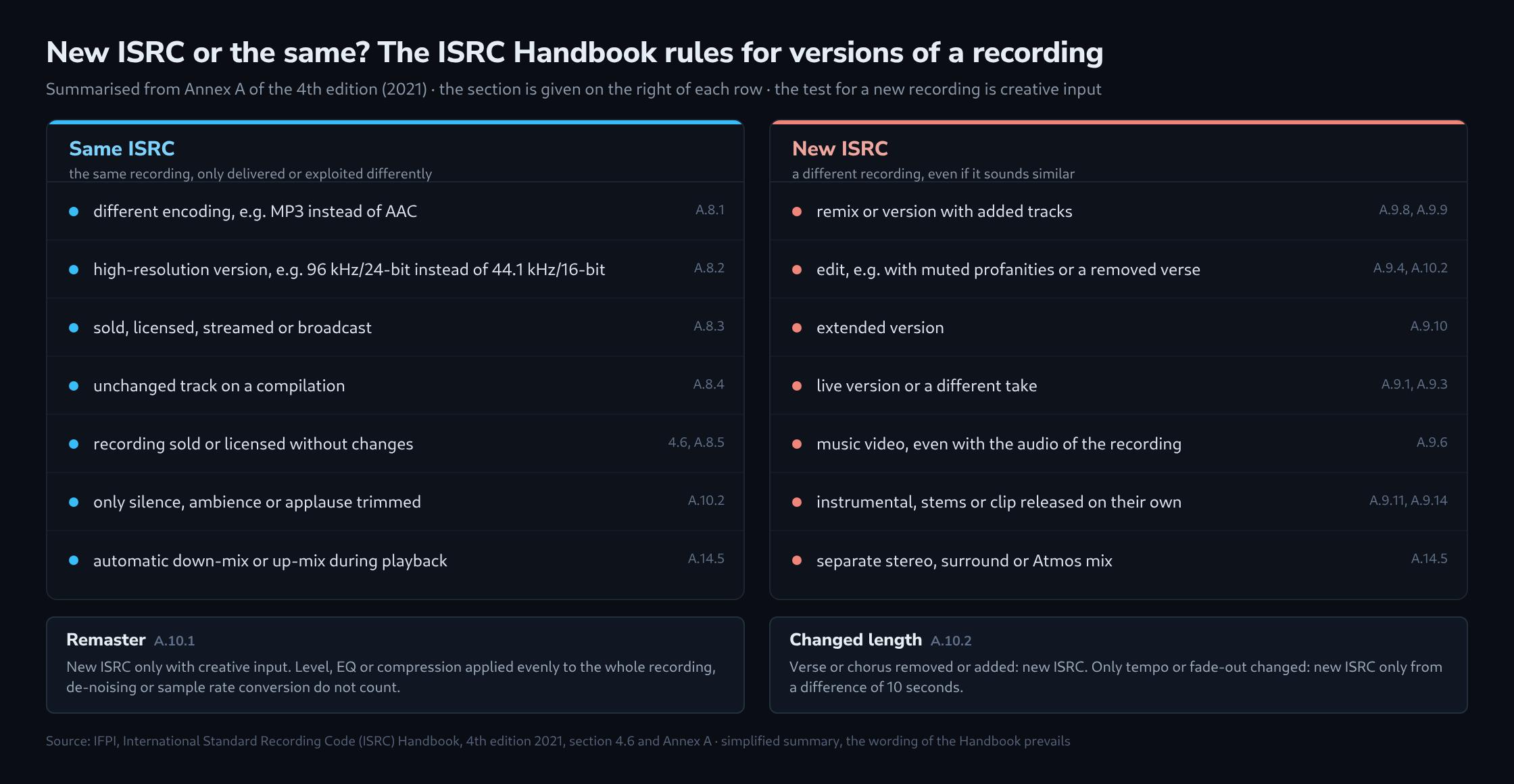
A new performance or distinct mix differs from a file that merely stores the same recording differently. The ISRC Handbook gives the following rules:
- Technical processing: Uniform level, EQ or compression settings, noise removal or sample-rate conversion do not by themselves justify a new ISRC. A remaster with creative changes can require a new code.
- Adding or removing sections: Added or removed verses and choruses require a new ISRC.
- Only tempo or fade-out changes: Without a substantive creative change, a length difference below ten seconds keeps the code. From exactly ten seconds, Annex A.10.2 calls for a new code.
- Only silence, ambience or applause changes: Changes consisting solely of material without creative input do not create a new ISRC. The ten-second rule is not a general rule for every trim.
- Stereo and multichannel: A distinct multichannel mix gets a different ISRC from the stereo mix. Automatic channel conversion during playback and different file encodings of the same mix do not create a new recording.
A filename containing “Remaster” or “Extended Mix” does not decide the issue. The actual change matters. The responsible ISRC agency can help classify unclear cases.
3. Recording the accompanying data
The ISRC needs a documented description of its recording. At minimum, records contain the code, main artist, recording title, version title, duration, content type and first publication. Content type distinguishes a sound recording from a music video. Duration concerns recorded content rather than arbitrary added silence.
A separate “Live in Paris” or “Extended Mix” field makes delivery easier when services use different naming rules. The handbook lists the first-publication year in section 4.7 and the date in Annex E. An accurately documented first publication prevents later confusion.
4. A product code for each release edition
GTIN is the product identifier in the GS1 system. GTIN-12 and GTIN-13 are commonly represented in UPC-A and EAN-13 barcodes. Adding a leading zero provides the corresponding 13-digit representation of a GTIN-12; it does not create a new product identity. The final digit is a calculated check digit.
A CD and a separately orderable vinyl edition are different products and need different GTINs. Unchanged recordings keep their ISRCs. An album is also a separate product from a previously released single.
A GS1 Company Prefix supports multiple numbers. Some GS1 organizations also offer individual numbers, such as single GTINs from GS1 US. A distributor can provide a product code too. Whether an existing code can transfer requires agreement with the new distributor; moving distributors does not itself technically require a new number.
5. An ISWC for the musical work
The ISWC consists of T, nine digits and a check digit. Authorized registration agencies assign it. Assignment usually accompanies work registration through the relevant collecting society. Every creator involved must be uniquely identified, including for new works.
Eligible publishers can obtain access to the ISWC Allocation Service through their society. Without a direct relationship to a registration agency, the central ISWC authority can assist. Creators cannot invent their own assignment. An ISWC specifies neither ownership shares nor a particular audio file.
6. ISRC storage in audio files
File metadata consists of additional text fields alongside the audio signal. The documented FL Studio Project Info window has no dedicated ISRC field. A suitable tool can add the code after export. The field name is not the only consideration: the receiving program must read the location where the value was stored.
The following table applies to the tested commands with FFmpeg 7.1.5. A short artificial tone was written to seven formats, with additional ID3v2.3, M4A metadata and BWF variants. Checks used ffprobe and, for MP3 and WAV, direct parsing of the metadata blocks.
FFmpeg converts audio files; ffprobe lists their stored properties. An ID3 frame is one labeled metadata block in an MP3 file. A format tag belongs to the whole file, while a stream tag belongs to a contained audio stream. BWF is a WAV variant with additional broadcast metadata.
| Format and option | Observed result |
|---|---|
| MP3: -metadata ISRC=… | A general TXXX text field named ISRC |
| MP3: -metadata TSRC=… | The intended TSRC frame; confirmed for ID3v2.3 and v2.4 |
| FLAC: -metadata ISRC=… | ISRC in Vorbis comments; ffprobe format tags |
| Ogg Vorbis / Opus: -metadata ISRC=… | ISRC in comments; ffprobe stream tags |
| M4A / AAC: -metadata ISRC=… | No ISRC in the tested default output |
| M4A with -movflags use_metadata_tags | A custom ISRC metadata key; receiver compatibility remains separate |
| WAV, also with -write_bext 1 | ISRC in RIFF INFO, where the name denotes Source, not the recording identifier |
| AIFF: -metadata ISRC=… | No ISRC in the tested default output |
The commands produce new files from a WAV master. -n prevents overwriting existing output files. The example code is for tests only. A release requires the ISRC actually assigned to that recording.
ffmpeg -n -i master.wav -c:a libmp3lame -q:a 2 -metadata TSRC=AA6Q72000047 test-release.mp3
ffmpeg -n -i master.wav -c:a flac -metadata ISRC=AA6Q72000047 test-release.flac
ffprobe -v error -show_entries format_tags:stream_tags -of json test-release.mp3
ffprobe -v error -show_entries format_tags:stream_tags -of json test-release.flac
For MP3, ffprobe displays the TSRC key. A general text field named ISRC can display the same value even though another program reads only the intended TSRC frame. File inspection therefore does not replace checking the distributor’s requirements.
Correctly embedded tags do not replace delivery metadata either. The distributor needs the right code in its form or agreed data exchange, such as a structured DDEX message containing release and recording details. A file field alone does not guarantee inclusion in the catalogue.
7. What a check proves
- The code validator checks structure and, for GTIN and ISWC, check digits. A “valid” result does not confirm assignment.
- The MusicBrainz lookup shows community database entries for a code. Several entries are a reason to investigate, not proof of an assignment error.
- Official ISRC search
- Official ISWC search
A database result indicates a stored association. A missing result does not prove an invalid assignment; official databases can also be incomplete. MusicBrainz is additionally maintained by a community and can contain errors. A suspected duplicate assignment needs checking against the assignment records.
For an ISRC actually used twice, Annex A.13.3 describes correction for one or both recordings. When a single recording has several ISRCs, one preferred code is selected and the others remain documented. Business partners need notification of the correction. Minor assignment errors should not trigger a replacement code without assessment.
Questions and answers
Does changing distributors change an ISRC?
An unchanged recording keeps its ISRC, even if the previous distributor assigned it. A shared list of codes and accompanying data supports the move. Transfer of the product code is addressed separately. Changing distributors does not give an unchanged musical work a new ISWC.
Why is a correct check digit insufficient?
A check digit detects certain input errors. A fabricated number can still be mathematically correct. The check proves neither assignment nor association with the right product or work. An ISRC has no check digit at all.
Does an album version of a single need new codes?
The album needs its own product code. An unchanged recording retains the single’s ISRC. A different mix or edited version follows the rules in step 2. Keeping the same ISWC requires that the same musical work is still being identified.
Sources and further detail
- ISRC Handbook, 2021
- IFPI: ISRC FAQ
- IFPI: ISRC validation
- IFPI: valid prefix characters
- ISWC: structure and purpose
- ISWC: assignment
- GS1: GTIN Management Standard
- GS1 US: Company Prefix
- GS1: check-digit calculation
- ID3v2.4: frame specification
- Xiph: Vorbis comments
- ExifTool: RIFF tags
- Image-Line: Project Info
- GS1 US: individual GTIN
- ExifTool: RIFF source code
Related articles