English
 Deutsch
 Polski
From Free Online Tool to SaaS: Which Feature Justifies a Subscription?

Contents
A free calculator answers a question. A paid product takes responsibility for a task. That difference needs more than a login: recurring service must replace a recognisable workflow. A paid download button rarely supplies that reason to buy.
The example is a hypothetical website checker. A free version checks a pasted file once in the browser. A possible SaaS compares recurring checks, reports new findings and records resolution. This does not introduce a paid service on this website.
Four extensions compared
| Feature | Reason to buy | New obligation |
|---|---|---|
| Saved projects | Avoid repeating settings | Export, deletion, access protection |
| History | Separate new errors from old ones | Stable, explained checking rules |
| Monitoring | Notice issues without individual checks | Reliable runs and alerts |
| Team and API | Integrate results into workflows | Permissions, limits, attribution |
From finding to action
A hundred warnings save little work if their meaning remains unclear. A paid workflow might report only new critical findings, show the last successful run and assign responsibility. Suppression needs reasons and expiry dates so that problems do not disappear permanently.
A server-side checker needs protection against requests to local and internal addresses. A robots.txt file is a crawling instruction, not access protection. Protected data needs other controls. These limits belong in the pilot. [2]
What a small subscription must cover
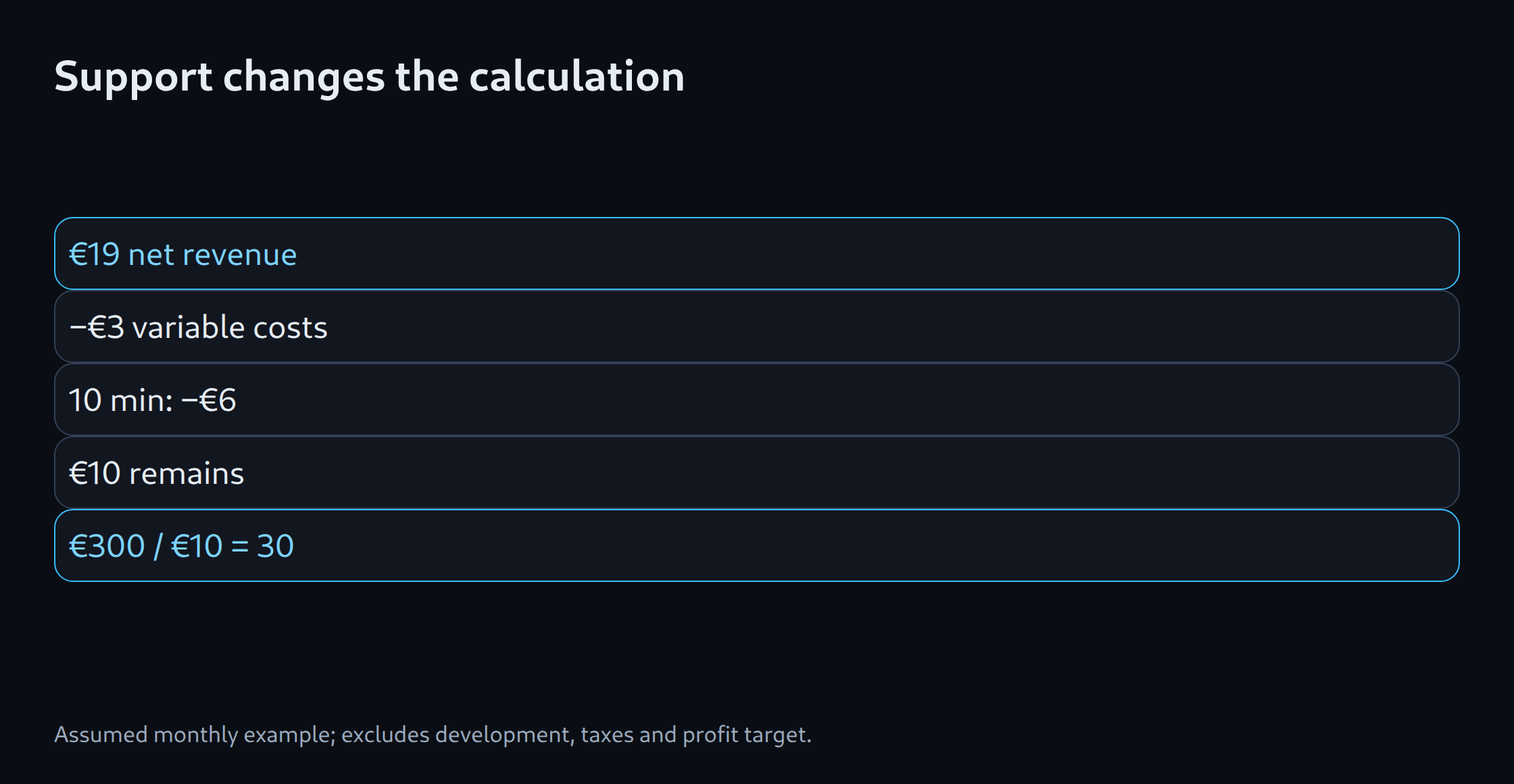
All net figures below are assumptions, not vendor prices: €19 monthly revenue, €3 for payments and variable infrastructure, and ten minutes of support valued internally at €36 per hour. Support costs €6, leaving €10 before fixed costs, development and taxes.
With assumed fixed monthly costs of €300, 30 comparable customers are required. Twenty minutes of support costs €12, leaves €4 and raises the break-even point to 75 customers. Clear findings and documentation are economic features rather than optional convenience.
A meaningful usage unit
Monitored projects or completed checks are easier to explain than internal API calls. Stripe documents usage billing; the product must define what counts. Repeats caused by internal errors should not become a second customer service. [1]
A bounded pilot includes one project, a check cycle, a change report and an agreed exit. Another run needs a real reason. The free single check can remain available; payment buys the ongoing workflow.
Related tools
Questions and answers
Is saved history enough for a subscription?
Only when comparison repeatedly saves relevant work. Storage alone does not establish recurring value.
Does the example forecast 30 customers?
No. It calculates break-even under assumed costs without proving demand.
Sources
Sources checked: 5 October 2026.
Related articles