English
 Deutsch
 Polski
AI Models for Coding: GPT and Claude versus DeepSeek and Qwen

Contents
A coding model becomes useful when a change works inside an existing project. Short snippets, repository repairs and multistep agent work are distinct tasks. This comparison, dated 6 October 2026, covers GPT-6 Astra and 6.1 Sol, Claude Opus and Sonnet 5.5, Gemini 3.8 Flash, DeepSeek V4.1 Flash and Qwen3.8-27B.
Cloud candidates and open weights
The documented cloud models support text processing and tool integration. OpenAI positions Astra for demanding work; Anthropic explicitly describes Opus 5.5 for long-running agentic coding. Gemini 3.8 Flash documents function calling and code execution. These features establish test candidates rather than directly comparable success rates. [1, 4, 6]
DeepSeek and Qwen publish model weights. Qwen’s model card lists serving engines and explains the conditions of its coding evaluations. A local Qwen run with a different quantization or agent framework does not automatically reproduce those conditions. [7, 8]
What the comparison should measure
| Task | Cloud: GPT / Claude / Gemini | Open: DeepSeek / Qwen |
|---|---|---|
| Small function | API latency and correct output | Startup and local latency |
| Repository bug | Patch and passing tests | Same tests, exact checkpoint |
| Agent work | Tool steps and total cost | Framework, memory and failures |
| Review | Relevant findings rather than volume | Same known defects and false alarms |
A concrete repository protocol
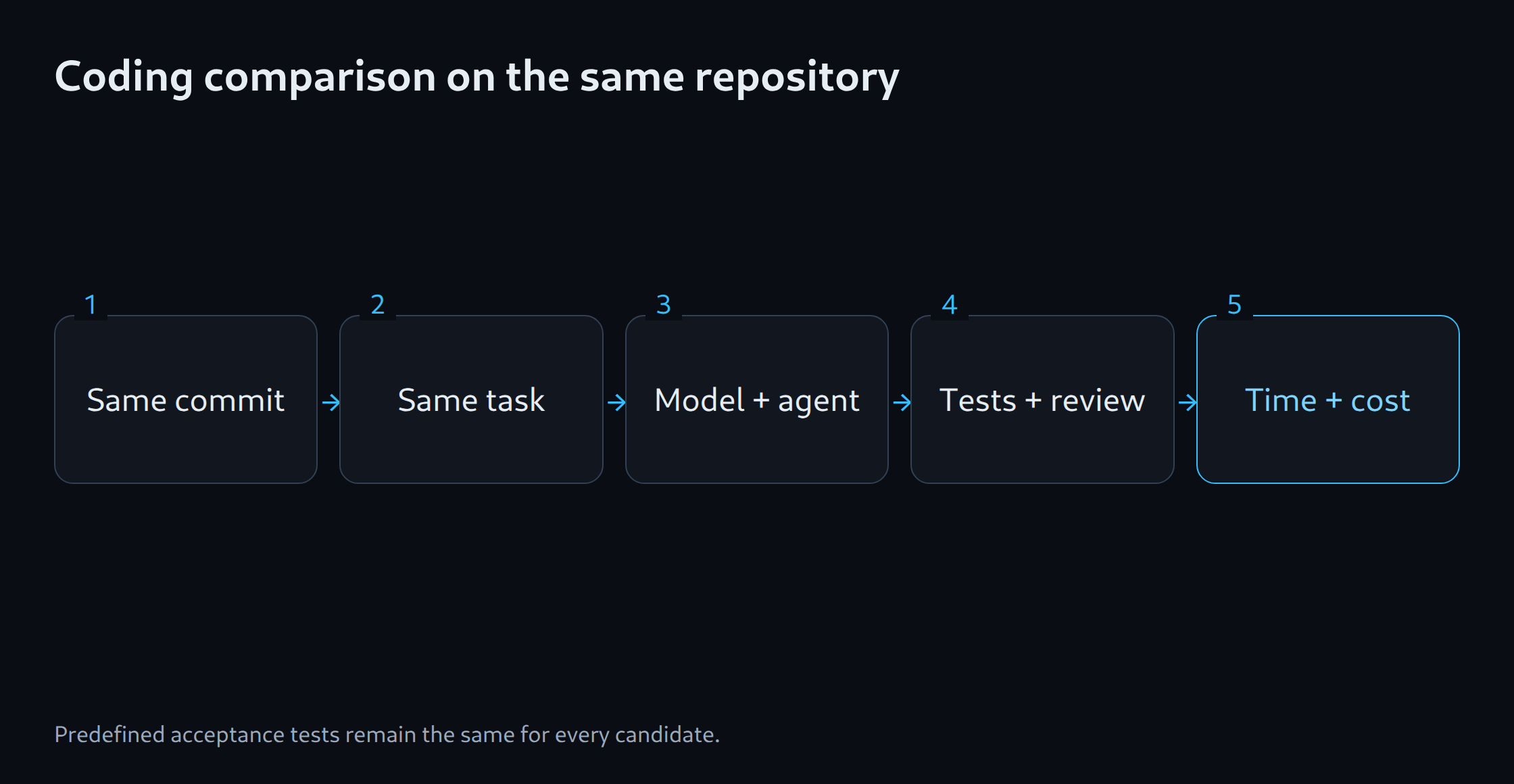
An editorial test plan includes six tasks: a reproducible bug, a small feature, an API change, a refactor, an additional test and a review with known defects. Every run starts at the same commit. Acceptance tests remain fixed; reducing the test suite does not count as successfully completing a change.
The log records completed tasks, new regressions, unnecessary files, tokens and minutes to a verified result. Repeated runs distinguish an accidental success from dependable quality. Results from different agent interfaces also need a separate system-level comparison.
When local operation matters
A local Qwen variant warrants testing when code should remain within the organisation and available hardware supports the required context. Ollama simplifies execution but does not replace architecture support or correct tool integration. DeepSeek planning must account for the complete model; a small count of active MoE parameters does not establish equally small memory requirements. [7, 9]
Cloud models remain possible escalation candidates for difficult changes. Switching follows a recorded failure threshold rather than brand preference. This article describes an evaluation design; actual success rates require executed tests.
Related tools
Questions and answers
Is a high coding benchmark score sufficient?
Test conditions, agent frameworks, repeated runs and real repository tasks also matter. A vendor score does not replace a project evaluation.
Does Ollama automatically keep code local?
The selected model call and integrated tools determine the data path. Ollama also supports cloud features, so local-only operation requires the corresponding configuration.
Sources
- OpenAI: model catalogue
- OpenAI: GPT-6.1 Sol
- Anthropic: Claude model overview
- Anthropic: Claude Opus 5.5
- Anthropic: Claude Sonnet 5.5
- Google: Gemini 3.8 Flash
- DeepSeek: V4.1 Flash model card
- Qwen: Qwen3.8-27B model card
- Ollama: FAQ and local/cloud operation
- OpenAI: API pricing
- DeepSeek: models and pricing
- Google: document understanding
Sources checked: 6 October 2026.
Related articles