Top 5 DAWs in 2026: FL Studio, Ableton Live, Logic Pro, Cubase and Bitwig Studio Compared

Contents
- What changed in 2026
- 1. FL Studio 2026: the fastest route from idea to finished pattern
- 2. Ableton Live 12: Session View, live performance and sound design
- 3. Logic Pro 12: the most complete package on the Mac
- 4. Cubase 15: MIDI depth, composition and scoring
- 5. Bitwig Studio 6: modulation, clips and Linux
- Features compared
- Usability compared
- Prices and licence models
- Just outside the top five
- Conclusion: FL Studio is the first choice for most productions
- Sources
A digital audio workstation, or DAW, is the program in which a track is written, recorded, arranged, mixed and exported. Five of them set the pace in music production in 2026, and each received a new major version or a substantial update between November 2025 and September 2026: Cubase 15, Ableton Live 12.3 and 12.4, Logic Pro 12, Bitwig Studio 6 and FL Studio 2026. This overview compares their features, their usability and their prices, and ends with a recommendation.
Version numbers, release dates and prices were checked against the manufacturers’ shops, release notes and the trade press on 16 September 2026. Prices are list prices in the currency the manufacturer’s own shop uses: Image-Line sells FL Studio in US dollars, the other four are quoted in euros. The selection concentrates on production — composing, beatmaking, sound design and mixing in one program. Fender Studio Pro, Pro Tools and Reaper follow in a separate section.
What changed in 2026
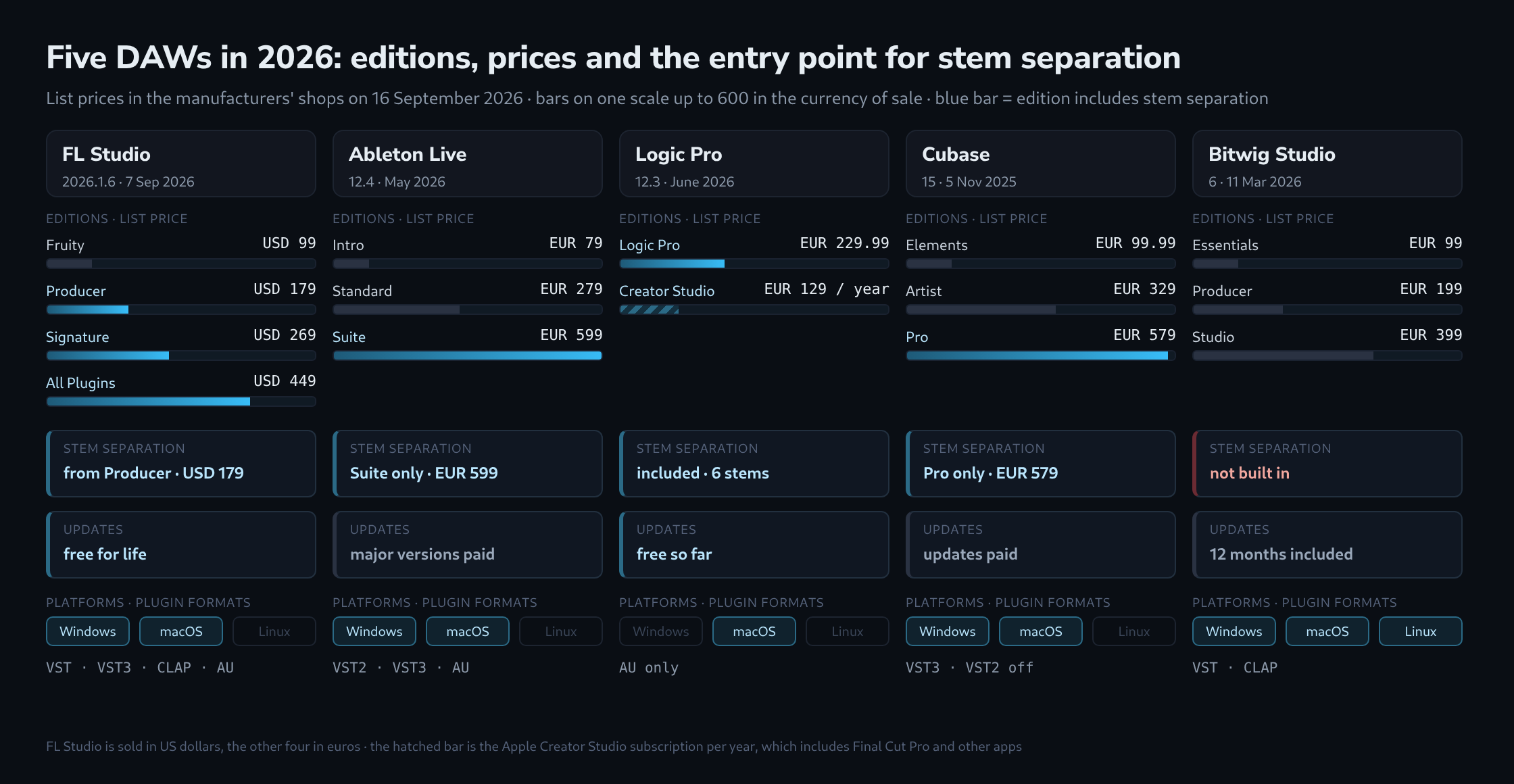
Stem separation became a standard feature. Splitting a finished stereo mix into vocals, drums, bass and the remaining instruments used to require a separate application. In 2026 it is built into FL Studio, Ableton Live, Logic Pro, Cubase and Fender Studio Pro. The differences lie in the details. Logic Pro separates six stems — vocals, drums, bass, guitar, piano and other — while Ableton Live and Cubase deliver four. Ableton reserves the feature for Live Suite, Steinberg for Cubase Pro, and Image-Line includes it from the Producer Edition upwards. Bitwig Studio has no built-in stem separation as of version 6.1, and Avid showed it for Pro Tools only as a tech preview at IBC in September 2026.
Assistants moved into the DAW. Since FL Studio 2026, the built-in assistant Gopher organises tracks, sets mixer levels, routes audio and writes Piano Roll and VFX scripts from a text instruction. Logic Pro 12 added a Synth Player to its AI Session Players and introduced Chord ID, which reads the harmony of audio and MIDI regions. Cubase 15 brought Omnivocal, a vocal synthesis engine based on Yamaha technology that sings lyrics typed into the Key Editor and is still labelled beta. None of these features produces a finished song; all of them work inside a project that a person arranges.
Licence models drifted apart. Three models now exist side by side: a one-off purchase with free updates (FL Studio for life, Logic Pro so far without exception), a purchase with paid upgrades or a time-limited update plan (Ableton Live, Cubase, Bitwig Studio), and subscriptions or rent-to-own plans (Apple Creator Studio for Logic Pro, rent-to-own for Ableton Live Suite).
The market consolidated. On 6 January 2026, LANDR, a company built around AI mastering and music distribution, bought Reason Studios. A week later, on 13 January, PreSonus Studio One Pro became Fender Studio Pro. And Logic Pro 12 ended support for Intel Macs: it requires Apple silicon and macOS 15.6 or later.
1. FL Studio 2026: the fastest route from idea to finished pattern
Image-Line released FL Studio 2026 in July 2026 as a free update; the current build is 2026.1.6 from 7 September. The program runs on Windows and macOS and is sold in four editions: Fruity Edition (USD 99), Producer Edition (USD 179), Signature Bundle (USD 269) and All Plugins Edition (USD 449). Every edition includes lifetime free updates, FL Cloud and the assistant Gopher.
FL Studio is built around patterns. A beat takes shape in the Channel Rack and the Piano Roll and is then arranged as patterns and audio clips in the Playlist. That order makes loop-based genres such as hip-hop, trap and EDM unusually quick to sketch. The Piano Roll, with ghost notes, scale highlighting and the chord stamp tool, is widely regarded as the most capable MIDI editor on the market, and version 2026 adds a Chord Panel with real-time chord detection as well as voice-leading options for chord stamps.
Several long-standing gaps were closed in 2026. Notes in the Piano Roll can be renamed, audio clips have their own gain control, and Audio Logger keeps the last 60 seconds of the master output in a buffer, so an idea played while nothing was recording is not lost. The synthesizer FLEX was rebuilt on a new engine that needs up to 50 per cent less CPU with second-generation packs, and eight free Core Series packs add more than 200 presets. Projects can be backed up in encrypted form to FL Cloud — 500 MB free, 5 GB with Plus, 1 TB with Pro — and Image-Line states that stored projects are not used to train AI models. Gopher no longer only answers questions but carries out tasks in the open project.
The limits are known as well. The single-window interface with floating panels divides opinion. The Fruity Edition cannot record audio, place audio clips in the Playlist or separate stems, which makes the Producer Edition the realistic entry point. Recording a band with many simultaneous inputs and comping takes is possible, but the pattern-based workflow is less natural for that job than the linear timelines of Logic Pro or Cubase. Plugins load as VST, VST3 and CLAP, on macOS also as Audio Units.
2. Ableton Live 12: Session View, live performance and sound design
Live 12.3 arrived on 25 November 2025 with stem separation, Splice integration and A/B states for devices; Live 12.4 followed in May 2026 as a free update. Ableton sells three editions: Intro (EUR 79, 16 tracks), Standard (EUR 279) and Suite (EUR 599, with Max for Live and more than 71 GB of sounds). Suite is also available on a rent-to-own plan at EUR 24.96 per month; after the last payment the licence belongs to the buyer. Live runs on Windows and macOS.
Live’s defining idea is the Session View: clips in a grid that can be launched in any combination, independently of a timeline. Ideas are jammed, varied and then recorded into the linear Arrangement View. This makes Live the reference for live performance and loop-based electronic music, and its warping — stretching audio to any tempo without changing the pitch — remains the benchmark. Suite adds Max for Live, a visual programming environment in which devices, sequencers and hardware interfaces can be built.
Live 12.4 introduced Link Audio, which streams audio between Link-enabled devices on the same local network, so that a second computer or an Ableton Move appears in Live as an input, without cables or manual latency settings. Stem separation can now be applied to a selected part of a clip instead of the whole file. For newcomers, a Learn View with guided tutorials replaced the previous Help View.
That flexibility comes at a price in two places. Stem separation and Max for Live exist only in Suite, which costs more than twice as much as Standard. And the two-view concept is harder to learn than a single timeline: a clip launched in Session View overrides the arrangement on its track until playback is switched back — a classic source of confusion. Plugins are supported as VST2, VST3 and, on macOS, Audio Units; CLAP is not supported.
3. Logic Pro 12: the most complete package on the Mac
Apple released Logic Pro 12 on 28 January 2026 as a free update for existing owners and followed with version 12.3 in June, which added a granular mode to the Alchemy synthesizer. Logic Pro costs EUR 229.99 once. Alternatively it is part of Apple Creator Studio, a subscription at EUR 12.99 per month or EUR 129 per year that also includes Final Cut Pro, Pixelmator Pro, Motion, Compressor, MainStage and the iPad versions of Logic Pro and Final Cut Pro. Logic Pro runs only on macOS and, since version 12, only on Macs with Apple silicon and macOS 15.6 or later.
Logic follows the classic linear model of tracks on a timeline and complements it with Live Loops, a clip grid comparable to Ableton’s Session View. Its main strength is the amount of included material: instruments such as Alchemy and Sampler, a large library of loops and sounds, effects such as ChromaGlow and the Mastering Assistant — all in a single edition without higher tiers. Audio recording and comping of takes are mature, and the Score Editor covers notation.
The AI Session Players are the most developed assistants in this comparison. Drummer, Bass Player, Keyboard Player and, new in version 12, Synth Player generate parts that follow the chord track and respond to controls for complexity and intensity. Chord ID creates that chord track from existing audio or MIDI regions. Stem Splitter separates up to six stems and runs only on Apple silicon.
The limitation is the platform. There is no Windows version, plugins have to be available as Audio Units, and a project cannot be handed to a collaborator who works on a PC. Anyone who already works on a Mac, however, gets more for the price here than from any other program in this comparison.
4. Cubase 15: MIDI depth, composition and scoring
Steinberg released Cubase 15 on 5 November 2025. The editions are Elements (EUR 99.99), Artist (EUR 329) and Pro (EUR 579); stem separation and the new dynamics processor UltraShaper are reserved for Pro. Cubase runs on Windows and macOS. It loads VST3 plugins; VST2 plugins have been disabled by default since version 14 and can only be switched back on manually, because Steinberg is phasing the format out.
Cubase has been a MIDI-centred program from the start, and that shows in its editors: the Key Editor, the Logical Editor for rule-based changes to many events at once, Expression Maps for orchestral articulations and extensive chord tools make it the usual choice of film and game composers and for arrangements with many instruments. Cubase 15 adds six new modulators that can be routed to parameters of instruments and effects, an extended Melodic Pattern Sequencer, 40 new Drum Machine kits and Omnivocal.
Recording, editing and mixing are just as mature, including VariAudio for editing the pitch of vocal recordings. The drawback is complexity: Cubase offers several routes to almost every goal, its menus are deeply nested, and its learning curve is steep. Updates between versions are paid, and the features that matter most in 2026 are concentrated in the most expensive edition.
5. Bitwig Studio 6: modulation, clips and Linux
Bitwig Studio 6 was released on 11 March 2026; update 6.1 rebuilt the sampler with slicing by beats, detected onsets or pitch changes. There are three editions: Essentials (EUR 99), Producer (EUR 199) and Bitwig Studio (EUR 399). Every licence includes twelve months of updates; after that the installed version keeps working, and a new upgrade plan is optional. Bitwig is the only program in this comparison with an official Linux version besides Windows and macOS, and it loads VST and CLAP plugins — a format Bitwig developed together with u-he.
Bitwig combines a clip launcher in the style of the Session View with a linear arranger, but its real distinction is modulation. Almost any parameter can be moved by LFOs, envelopes, step sequencers or macros by placing a modulator on the device and assigning it: Essentials offers 10 modulators, Producer 18 and the full edition 43. The full edition also includes The Grid, a modular environment in which instruments and effects are built from small blocks. Version 6 overhauled automation editing and introduced automation clips that can be moved and reused like note clips, clip aliases whose edits carry over to every copy, and a project-wide key signature.
Bitwig is technically the most adventurous of the five and rewards producers who design sounds rather than play them. As a first DAW it is less suitable: the modulation system is abstract, and there is no built-in stem separation. A practical detail in everyday work: plugins can run in separate processes, so a crashing plugin does not take the whole project down with it.
Features compared
| Feature | FL Studio 2026 | Ableton Live 12.4 | Logic Pro 12 | Cubase 15 | Bitwig Studio 6 |
|---|---|---|---|---|---|
| Stem separation | from Producer Edition | Suite only, 4 stems | included, 6 stems | Pro only, 4 stems | not built in |
| Assistants and AI | Gopher acts in the project | no assistant | Session Players, Chord ID | Omnivocal (beta) | none |
| Working model | patterns and Playlist | Session and Arrangement View | timeline and Live Loops | timeline | clip launcher and arranger |
| MIDI editing | Piano Roll, Chord Panel | MIDI tools and generators | Piano Roll, Score Editor | Key and Logical Editor, Expression Maps | note editor, key signature |
| Sound design | FLEX, Sytrus, Harmor (by edition) | Max for Live (Suite) | Alchemy with granular mode | six new modulators | The Grid, up to 43 modulators |
| Plugin formats | VST, VST3, CLAP, AU | VST2, VST3, AU | AU only | VST3 (VST2 off by default) | VST, CLAP |
| Platforms | Windows, macOS | Windows, macOS | macOS (Apple silicon) | Windows, macOS | Windows, macOS, Linux |
Usability compared
Usability is less a question of good or bad than of how many concepts stand between the first start and the first finished loop.
FL Studio has the lowest threshold for beats: one pattern, a few steps in the Channel Rack, and the loop is running. The price is a crowded interface of floating windows that takes getting used to, especially when mixing.
Logic Pro is the easiest start for songwriting and recording. A single timeline, sensible defaults, Session Players that deliver a playable accompaniment within minutes, and templates for common setups make it the most approachable program for musicians who come from an instrument.
Ableton Live is fast for loops and live sets once the relationship between Session and Arrangement View is understood. The interface is clean and consistent, and the new Learn View guides through the basics inside the program.
Cubase requires the most reading. Almost everything is possible, but many functions sit in sub-menus and dedicated editors, and the program shows its strengths only with a trained routine.
Bitwig Studio is logically structured but conceptually demanding: the modulation system and The Grid pay off only once their principles are understood.
| Criterion | FL Studio | Ableton Live | Logic Pro | Cubase | Bitwig Studio |
|---|---|---|---|---|---|
| Entry threshold | low for beats | medium | low | high | high |
| Interface | one window, floating panels | clean, two views | classic, well structured | dense, many editors | modern, clearly organised |
| Strongest in | beats, hip-hop, EDM | live sets, electronic music | songwriting, recording | composition, scoring | sound design, modulation |
| Weakest in | multitrack band recording | notation | cross-platform work | quick sketches | stem editing |
Prices and licence models
| DAW | Editions and list prices | Updates | Subscription or rent-to-own |
|---|---|---|---|
| FL Studio | Fruity USD 99 · Producer USD 179 · Signature USD 269 · All Plugins USD 449 | free for life, all editions | not offered by the manufacturer |
| Ableton Live | Intro EUR 79 · Standard EUR 279 · Suite EUR 599 | new major versions are paid | Suite: rent-to-own, EUR 24.96 per month |
| Logic Pro | one edition, EUR 229.99 | free so far | Apple Creator Studio, EUR 12.99 per month or EUR 129 per year |
| Cubase | Elements EUR 99.99 · Artist EUR 329 · Pro EUR 579 | paid updates | not offered by the manufacturer |
| Bitwig Studio | Essentials EUR 99 · Producer EUR 199 · Studio EUR 399 | 12 months included, then optional plan | not offered by the manufacturer |
The list price alone says little. More relevant in 2026 is the price of the first edition that contains the features a project needs, and the cost of staying current. For stem separation the entry point is USD 179 with FL Studio, EUR 229.99 with Logic Pro, EUR 579 with Cubase and EUR 599 with Ableton Live; Bitwig Studio does not offer it in any edition. Over several years, the update model weighs more than the purchase price: Image-Line has kept its promise of free updates for more than 25 years, while Ableton and Steinberg charge for new major versions and Bitwig for updates after the first year.
Just outside the top five
Fender Studio Pro is the former PreSonus Studio One Pro, renamed on 13 January 2026 and at version 8.1 since June, which added an AI assistant, integration of Moises and a pitch correction tool. It is known for its drag-and-drop workflow and an integrated mastering page, includes stem separation into four stems, and is sold as a perpetual licence with one year of updates for USD 199.99 or as a Pro+ subscription for USD 19.99 per month.
Pro Tools remains the standard in recording studios and post-production and offers the most precise audio editing. It is sold mainly as a subscription, is weaker for MIDI-based production and still lacks native stem separation; until the version shown at IBC 2026 ships, SpectraLayers Go, which is bundled with active subscriptions and integrated via ARA 2, fills the gap.
Reaper costs USD 60 for private use and small businesses and USD 225 for commercial use, runs on Windows, macOS and Linux, and can be adapted in almost every detail through scripts. It includes hardly any instruments or sounds and suits those who prefer to assemble a setup themselves.
Conclusion: FL Studio is the first choice for most productions
For the majority of productions built from beats, samples, synthesizers and MIDI, FL Studio is the strongest overall package in 2026. Three reasons carry that verdict.
Cost over time. Every edition includes lifetime free updates. The USD 179 for the Producer Edition is a one-off payment, while Ableton, Steinberg and Bitwig charge again for new versions or update plans. Over five or ten years, no other program in this comparison is as predictable in price.
Speed from idea to track. The pattern workflow and the Piano Roll lead to a finished loop faster than any linear timeline, and FL Studio 2026 closed several remaining gaps with clip gain, the Chord Panel, Audio Logger and cloud backups.
Current features in an affordable edition. Stem separation from the Producer Edition upwards, an assistant that acts inside the project, CLAP support and identical versions for Windows and macOS: the features that define 2026 are available in FL Studio at a lower edition price than elsewhere.
For specific profiles the other four remain the better choice. Logic Pro delivers the most content per euro on a Mac and the most advanced AI Session Players. Ableton Live Suite is unmatched for live performance and experimental sound design. Cubase Pro leads in orchestral composition, MIDI editing and scoring. Bitwig Studio is the first choice for modulation-heavy sound design and the only one of the five with an official Linux version.
All five can be tested before buying, and a single piece taken from the first idea to the finished export reveals more about the right choice than any feature list.
Sources
- Compare FL Studio Editions – Features & Pricing
- Here’s the Rundown of What’s New in FL Studio 2026
- Live 12.4 is out now – with Link Audio, updated devices and more
- Ableton Live 12.3 – Stem Separation
- Extract vocal and instrumental stems with Stem Splitter in Logic Pro for Mac
- Steinberg Releases Cubase 15 with AI Stem Separation, New Modulators and Workflow Updates
- Bitwig Studio 6 is here with improved automation, Clip Aliases and tons of workflow enhancements
- Studio One becomes Fender Studio Pro
- Avid Show Pro Tools Stem Separation Tech Preview At IBC 2026
- AI-powered music production platform LANDR acquires Stockholm-based DAW developer Reason Studios
Related articles