English
 Deutsch
 Polski
AI Models for Research and Documents: Gemini, GPT and Claude versus Open LLMs

Contents
A fluent summary establishes neither completeness nor accurate sourcing. Research and document work depend on the entire workflow: ingestion, text or image processing, retrieval and verifiable output. This comparison, dated 6 October 2026, covers Gemini 3.8 Flash, GPT-6.1 Sol, Claude Opus/Sonnet 5.5, DeepSeek V4.1 Flash and Qwen3.8-27B.
Gemini and document ingestion
Gemini 3.8 Flash documents PDF, text, image, video and audio inputs, together with file search and search grounding. This makes it a broad candidate for mixed materials. The limits of the specific endpoint still apply. A large context window does not guarantee complete treatment of every footnote. [6, 12]
GPT and Claude under the same protocol
GPT-6.1 Sol and current Claude models support text and image inputs. A fair document comparison gives every candidate the same information. A system with a search tool and a model without search otherwise perform different tasks. Tool availability also needs separate assessment from answer quality. [2, 3]
Additional components for open models
DeepSeek V4.1 Flash and Qwen3.8-27B publish multimodal weights. This does not provide a complete document platform. PDF preprocessing, OCR where necessary, indexing, retrieval and output formatting remain additional components. Their configuration determines the data path and reliability of a local system. Ollama alone establishes neither a working vision pipeline nor local web search. [7, 8, 9]
| Comparison point | Cloud workflow | Local workflow |
|---|---|---|
| Ingestion | Supported upload / API input | Parser, OCR and vision support |
| Knowledge access | Configured file or web search | Own index and retrieval |
| Source evidence | Open the original evidence | Check the local document location |
| Freshness | Date of retrieved source | Index update date |
A test with verifiable answers
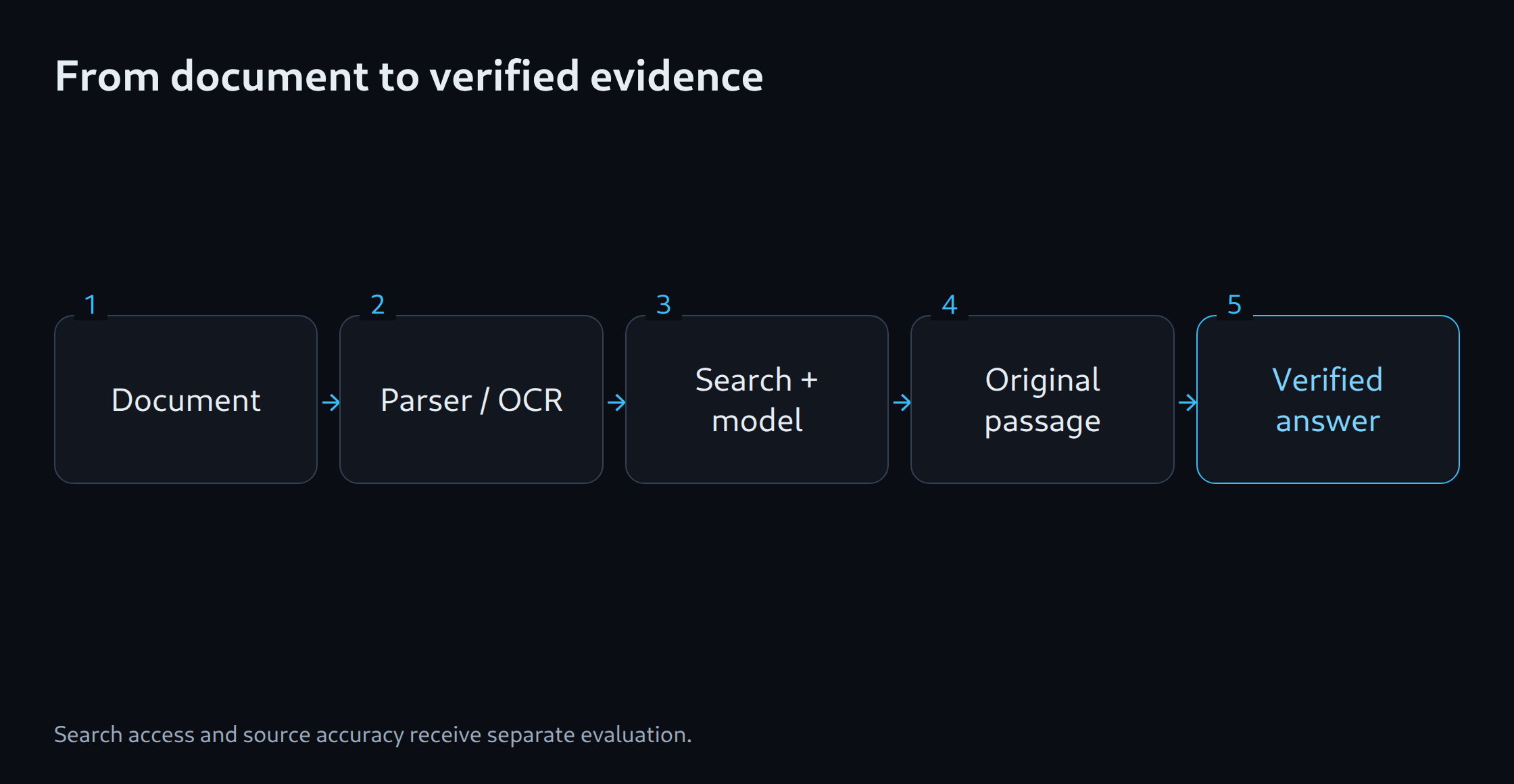
A useful package contains a short report, a long PDF with tables, a scan and two conflicting versions. Tasks cover extraction, summarisation, contradiction detection and a deliberately unanswerable question. Expected facts and source locations are recorded in advance.
Scoring covers correct statements, missing required information, invented evidence and appropriate acknowledgement of unavailable answers. A source must support the particular claim. A link to the right website is insufficient when the stated figure is absent.
The editorial shortlist
Gemini is a natural first candidate for mixed files. GPT and Claude belong in the same structured knowledge-work pilot. Open models are particularly interesting for controlled processing of an internal document collection. This shortlist reflects documented capabilities; only the same document test can establish a quality winner.
Related tools
Questions and answers
Does a large context window replace search?
The context window limits processable input. Search accesses a collection and selects relevant material. These functions solve different problems.
Are generated citations automatically reliable?
Important evidence requires checking against the original. A working URL does not establish that the associated claim is supported.
Sources
- OpenAI: model catalogue
- OpenAI: GPT-6.1 Sol
- Anthropic: Claude model overview
- Anthropic: Claude Opus 5.5
- Anthropic: Claude Sonnet 5.5
- Google: Gemini 3.8 Flash
- DeepSeek: V4.1 Flash model card
- Qwen: Qwen3.8-27B model card
- Ollama: FAQ and local/cloud operation
- OpenAI: API pricing
- DeepSeek: models and pricing
- Google: document understanding
Sources checked: 6 October 2026.
Related articles