English
 Deutsch
 Polski
Which AI Models Fit German, English and Polish?

Contents
A model may perform convincingly in English while requiring more corrections for Polish inflection or German technical terminology. A general leaderboard therefore cannot settle a three-language editorial decision. This comparison covers GPT, Claude and Gemini candidates documented on 6 October 2026 alongside DeepSeek V4.1 Flash and Qwen3.8-27B.
Multilingual capability is not a quality guarantee
OpenAI and Anthropic document multilingual capabilities. This does not establish a quality ranking for German, English and Polish. Open checkpoints with strong general results also require language-specific evaluation. The chosen Qwen or DeepSeek checkpoint, runtime and quantization remain part of the test configuration. [1, 3, 7, 8]
Different language tasks
| Language | Material | Acceptance criterion |
|---|---|---|
| DE | Technical explanation and short FAQ | Terminology, clear references, neutral style |
| EN | Product description and summary | Precision, natural wording, no additions |
| PL | Technical text and localised UI | Inflection, vocabulary and natural syntax |
| DE / EN / PL | Same factual core | Identical figures, qualifications and claims |
A protocol without an English advantage
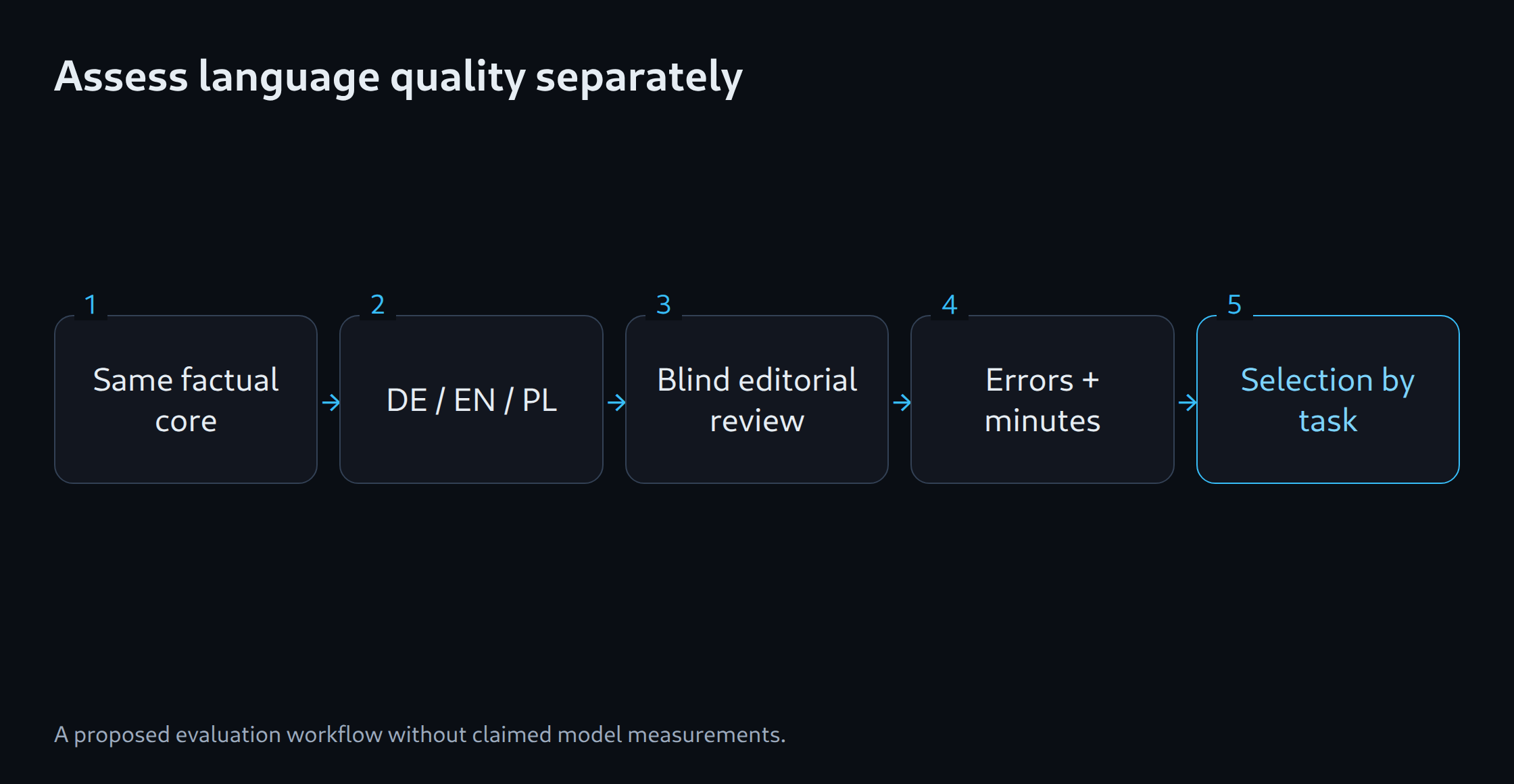
An editorial evaluation could contain twelve tasks per language. This is a proposed scope rather than an executed measurement. Each task has a fact checklist, approved terminology and an audience. Some tasks are written directly in the target language; others translate the same source. Language generation and translation quality can then receive separate assessment.
Scoring covers meaning errors, omitted qualifications, grammar, terminology and unnecessary additions. Smooth wording earns no credit when a figure or uncertainty disappears. Correction minutes are also useful: a usable draft may require less editorial effort than an elegant but unreliable answer.
Fair cloud and local comparison
GPT-6.1 Sol, Claude Sonnet 5.5 and Gemini 3.8 Flash form a practical cloud shortlist. Astra and Opus extend the evaluation for difficult tasks. An appropriate Qwen checkpoint is a candidate for local editorial work; DeepSeek extends the comparison through a suitable API or adequately equipped infrastructure. These are deployment hypotheses rather than declared language-quality winners.
Local tests record context, chat template and quantization. Moving from Q8 to Q4 creates a new test condition. Ollama provides the execution layer; its memory and runtime conditions require separate treatment from model quality. [9]
Selection by task
A three-language editorial workflow does not need a single model for every piece of content. A cheaper candidate may handle short structured outputs while difficult texts receive a second review. Selection depends on errors per language and correction effort. Differences remain visible rather than disappearing inside an overall average.
Related tools
Questions and answers
Does an English benchmark establish Polish quality?
English benchmarks cover different tasks and language features. Polish inflection, terminology and preservation of meaning require their own materials.
Should all three languages use the same model?
A shared model simplifies workflows. Different models are also viable when factual checks, terminology and quality thresholds remain consistent.
Sources
- OpenAI: model catalogue
- OpenAI: GPT-6.1 Sol
- Anthropic: Claude model overview
- Anthropic: Claude Opus 5.5
- Anthropic: Claude Sonnet 5.5
- Google: Gemini 3.8 Flash
- DeepSeek: V4.1 Flash model card
- Qwen: Qwen3.8-27B model card
- Ollama: FAQ and local/cloud operation
- OpenAI: API pricing
- DeepSeek: models and pricing
- Google: document understanding
Sources checked: 6 October 2026.
Related articles